Field Ready Oilfield Maintenance Log for Operators' Cost Tracking

An oilfield maintenance log is the written or digital record of every inspection, repair, and part swap performed on wellsite equipment, tied to the date, the technician, and the asset’s run hours. The immediate action: start every entry with date/time, asset ID, technician name, and current run hours before you write a single word about the actual problem. Use the template further down or a field work ticket system to capture this shift’s work now, not at the end of the week.
TL;DR:
- Accurate maintenance logs require mandatory fields such as date, time, asset ID, technician, run hours, work performed, parts used, and findings to ensure auditability and proper cost allocation.
- Daily walkarounds should follow the equipment’s natural cycle and include inspections of ground conditions, fluids, engine components, safety systems, and attachments, with photos attached to any defect.
- Digital maintenance records with timestamping, photo attachments, and asset linkage offer superior reliability and audit readiness compared to paper or spreadsheet systems, enabling precise cost tracking.
- Auditors prioritize evidence of date-stamped entries, review sign-offs, and timely closure of corrective actions, making organized, complete records essential for regulatory and internal reviews.
- Consistent, mandatory data entry, especially for defect photos, run hours, and detailed findings, prevents logs from becoming incomplete and significantly improves equipment and cost management.
Table of Contents
- What Fields Belong in Every Oilfield Maintenance Log?
- What Should a Daily Walkaround and Monthly PM Checklist Cover?
- Paper, Spreadsheet, or CMMS: Which Fits Your Operation?
- What Do Auditors Actually Look For?
- How Do You Fill Out a Maintenance Log Template Correctly?
- What Operators Get Wrong About Keeping Maintenance Logs
- Why Most Maintenance Logs Fail Before the Audit Ever Happens
- How WellsManager Turns Field Logs Into Real Cost Tracking
- Sources
- FAQ
What Fields Belong in Every Oilfield Maintenance Log?
A maintenance log that skips fields is worthless the day you need it, whether that’s a warranty claim, an insurance audit, or a partner asking why a well’s lease operating expense jumped. The fields below aren’t optional extras. Each one answers a question someone will eventually ask.
- Date and time: establishes the timeline for warranty claims and helps spot recurring failure patterns tied to weather or shift changes.
- Asset ID: ties the entry to a specific pump jack, compressor, or tank battery, not just “the unit out on Lease 12.”
- Technician name: creates accountability and lets you follow up with the person who actually saw the problem.
- Run hours or cycle count: the single most important number for predicting the next failure, since calendar time tells you almost nothing about wear.
- Work performed: plain description of what was done, not “fixed issue.”
- Parts used, with part numbers and quantities: feeds directly into your well cost book so repair spend gets allocated to the right well instead of a general “maintenance” bucket.
- Findings and root cause notes: what caused the failure, if known, so the next tech isn’t starting from zero.
Small crews running two or three wells can get by with those seven fields on a clipboard. Larger operators managing a dozen-plus wells across Midland and Odessa need to add verification sign-off, corrective action status, and photo evidence, because more people touch the same equipment and more people need to trust the record without calling the tech directly.
Statistic callout: Operators aiming for best-in-class reliability targets treat preventive maintenance completion above 90% as the benchmark. Logs with missing run-hour or work-performed fields are the most common reason that number slips, because incomplete records make it look like PM didn’t happen even when it did.
What Should a Daily Walkaround and Monthly PM Checklist Cover?
The daily walkaround is the cheapest insurance you’ll ever buy. It takes ten minutes and it’s the single highest-leverage safety check on a wellsite, because struck-by incidents involving heavy equipment account for 75% of related fatalities in that category, and OSHA serious-violation fines have been in the range of about $16,000 per citation. Skipping the walkaround to save time is a bad trade every time.
Structure the walkaround the way an operator naturally circles the machine, not in some arbitrary order that sounds good on paper:
- Ground and undercarriage: check for leaks pooling underneath, tire or track wear, and loose debris.
- Fluids: oil level and color, hydraulic fluid, coolant, and any visible contamination.
- Engine and hydraulics: unusual noise, belt tension, hose condition, pressure readings if the unit has gauges.
- Cab and controls: gauges responding correctly, warning lights, seatbelt and mirrors intact.
- Attachments: pins, hoses, and connection points specific to whatever’s mounted.
- Startup and safety systems: horn, backup alarm, fire extinguisher present and charged, E-stop functional.
Weekly PM items step up from “does it work” to “how much life is left”: grease points on schedule, filter condition checks, belt tension measurements logged as numbers, not just “OK.” Monthly PM ties directly to run hours, so a 250-hour oil change gets flagged automatically once cumulative hours cross that line rather than relying on someone remembering.
Any defect found during a walkaround needs a photo attached before the entry gets closed. A picture settles arguments about severity and gives the next shift a reference point.

Pro Tip: Require a photo on every defect entry, no exceptions, even for something that looks minor. Six months from now when you’re trying to figure out if a small leak turned into a $40,000 pump failure, that photo serves as objective evidence.
Paper, Spreadsheet, or CMMS: Which Fits Your Operation?
Paper logs are fast to start and cost nothing upfront, but they’re the hardest to search, the easiest to lose, and impossible to back up automatically. A spreadsheet solves the search problem but still relies on someone manually entering data at a desk, hours or days after the actual work happened. A CMMS or field work ticket system captures the entry at the moment of the work, timestamped, and links it straight to the asset record.
The minimum digital features worth requiring, regardless of which system you pick:
- Automatic timestamps on every entry, not editable after the fact.
- Asset linking so every ticket rolls up to a specific well or piece of equipment.
- Photo attachment built into the entry, not a separate step.
- Offline capture for locations with no signal, syncing once connectivity returns.
- Mandatory failure codes so findings are searchable later, not buried in free text.
- Run-hour triggers that flag upcoming PM automatically.
- Exportable audit packs by asset or date range.
Digital records are timestamped and tied directly to work orders, which makes them more complete and auditable than paper by default. That completeness matters for more than compliance. Every part number, labor hour, and parts cost entered on a field work ticket is what feeds a well cost book, which is what tells you whether a given well is actually profitable this month.
What Do Auditors Actually Look For?
Auditors don’t care how neat your handwriting is. They care whether entries are date-stamped, whether someone reviewed the finding, and whether corrective actions got closed out instead of left open indefinitely. A log with fifty entries and zero sign-offs reads as unreviewed work, even if every repair was done correctly.
FMCSA’s 49 CFR 396.3 requires motor carriers to keep systematic maintenance and repair records and retain annual periodic inspection certificates for 14 months. That’s a trucking-specific rule, but it’s a useful example of what “systematic” means in practice: organized by asset, retrievable by date, kept long enough to matter. Oilfield operators without a direct FMCSA obligation still get audited by insurers, partners, and sometimes regulators, and the same logic applies.
For asset integrity specifically, IOGP Report 510 expects inspection schedules, an anomaly register, and management-of-change logs to be current and producible on demand, not reconstructed after the fact.
An auditor asking for last quarter’s pump maintenance history shouldn’t trigger a scramble through a truck console or a group text thread. If you can’t produce it in the time it takes to make coffee, your log system has already failed the test.
A workable 15 to 30 minute audit-pack checklist:
- Filter entries by asset ID and date range.
- Confirm every open finding has a corrective action and a closure date.
- Pull photos for any flagged defects in the period.
- Export sign-offs showing entries were reviewed, not just logged.
- Cross-check run-hour PM triggers fired on schedule.
Read more on spill reporting requirements for a related look at what audit-ready records look like in another compliance context.
How Do You Fill Out a Maintenance Log Template Correctly?
A workable template runs in the order the tech actually works, not the order a form designer imagined. Here’s the field sequence, in the order you fill it:
- Asset ID: which unit, no abbreviations that only you understand.
- Date/time: start time of the check or repair.
- Technician and shift: who, and which shift, for scheduling patterns later.
- Run hours: pull straight from the meter, don’t estimate.
- Check type: walkaround, weekly PM, monthly PM, or unscheduled repair.
- Findings: specific, not “noise” but “grinding noise from left bearing housing.”
- Corrective action taken: what was actually done to fix it.
- Parts, part number, and quantity: for cost tracking.
- Labor hours: time spent, for cost allocation.
- Photo attached, yes or no: mandatory yes on any defect.
- Verification sign-off: supervisor or lead confirms the entry is complete.
A defect found on a walkaround becomes a work order the moment it’s flagged, gets a corrective action assigned, and closes out with parts and labor hours filled in. Tag each entry with a cost category (repair, PM, inspection) so it routes correctly into your well cost book and shows up right in investor reporting instead of getting lumped into a catch-all expense line.
What Operators Get Wrong About Keeping Maintenance Logs
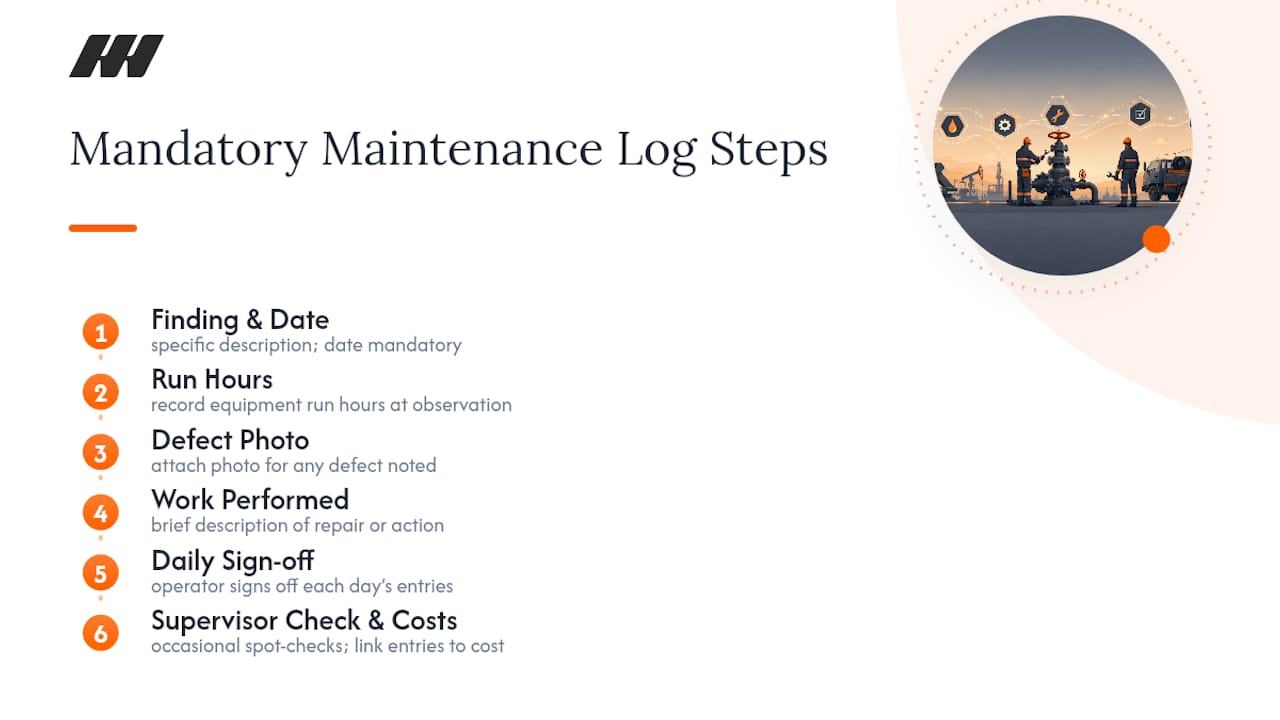
The three mistakes I see most: vague findings (“fixed pump”), missing run hours, and zero photos on defects. Each one guts the log’s value for the next person who reads it. The fix is boring but it works: make date, run hours, and a photo on any defect mandatory fields the system won’t let anyone skip. Add a daily sign-off and occasional supervisor spot checks. Do that consistently and your logs stop being paperwork and start being the backbone of your equipment downtime tracking and cost allocation.
Why Most Maintenance Logs Fail Before the Audit Ever Happens
Most operators treat the maintenance log as a compliance chore, something you fill out because someone might ask for it someday. That’s backwards. The log is a cost accounting tool first and a compliance record second. Every part number and labor hour you skip logging is a cost that either disappears from your well cost book or and gets guessed at later, usually wrong.
The conventional advice, “just keep good records,” misses the actual failure point. Records don’t fail because people are lazy. They fail because the system makes it easy to skip fields under time pressure. A tech running behind on a Friday afternoon will write “fixed leak” instead of the real finding unless the form won’t accept anything shorter.
Prioritize the mandatory fields over the fancy features. A system with ten mandatory fields and no dashboard beats a system with a beautiful dashboard and optional fields every time, because the data you don’t capture can’t be analyzed no matter how good the software looks. Get the fields locked down first. Everything else, including tying logs to your lease operating statement, only works once the raw entries are actually complete.
— Pedro
How WellsManager Turns Field Logs Into Real Cost Tracking
WellsManager exists to replace the notebook and the group text with field work tickets that actually hold up, not to sell you another dashboard. Every ticket captures the timestamp, the asset, the technician, and the work performed automatically, with photo attachments on defects and run-hour PM scheduling built in so nothing gets tracked on memory. That data flows straight into a per-well cost book, so repair spend and parts costs land on the right well instead of a vague monthly total, and it feeds investor checks and into your lease operating statement without a month-end scramble to reconstruct what happened three weeks ago. If you’re running wells in Midland or Odesso and tired of chasing down what a repair actually cost, see how WellsManager handles field work tickets a and well cost tracking and get a demo set up.
Sources
- FMCSA 49 CFR Part 396.3 — Records of duty status; maintenance records
- Wellsite heavy equipment walkaround checklist — Heavy Vehicle Inspection blog
- Maintenance Logs: Definition — Tractian
FAQ
What should be included in a maintenance log?
At minimum: date and time, asset ID, technician name, run hours, work performed, parts used with part numbers, and findings. Larger operations should add photo evidence and a verification sign-off.
What is the 10 rule in maintenance?
Definitions of a “10 rule” vary across industries and aren’t standardized for oilfield maintenance specifically, so treat any specific version you encounter with caution rather than as a universal standard.
How do I create a maintenance log?
Start with a fillable template that lists asset ID, date/time, technician, run hours, check type, findings, corrective action, parts, labor hours, and sign-off, then either use it on paper or move it into a field work ticket system for timestamped, searchable entries.
What are the core elements auditors expect in a maintenance record?
Auditors look for date-stamped entries, evidence the finding was reviewed, and proof that corrective actions were closed out, aligned with frameworks like IOGP Report 510 for asset integrity.
Should I use paper or digital logs for oilfield equipment?
Digital logs tied to work orders are timestamped automatically and easier to audit than paper, and they feed directly into cost tracking systems like WellsManager’s field work tickets without manual re-entry.