Contract Management for Oil and Gas: An Operations Playbook

Effective contract management for independent upstream operators means one thing in practice: a single system that ties lease operating statements, per-well profit and loss, field maintenance records, vendor invoices, and investor distributions into one accounting chain. If any link in that chain is manual or disconnected, LOS numbers lag, distributions slip, and nobody can tell which wells are actually making money.
A working system needs five capabilities, non negotiable:
- Accurate LOS that reconciles to the general ledger every month, not every quarter
- Per-well P&L that allocates shared costs and water handling down to the well level
- Field and mobile logging that captures maintenance events and costs the day they happen, even offline
- Invoice to work-order linkage so every dollar billed traces back to a documented job
- Automated investor distributions built on the same numbers, not a separate spreadsheet
Peer-reviewed research on well-level profitability confirms what most operators already suspect: some high-volume wells are quietly losing money once true costs are allocated, and only well-by-well accounting exposes it. The same logic applies to equipment. Studies on component-level asset tracking show that treating pumps, motors, and separators as serialized sub-assets, rather than lumping them into a single well record, changes maintenance decisions and cuts repeat failures.
Key Takeaways
Contract management for independent operators works when LOS, per-well P&L, field logging, vendor invoices, and investor distributions run on one connected data chain instead of five disconnected spreadsheets.
| Point | Details |
|---|---|
| Start with the data chain | Map who owns production, maintenance, accounting, and land data before choosing software. |
| Design asset hierarchy first | Serialize sub-assets and preserve exposure history so maintenance decisions stay accurate through rebuilds. |
| Rank wells by contribution, not volume | Allocate water handling and shared costs fully before deciding which wells deserve capital. |
| Pilot before full rollout | Test on five to ten wells for one LOS cycle and measure reconciliation lag before going live. |
| WellsManager as the domain-specific option | Wellsmanager links LOS, per-well P&L, offline Field Log, invoice matching, and distribution automation in one system built for upstream operators. |
Table of Contents
- What “Contract Management” Means in Oil and Gas Operations
- Core Components: LOS, Per-Well P&L, Field Logging, Vendor Workflows, and Distributions
- How to Build the Contract Management Pipeline: A Five-Phase Rollout
- Which KPIs Actually Prove Contract Management Is Working?
- How WellsManager Maps to Every Item on This Checklist
- Contract Lifecycle Basics for Upstream Operators
- Managing Risk and Compliance Across Vendor and Regulatory Contracts
- Connecting Contract Data to Production Systems
- What Data Security Looks Like for Operational Contract Records
- Negotiating Vendor and Service Contracts the Right Way
- Where WellsManager Fits for Operators Ready to Consolidate
- Sources
- FAQ
What “Contract Management” Means in Oil and Gas Operations
Forget the enterprise definition of contract management that dominates procurement software marketing. For an independent operator, contract management oil and gas work is operational: it is the discipline of managing the data objects that generate your lease operating statement and your investor checks, not negotiating master service agreements with a legal team.
That distinction matters because it changes what “success” looks like. You’re not trying to reduce contract cycle time with vendors in the abstract. You’re trying to make sure a workover ticket from March turns into an accurate LOE entry, then an accurate per-well deduction, then an accurate distribution to the right investor, without three people re-keying the same numbers.
The core data objects every operator needs to manage are:
- Lease operating statements (LOS) — the monthly financial record per lease, pulling from revenue, LOE, and capital categories
- JIB and A&R entries — joint interest billing and accounts receivable records that split costs and revenue across working interest owners
- Work orders — the record of what maintenance happened, when, and what it cost
- Vendor invoices — tied to specific work orders or purchase orders, not entered as loose line items
- Asset and sub-asset records — the equipment hierarchy, serialized down to the component level, that work orders attach to
Each object feeds the next. A work order generates a cost; that cost hits an asset record and a LOE category; the LOE category rolls into the LOS; the LOS drives the lease operating expense calculation that determines what’s left to distribute.
Core Components: LOS, Per-Well P&L, Field Logging, Vendor Workflows, and Distributions
Build these five components correctly and everything downstream gets easier. Skip one, and you’ll be patching the gap with a spreadsheet by month three.
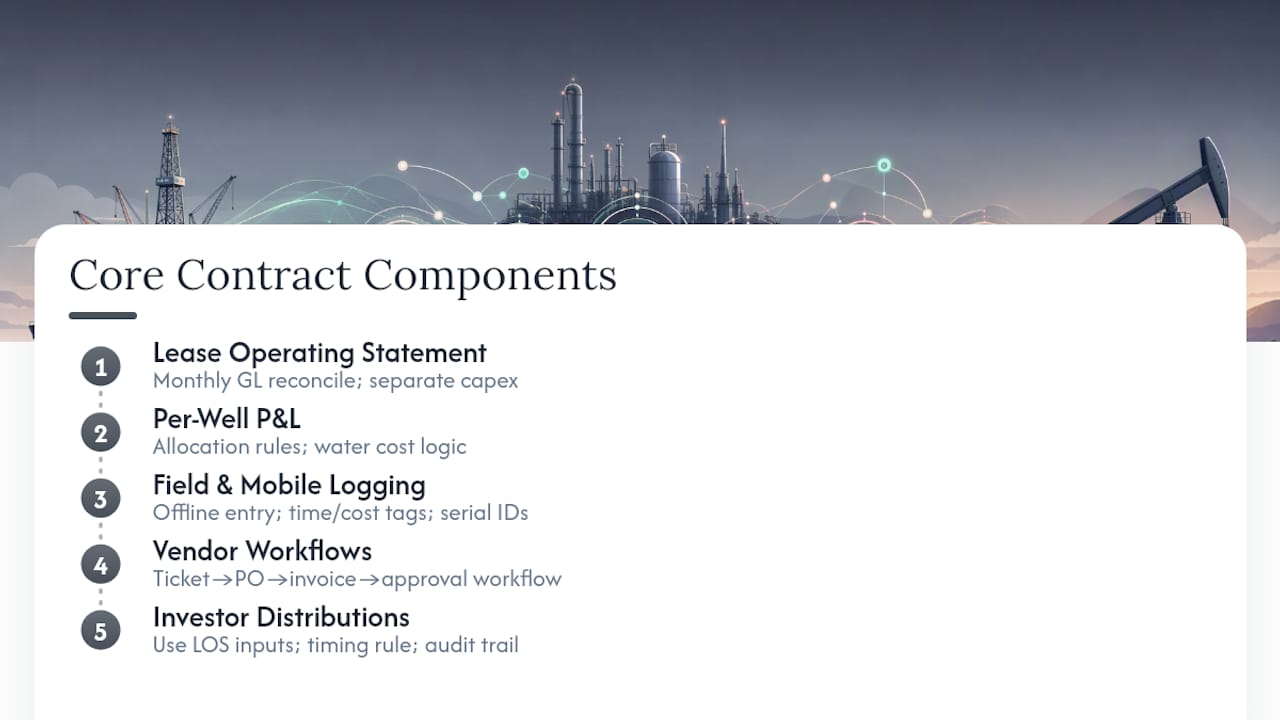
Lease operating statements need consistent line items: gross revenue by product, deductions, LOE by category (labor, chemicals, water disposal, repairs, utilities), and capital expenditures kept separate from operating costs. Reconcile the LOS to your general ledger monthly, not quarterly. Quarterly reconciliation means you’re always making decisions on stale numbers.
Per-well P&L requires allocation rules for shared costs, most commonly compressor stations, disposal wells, and shared roads or electrical infrastructure serving multiple wells. Water handling costs, in particular, need their own allocation logic since water cut varies well by well and heavily skews net operating income. Get this wrong and a well that looks profitable on a flow basis can be quietly bleeding cash.
Field and mobile logging has to work offline. Most well sites in the Permian and similar basins don’t have reliable connectivity, so a Field Log that only syncs when the pumper drives back to the office is a Field Log that loses same-day cost visibility. Time and cost tagging at the point of entry, combined with serialized sub-asset identifiers, preserves exposure history through swaps and rebuilds, which matters when you’re trying to calculate mean time between failures.
Vendor workflows follow a ticket to invoice lifecycle: a field ticket documents the work, it links to a purchase order or AFE, the vendor invoice matches against that ticket, and an approval workflow enforces a service level agreement before payment. Integrated systems that connect maintenance data to finance cut the manual re-entry that causes invoice disputes.

Investor distributions need the same inputs as your LOS, plus a fixed timing rule (net revenue interest calculated by the 20th, checks issued by month end, for example) and an exception process for suspended interests or title disputes. Every distribution needs an audit trail back to the source ticket.
Pro Tip: Tag every field ticket with the asset’s serial number, not just the well name. When a pump gets swapped between wells, you’ll still be able to trace its full maintenance history instead of losing it at the transfer point.
How to Build the Contract Management Pipeline: A Five-Phase Rollout
Consolidating field data, invoices, and distributions into one system is a project, not a switch you flip. Here’s a rollout sequence that avoids the two most common failure points: skipping asset hierarchy design, and ignoring offline field realities.
- Map your sources. Document who owns production data, who owns maintenance records, who owns accounting, and who owns land and title data. Most operators find these live in three or four disconnected systems, sometimes still on paper.
- Design the asset hierarchy before touching software. Build it around failure mechanics, meaning the components that actually break, rather than your org chart. Serialize sub-assets and set up meter cascading so exposure history survives a rebuild or reinstallation.
- Configure field tools and CMMS settings. Confirm offline sync actually works in the field, not just in a demo. Define the work-order lifecycle stages and standardize failure codes so your data is consistent enough to analyze later.
- Integrate invoices and LOS. Set up ticket matching rules, map costs to JIB and AFE codes correctly, and confirm your general ledger reconciliation process before go-live, not after.
- Run a parallel test. Keep your old process running alongside the new one for at least one full LOS cycle. Track reconciliation lag, LOE accuracy, and distribution timing as your go/no-go criteria.
Pro Tip: Don’t roll out to your whole lease portfolio at once. Pick five to ten wells with mixed performance, run both systems in parallel for a full quarter, and measure the reconciliation gap before you commit.
Which KPIs Actually Prove Contract Management Is Working?
Five metrics tell you whether the system is paying for itself: LOE per barrel of oil equivalent, per-well netback, mean time between failures at the component level, invoice processing time, and distribution accuracy measured against audit.
Ranking wells by contribution, not volume, is where most of the value shows up. That means fully loaded cost allocation, including water handling and contractual deductions, applied consistently across every well in the portfolio. Research on well-level profitability makes the case directly: prioritizing wells by profitability instead of flow rate regularly surfaces high-volume wells that are actually losing money once real costs are counted.
The operational payoffs tend to show up fast. Faster invoice cycles mean fewer vendor disputes and cleaner month-end closes. Better component-level maintenance data means fewer surprise failures and smarter overhaul scheduling. And clean per-well P&L gives you a real basis for capital allocation decisions instead of gut-feel prioritization of which wells get next quarter’s workover budget.
How WellsManager Maps to Every Item on This Checklist
Wellsmanager was built around this exact operational chain, not adapted from generic procurement software. It handles the five must-have capabilities directly:
- LOS and per-well P&L generated from the same underlying cost and production data, so there’s no separate reconciliation step
- Mobile Field Log built offline-first, with time and cost tagging captured at the wellhead and synced when connectivity returns
- AI connector that lets field and finance staff ask questions about operational data in plain language instead of building a new report
- Invoice and work-order linkage that ties vendor billing directly to the job that generated it
- Distribution automation that pulls straight from the reconciled LOS, cutting the manual spreadsheet step most operators still run
For deeper implementation detail, Wellsmanager’s blog covers field-to-finance workflows in more depth, and the request-access page is the starting point for operators ready to test it on a small well set.
Contract Lifecycle Basics for Upstream Operators
A contract lifecycle in this context isn’t a legal negotiation cycle. It’s the operational path a job takes from authorization to payment to reporting, and it repeats constantly across every well in your portfolio.
The cycle starts with an authorization, usually an AFE for capital work or a standing purchase order for routine field services. A field ticket or work order documents the actual job. The vendor submits an invoice referencing that ticket. Someone approves it against the original scope and cost estimate. The approved cost lands in the correct LOE category on the LOS. That LOS feeds the JIB statement, which allocates cost across working interest owners, and eventually informs the investor distribution.
Where this breaks down is almost always at the handoff points, not within any single step. A field ticket that never gets matched to an invoice creates a gap between what the field says happened and what accounting pays for. An AFE that isn’t referenced on the invoice means capital and operating costs get mixed, which distorts your per-well P&L and, eventually, your tax reporting.
Treat each handoff as a control point, not a formality. Require the reference number, whether it’s a work order ID, AFE number, or PO, at every step of the chain. That single habit closes most of the gap between field activity and financial accuracy, and it’s the difference between a LOS you can trust and one you have to double-check every month.
Managing Risk and Compliance Across Vendor and Regulatory Contracts
Two kinds of risk sit inside every oil and gas contract: commercial risk from vendors and counterparties, and regulatory risk from compliance obligations tied to permits, safety, and reporting deadlines.
Commercial risk shows up most often in service contracts with unclear scope, vague pricing on call-out work, or no defined escalation path when a job runs over budget. The fix is procedural: require a documented scope and rate sheet before work starts, and flag any invoice that exceeds the AFE or PO amount by a set threshold for manager review before payment.
Regulatory risk is different in character but just as costly if ignored. Permits, bonding, and insurance certificates all carry expiration dates, and a lapsed document can halt operations or trigger fines. The practical answer is a compliance calendar tied directly to your asset records, so a permit renewal or insurance certificate expiring in 30 days generates an alert automatically instead of surfacing when a regulator asks for it. Commercial risk around post-production deductions and settlements can also move the numbers more than operators expect. Vitesse Energy’s 2025 second-quarter results show how a litigation resolution and an in-kind election changed revenue recognition and distribution inputs for that quarter, a reminder that contract terms and settlements aren’t just legal line items. They flow straight into the numbers investors see.
Build both risk categories into the same system that tracks your assets and invoices. Compliance and commercial risk tracked separately from operational data tend to get checked less often, simply because nobody’s looking at them daily.
Connecting Contract Data to Production Systems
Contract and financial data mean little in isolation. The real value comes from linking maintenance events, invoices, and cost allocations directly to production volumes at the well level.
Industry guidance on connecting reliability engineering with asset data points to the same conclusion operators reach independently: predictive maintenance and capital planning only work when maintenance history, production reporting, and finance sit on shared data, not three separate systems that get reconciled by hand once a month.
In practice, that means your work-order system needs to know the well’s current production rate and water cut when a technician logs a repair, and your LOS needs to know the maintenance cost the moment it’s approved, not thirty days later when someone finally enters it. A pump running at high load on a well with rising water cut is a different maintenance priority than the same pump on a stable, low-water well, but you can only make that call if production and maintenance data are visible in the same place.
This is also where offline field tools matter most. A pumper logging a failure at a remote site with no signal needs that entry captured immediately and synced later, not lost until the next office visit. Systems that treat offline capability as an afterthought consistently see slower reconciliation and more disputed invoices, because the gap between field activity and recorded cost stretches for days instead of hours.
The integration point that pays off fastest is usually the simplest: linking work orders to the specific well and asset ID that generated them, then letting production and cost data roll up automatically instead of through a monthly export-and-reconcile routine.
What Data Security Looks Like for Operational Contract Records
Operational and financial data in this system includes investor payment details, vendor pricing, and well-level profitability figures, information that’s sensitive for competitive and privacy reasons, even without touching classic legal contract confidentiality concerns.
Access control matters more here than in most back-office software, because the same system holds field data, financial data, and investor information. A pumper logging a work order shouldn’t necessarily see distribution figures for working interest owners, and an investor checking their distribution history shouldn’t see vendor pricing across the portfolio. Role-based permissions need to reflect that separation from day one, not get bolted on after a data exposure.
Offline mobile logging adds a second consideration: data captured in the field before it syncs needs to be encrypted on the device, not just in transit and at rest on the server. A lost or stolen tablet shouldn’t become a data exposure event just because it was carrying a day’s worth of unsynced field tickets.
Any platform handling this volume of financial and personal data should publish a clear data governance policy, and it’s worth reviewing that documentation, such as Wellsmanager’s privacy policy, before committing to any system that will hold your investor and vendor records long term.
Negotiating Vendor and Service Contracts the Right Way
Negotiating oil field service contracts well starts before the first quote lands, with a clear scope and a documented rate structure for the routine work that generates most of your invoices. Vague scope is the single biggest driver of billing disputes.
Set standard rates for common call-out categories, well servicing, water hauling, chemical treatment, ahead of time, and require any deviation to be documented on the ticket before work starts. This turns an argument after the fact into a two-minute conversation up front.
Tie payment terms to documentation, not just delivery. A vendor invoice without a matching field ticket and reference number shouldn’t clear approval, no matter how routine the vendor relationship. That single rule, consistently enforced, eliminates a large share of billing errors before they ever reach the general ledger.
Review vendor performance data, not just price, when it’s time to renew. A cheaper vendor with a higher repeat-failure rate on the same equipment is usually costing more once maintenance data is tracked at the component level, a case reference in the sub-asset management framework is a useful check here. For readers focused on commercial risk in vendor and partner agreements from an investor-reporting angle, FieldVest’s guide to risk mitigation walks through the contract terms that most often surface in disputes. Understanding oilfield equipment terminology also helps when negotiating scope language for equipment-heavy service contracts, since ambiguous component descriptions are a common source of billing disagreements.
Governance and Adoption Lessons From the Field
Governance breaks down more often than technology does. Unclear data ownership, undertrained field staff, and pilots that try to cover the whole portfolio at once all stall adoption before the system proves its value. Start small: five to ten wells, one quarter, clear ownership of who updates what.
— Pedro
Where WellsManager Fits for Operators Ready to Consolidate
Wellsmanager replaces the spreadsheet relay race most independent operators run between field, accounting, and investor reporting. Instead of a pumper’s paper ticket getting re-keyed three times before it reaches a distribution statement, one entry in the mobile Field Log flows straight through to per-well P&L and the investor payout, with the AI connector letting your team ask plain-language questions about any well’s costs or maintenance history instead of building a new report each time.
It fits operators running anywhere from a handful of wells to a full portfolio who are still reconciling LOS by hand or chasing invoices that never matched a work order. If that’s your current process, start with the WellsManager platform overview to see how the modules connect, then head to the request-access page to set up a pilot on a small group of wells and see the reconciliation gap close in real numbers.
Sources
- Profit and Loss at the Wellhead; Producing from the Wells that are Profitable and Shutting-in the Loss-makers
- A reliability-centred framework for sub-asset management in CMMS
- Lease operating expenses | Enverus
- Why leading upstream companies are switching to integrated maintenance solutions - GET Global Group
FAQ
Who Should Own LOS Updates Inside an Operating Company?
LOS updates should sit with whoever owns the accounting close, usually a controller or accounting manager, but the underlying data should flow in automatically from field and vendor systems rather than being manually entered by that same person.
Can Field Staff Log Tickets Without Internet Access?
Yes. A properly built Field Log captures time, cost, and asset details offline at the wellhead and syncs automatically once connectivity returns, which keeps same-day cost visibility even at remote sites.
How Do You Measure Whether Distribution Automation Is Working?
Track distribution accuracy against an independent audit and measure how many distribution cycles run without manual correction; a well-integrated system should need exception handling only for genuine title or interest disputes.
How Long Does It Take to See ROI From a New Contract Management System?
Most operators see measurable improvement in invoice processing time and reconciliation lag within one full LOS cycle of a pilot, typically a single quarter, when the pilot covers five to ten wells with mixed performance.
Does Switching Systems Mean Losing Historical Maintenance and Financial Records?
Not if the asset hierarchy is designed correctly. Serialized sub-assets with preserved exposure history let historical maintenance data migrate with the equipment, so component-level records survive the transition to a new system like Wellsmanager.