Single Source of Truth for Upstream Oil & Gas Operators

A single source of truth (SSOT) for upstream oil & gas is the centralized, authoritative dataset that produces consistent per-well P&Ls, real-time compliance alerts, and executive briefs from one shared record — not from five competing spreadsheets. If you’re an independent operator or CFO trying to close the books faster and stop reconciling conflicting numbers, the most direct path forward is a pilot that pulls production data, field maintenance logs, and vendor invoices into a single ledger for two to five wells before scaling. Platforms like Wellsmanager are built specifically for this workflow.
Table of Contents
- What does “single source of truth” actually mean for upstream operations?
- Why an SSOT matters: benefits and the risks it removes
- How to build an SSOT for wells, costs, and field work
- What KPIs tell you whether your SSOT is working
- Common implementation pitfalls and how to avoid them
- Operator’s checklist for evaluating platforms and vendor proposals
- How Wellsmanager operationalizes an SSOT for upstream operators
- Key Takeaways
- What operators actually get wrong about SSOT adoption
- Wellsmanager gives upstream operators a real path to centralized data
What does “single source of truth” actually mean for upstream operations?
In information science, SSOT architecture means every data element is mastered in exactly one place, so any system that needs it reads from that master rather than keeping its own copy. For upstream oil & gas, that translates to a centralized authoritative dataset that every team — field, accounting, compliance, and executive — references without maintaining a parallel version.
The core data domains that belong inside an upstream SSOT:
- Production data: meter readings, allocation volumes, downtime events
- Operations and maintenance logs: work orders, pump-off events, field technician notes
- Vendor costs: AFE-coded invoices, purchase orders, contract rates
- Lease operating statements (LOS): monthly cost summaries by well and lease
- Sales and revenue: purchaser statements, pricing differentials, transportation deducts
- Well-level capital and operating expenses: per-well capex and opex tied to the same well identifier
- Asset metadata: wellbore details, completion dates, regulatory IDs, ownership splits
- Regulatory filings: production reports, environmental submissions, permit status
What an SSOT is not: a spreadsheet that someone exports from the ERP every Monday, a one-time data migration, or a static report. SSOT is a practice, not a product you buy and install once. It requires integration, governance, and active stewardship to stay authoritative.
Why an SSOT matters: benefits and the risks it removes
The most immediate payoff is per-well P&L accuracy. When production volumes, revenue, and expenses all trace back to the same master record, the P&L your field superintendent sees matches the one your CFO signs off on. That alignment alone cuts the back-and-forth that typically delays month-end close by days.
Centralizing operations data removes the operational risk that comes from siloed spreadsheets: duplicate entries, stale cost allocations, and investor reports built from different versions of the same well’s expenses. One operator running 30 wells across two basins might have a pumper logging downtime in a field app, an accountant pulling vendor invoices into a separate Excel file, and a compliance officer tracking permit renewals in a third system. None of those records talk to each other. The result is reconciliation work that takes longer than the actual analysis.
Real-time compliance signals are the other high-stakes benefit. Data accuracy decays the moment it is captured, and stale regulatory data carries real exposure. An SSOT with automated compliance notifications catches a missed production report deadline or a permit renewal before it becomes a violation, not after.
A practical example: an operator using live per-well P&L data can make an investor distribution decision on day three of the month rather than waiting for a manually assembled report on day fifteen. That’s not a marginal improvement — it changes how capital gets deployed.
How to build an SSOT for wells, costs, and field work
Follow this phased roadmap. The timeline estimates below reflect typical independent operator deployments; enterprise-scale projects with legacy SCADA infrastructure will run longer.
- Discovery (months 0–3): Audit every system that touches well data. Map data owners, identify duplicate records, and document field-to-office data flow gaps. Select two to five pilot wells that represent your typical operational complexity.
- Pilot (months 3–6): Connect the four core sources for those wells: production meter data, field maintenance logs, vendor invoices, and accounting entries. Choose your architecture — a consolidated data store works well for operators who need a single ledger; data virtualization suits those who cannot move data out of existing systems. Integration strategies like master data management (MDM), enterprise service bus (ESB), or API-based connectors each have trade-offs on latency and complexity.
- Governance setup (parallel with pilot): Assign explicit roles: a data owner (accountable for accuracy in a domain), a data steward (day-to-day quality checks), and a data custodian (technical access and storage). Without these roles defined, governance failures are nearly inevitable.
- Integration checklist for rollout:
- SCADA/RTU connectors for real-time telemetry
- Field mobile app sync for maintenance logs
- Accounting/ERP integration for invoice and journal entry matching
- Vendor EDI feeds for purchase orders and receipts
- Production allocation engine tie-in
- Phased rollout (months 6–12): Expand well by well. Primary cost drivers are the number of connectors, data retention requirements, custom schema work, and role-based access configuration.
Pro Tip: Minimize data movement. Every copy or export you create introduces a new version-mismatch risk. Keep authoritative records in one system and surface them via APIs or virtual layers rather than scheduled exports.
What KPIs tell you whether your SSOT is working

Instrument these metrics from day one of the pilot. They give you an objective signal of whether the centralized data platform is actually delivering data consistency — or just adding infrastructure.
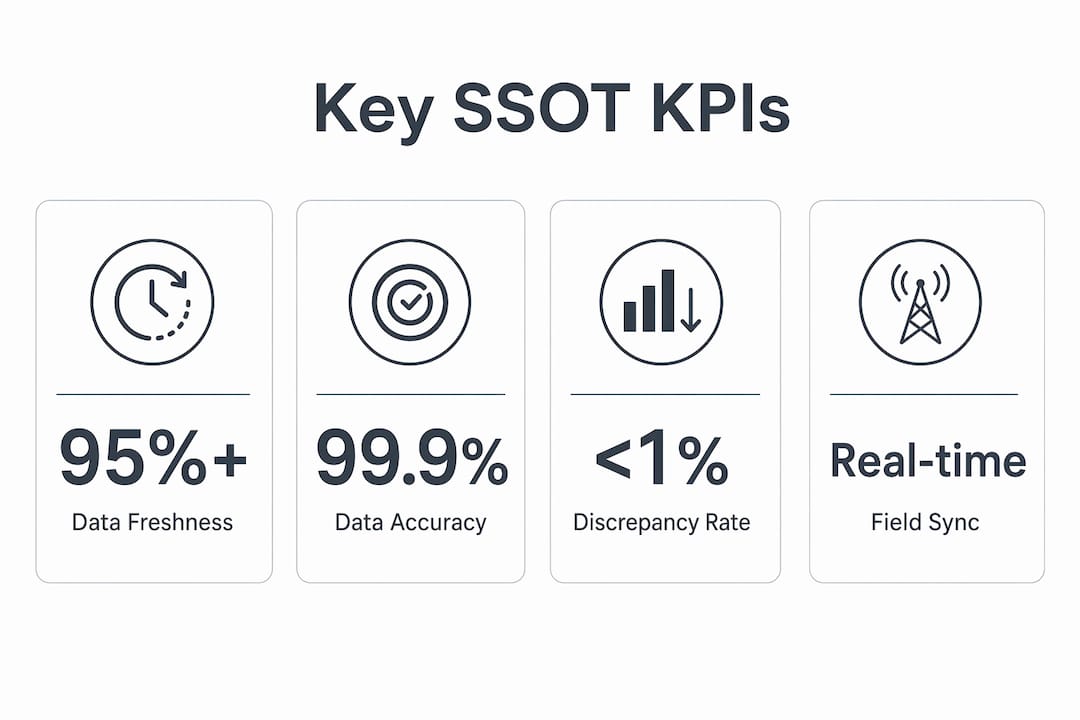
| KPI | Target | What it signals |
|---|---|---|
| Data freshness (critical telemetry) | — | Field-to-office sync is working; stale data windows are closed |
| Reconciliation rate | — | Master records are authoritative; duplicates are suppressed |
| Time-to-close month | A significant reduction compared to baseline | Accounting no longer waits for manual data assembly |
| Per-well P&L variance vs. audited | < 1% | Revenue and expense records are consistent across systems |
| Compliance event resolution time | — | Notifications are firing and owners are acting |
Data accuracy measures how closely a record reflects real-world values; data integrity measures whether that record stays consistent across its lifecycle. Track both. An SSOT that scores well on accuracy but poorly on integrity means records are correct at entry but drift over time — a common failure mode when field teams submit corrections outside the master system.
Automate these KPIs in a dashboard with alert thresholds. Audit logs should capture every record change with a timestamp and user ID so you can trace any variance back to its source.
Common implementation pitfalls and how to avoid them
Most SSOT projects that stall do so for organizational reasons, not technical ones. Practitioners consistently report that the hardest part is organizational discipline — getting field teams to submit data through the master system instead of their own spreadsheets.
Cultural pitfalls:
- Domain owners who keep a “backup” spreadsheet because they don’t trust the new system yet. This is the single fastest way to recreate the problem you just solved.
- Accounting teams that continue to export data and manipulate it locally before reporting. Any transformation outside the SSOT creates a new version of truth.
- Field staff who see the new system as extra work rather than a replacement for existing logging.
Technical pitfalls:
- Missing metadata on well identifiers — if your SCADA system uses a different well ID than your ERP, every join will fail silently.
- Weak lineage tracking means you cannot explain where a number came from, which destroys trust in the system during audits.
- Slow or unreliable connectors to legacy RTUs create data freshness gaps that undermine real-time compliance monitoring.
Pro Tip: Run a “shadow period” during the pilot where both the old spreadsheet process and the new SSOT run in parallel. When the SSOT numbers match the spreadsheet consistently for 30 days, retire the spreadsheet. This builds trust faster than any training session.
Operator’s checklist for evaluating platforms and vendor proposals
When you’re shortlisting a centralized data platform, ask vendors to address each of these in writing:
- Integration breadth: Which SCADA systems, ERPs, field mobile apps, and EDI formats does the platform connect to natively? What is the average connector deployment time?
- Metadata and lineage: Does the platform maintain a centralized metadata layer that tracks data origin, transformation history, and ownership?
- Per-well P&L support: Can the platform generate a P&L at the individual well level, not just at the lease or entity level?
- Real-time notifications: What is the latency on compliance alerts? Are thresholds configurable by well, lease, or regulatory jurisdiction?
- Audit trails: Are all record changes logged immutably with user ID, timestamp, and prior value?
- Security attestation: Does the vendor hold SOC 2 Type II or ISO 27001 certification? How is data residency handled for U.S. operators?
- Data model openness: Can you export your full data model and records without vendor lock-in? Does the platform support open, hybrid data foundations or zero-copy access?
Major cost drivers to budget for: number of connectors, data retention period, tenanting and role-based access configuration, and any custom schema work required to match your well identifier conventions.
How Wellsmanager operationalizes an SSOT for upstream operators
Wellsmanager is built as an operating system for upstream oil & gas, which means it maps directly to the SSOT requirements above rather than requiring you to assemble them from generic data tools.
Key capabilities:
- Per-well P&L: Revenue, expenses, and production volumes tracked at the individual well level, so every stakeholder reads from the same ledger.
- Real-time compliance notifications: Automated alerts tied to regulatory deadlines and operational thresholds, reducing the window for stale data to create exposure.
- Centralized metadata and intelligence layer: A unified architecture that consolidates field maintenance logs, vendor costs, and production data without fragmentation — enabling downstream features like BI reporting and AI-generated executive briefs.
- AI-generated executive briefs: Summaries drawn from the same authoritative dataset, so the brief your CFO reads reflects the same numbers your field superintendent logged.
- Audit logs: Immutable record of every change, with user attribution and timestamps, supporting both internal governance and external regulatory review.
Pro Tip: When onboarding field teams to Wellsmanager, start with the maintenance logging module. It has the lowest barrier to entry and immediately demonstrates value by replacing the paper or spreadsheet logs they already keep. Once field staff see their own data surfacing in the per-well P&L, adoption of the broader platform accelerates.
For integration, Wellsmanager connects to the core upstream data sources — production, expenses, and field logs — and surfaces them through a single interface. Change management is most effective when you assign a Wellsmanager data steward from the accounting team and a field champion who can answer questions from pumpers and field technicians during the first 90 days.
Key Takeaways
A successful upstream SSOT requires governance and integration discipline as much as the right platform — the technology alone will not hold if data roles and submission habits are not locked in first.
| Point | Details |
|---|---|
| Start with a pilot | Select 2–5 wells and connect production, expenses, and maintenance logs before scaling. |
| Assign governance roles | Define data owners, stewards, and custodians before go-live to prevent record drift. |
| Track five core KPIs | Monitor data freshness, reconciliation rate, time-to-close, P&L variance, and compliance resolution time. |
| Avoid the spreadsheet shadow | Retire parallel spreadsheets after a 30-day match period to prevent a second source of truth from forming. |
| Wellsmanager as your SSOT | Wellsmanager delivers per-well P&L, compliance alerts, audit logs, and AI briefs from one centralized platform built for upstream operators. |
What operators actually get wrong about SSOT adoption
The conventional wisdom says the hard part is technology. Pick the right platform, connect your systems, and the data will flow. That framing is backwards. The technology is the easy part. The hard part is convincing a 20-year veteran pumper that the field app is now the record of truth — not the notebook he’s kept in his truck since 2009.
Every SSOT project I’ve seen stall does so at the same moment: when the first reconciliation discrepancy surfaces and someone defaults to “my spreadsheet is right.” That instinct is rational. The spreadsheet has never let them down before. The new system is three weeks old. The only way through that moment is governance that was agreed on before the pilot started — not governance you try to negotiate after the first conflict.
The other underestimated factor is timeline. Operators consistently underestimate how long it takes to clean historical data before it can be trusted in a centralized system. A well that has been producing for eight years may have three different well IDs across four systems. Resolving that before go-live is unglamorous work, but skipping it means your SSOT inherits the same identity conflicts that made the old system unreliable.
Build the governance structure first. Then connect the systems. The technology will hold if the people and processes are already aligned.
Wellsmanager gives upstream operators a real path to centralized data
Operators who’ve spent years managing wells across spreadsheets, field notebooks, and disconnected accounting systems know the cost: slow month-end closes, investor reports built from mismatched numbers, and compliance deadlines that slip through the cracks. Wellsmanager is the purpose-built alternative — a centralized operating system that puts per-well P&L, compliance notifications, and AI-generated executive briefs on the same platform your field team logs maintenance work.
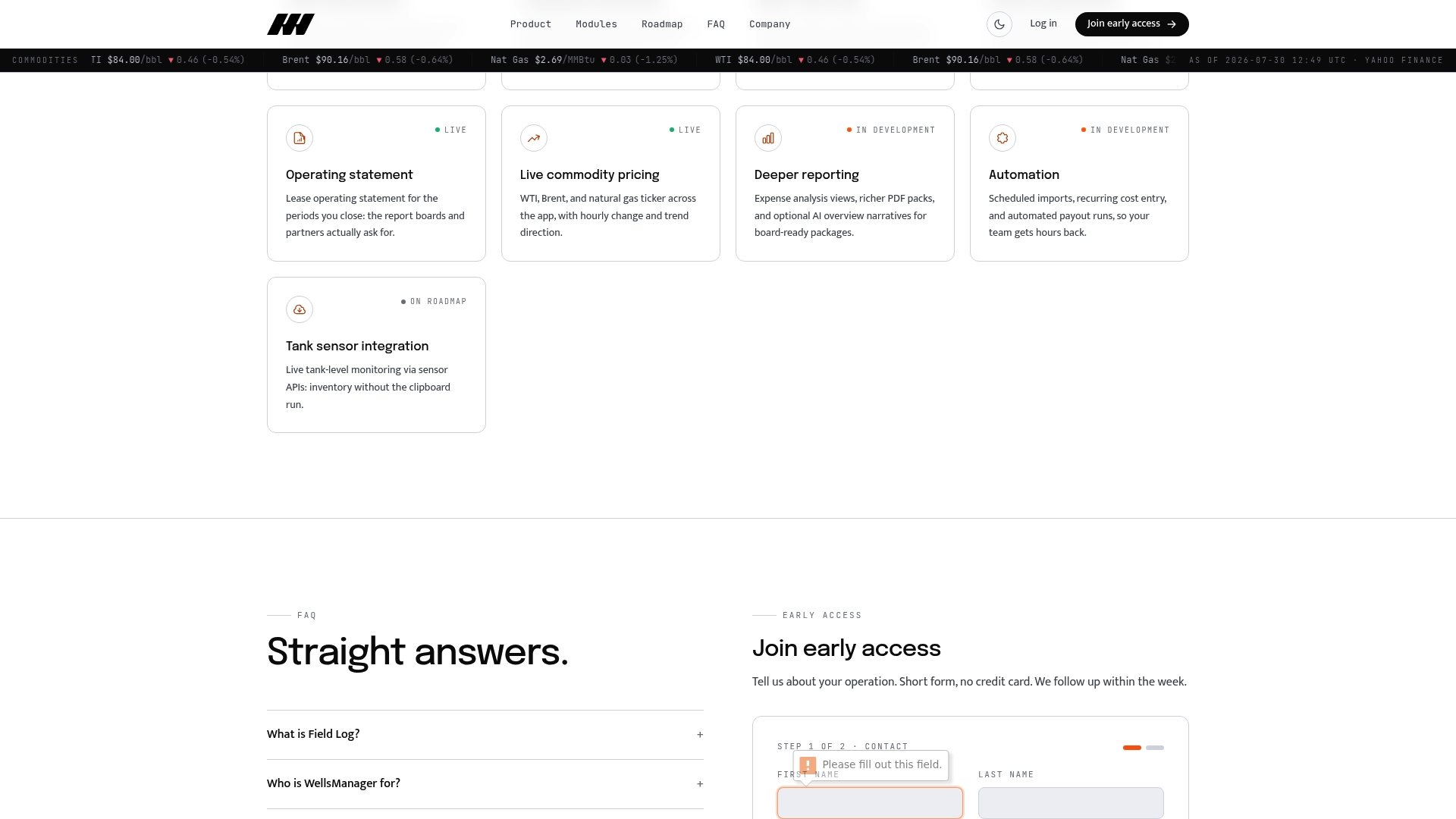
The platform connects production data, vendor expenses, and field maintenance logs into one authoritative record, so your CFO and your pumper are working from the same numbers. No parallel spreadsheets. No reconciliation marathons at month-end. If you’re ready to evaluate whether Wellsmanager fits your operation, request access and see how the platform maps to your current well count and data sources.