Oil and Gas Spill Reporting: Required Steps and Checklists
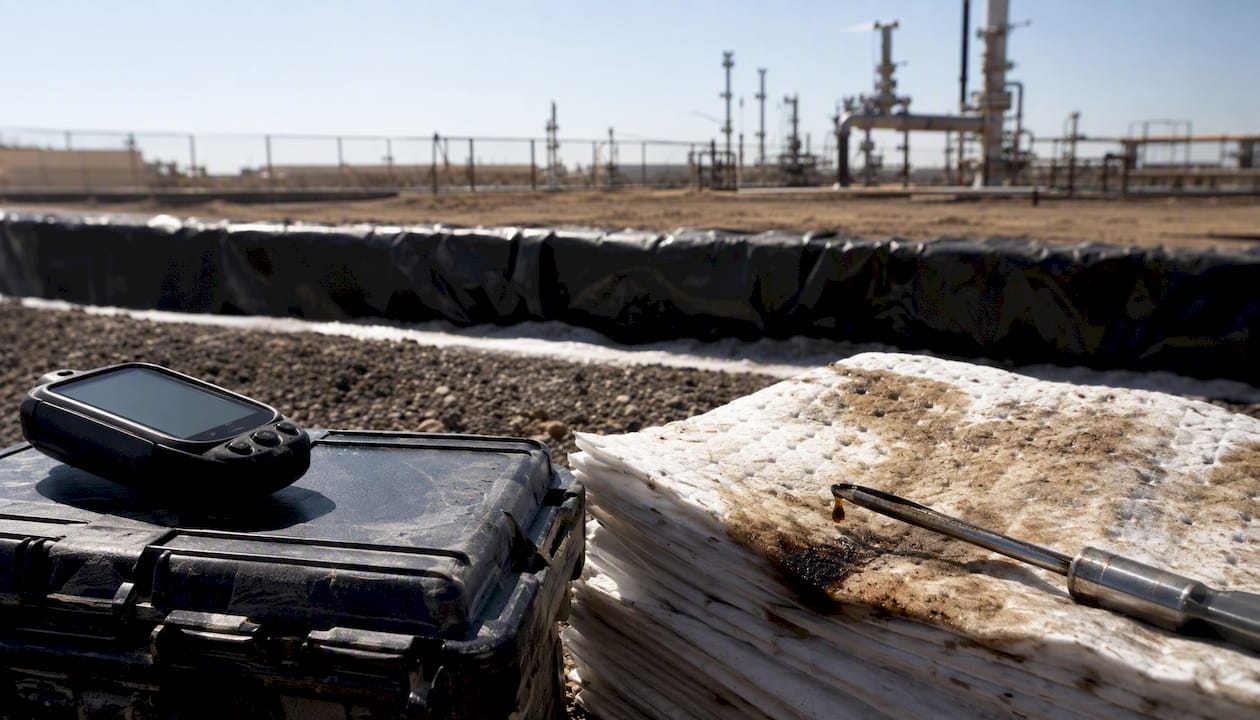
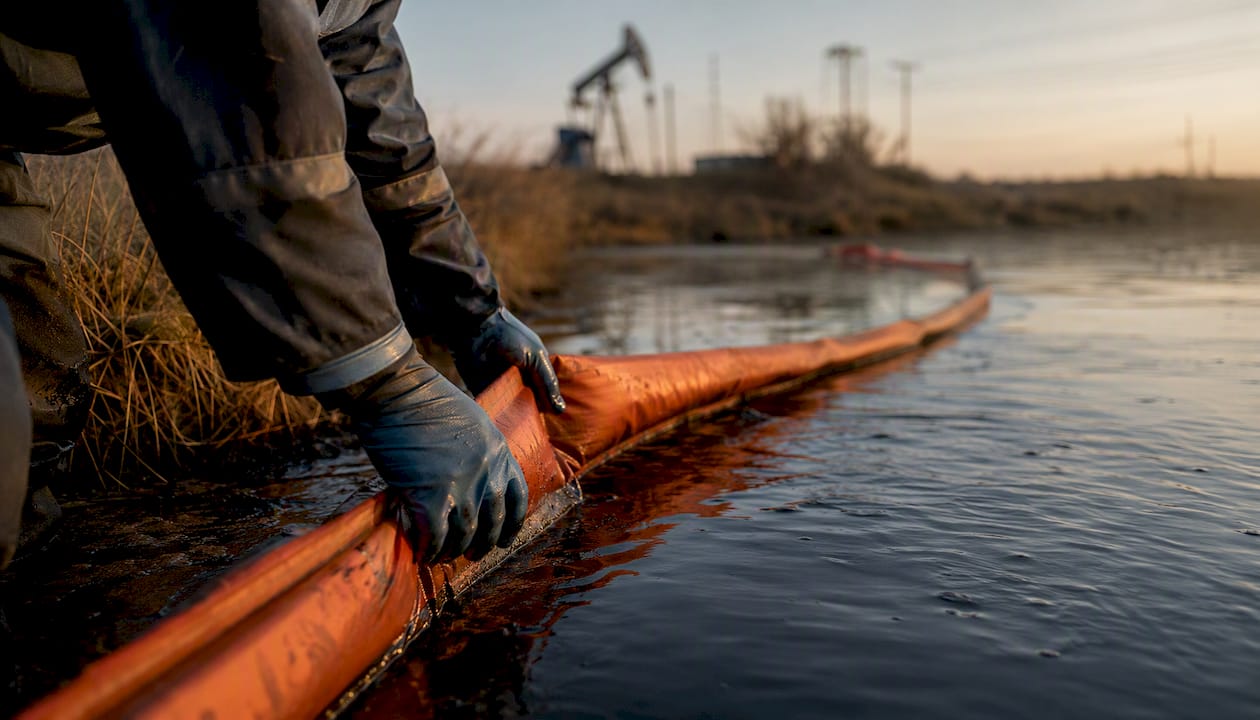
If oil reaches navigable water or creates a visible sheen, call the National Response Center at 800-424-8802 immediately, then begin containment. That call is your federal legal obligation under U.S. EPA guidance, and it must happen before you write a single word of documentation.
Here is what to do in the first three minutes:
- Call first. Dial NRC at 800-424-8802 (24/7). If your state has a dedicated routing line, call that next.
- Secure life and safety. Evacuate personnel from the release zone, isolate ignition sources if the product is flammable, and establish a perimeter.
- Start containment and document. Deploy berms, booms, or shutoffs. Take timestamped photos immediately.
Pro Tip: Write down the NRC incident ID and the name of the official who took your call before you hang up. Enforcement inspectors check this first.
Key Takeaways
Compliant spill reporting in oil and gas requires an immediate verbal notification to the National Response Center, parallel state notifications, and a written follow-up with lab results and documentation within state-mandated timelines.
| Point | Details |
|---|---|
| Call NRC first | Dial 800-424-8802 immediately for any release that reaches water or creates a sheen. |
| State notifications are separate | One NRC call does not satisfy state agency requirements; use a pre-built notification matrix. |
| Document from minute one | Timestamped photos, GPS coordinates, and NRC incident IDs are what regulators check first. |
| Written follow-up is mandatory | Timelines range from 24 hours (North Dakota online form) to 30 days (Hawaii written report). |
| Penalties for late reporting are real | Civil penalties and increased oversight follow missed or incomplete notifications under federal and state law. |
| Wellsmanager | Centralizes incident logging, deadline tracking, and audit-ready documentation for upstream operators. |
Table of Contents
- Spill reporting triggers for oil and gas operators
- Who to notify and how to route calls
- What your initial verbal report must include
- On-site priorities before responders arrive
- Written follow-up reports, timelines, and recordkeeping
- Federal and state regulations, and what failure to report costs
- ICS and best practices for audit-ready reporting workflows
- What compliance teams consistently get wrong
- Wellsmanager closes the gap between field reports and audit-ready records
- Sources
Spill reporting triggers for oil and gas operators
The federal baseline, set by the U.S. EPA, does not require a minimum volume. Any discharge of oil that creates a visible sheen, discoloration, or deposits sludge or emulsion on navigable waters triggers mandatory notification. That “sheen rule” catches a lot of operators off guard because a small pipeline drip reaching a drainage ditch can be reportable even if it measures less than a gallon.
States layer additional thresholds on top of that federal floor. Some set gallon or barrel cutoffs; others add containment-and-timing exceptions that can exempt a release if you act fast enough.
| Trigger | Threshold / Condition | Notes |
|---|---|---|
| Oil sheen on navigable water | Any visible sheen | Federal baseline; no volume minimum |
| Free product on groundwater | Any detectable amount | Common state trigger |
| Surface release (general) | >25 gallons | Reportable unless fully contained and remediated within 72 hours (Hawaii example) |
| Texas RRC — moderate release | a moderate volume range as defined by the state | Delineation sampling required |
| Texas RRC — significant release | >25 barrels | Lab-confirmed TPH analysis required; remediation target ≤1% TPH in soil |
| North Dakota verbal report | Any spill | Immediate verbal notification; online form within 24 hours |
Key state-level triggers to keep in your notification matrix:
- Any release that reaches surface water, regardless of volume
- Free product detected on groundwater monitoring
- Releases above a state-defined gallon or barrel threshold, even when contained on-site
- Smaller releases that are not fully contained and remediated within 72 hours
The Texas Railroad Commission field guide and Hawaii HEER Office both illustrate how state thresholds create concrete sampling and timeline obligations that go well beyond the federal sheen rule.
Who to notify and how to route calls
Most operators know to call NRC. Fewer realize that a single NRC call rarely satisfies every jurisdiction simultaneously. Federal, state, and sometimes local agencies each have independent notification requirements, and missing one can trigger enforcement even when the NRC report was filed correctly.
Federal contact:
- National Response Center: 800-424-8802 (24/7, every day of the year)
- NRC logs your report and routes it to the appropriate federal agency (EPA, Coast Guard, or others depending on the release type and location).
State contacts — routing examples:
- North Dakota: Call 1-833-99SPILL. The unified routing system directs your call to the Oil & Gas Division, Department of Environmental Quality, or another agency based on containment status and spill type. You still complete an online incident report within 24 hours.
- Texas: Contact the Texas Railroad Commission and the Texas Commission on Environmental Quality (TCEQ) depending on the release location and substance.
- Hawaii: Notify the HEER Office and NRC verbally, then submit a written follow-up within 30 days.
Practical routing rule: When uncertain whether a state hotline covers all required agencies, call NRC first, then your state emergency warning center, then the state oil and gas regulatory body. Document the name of every official you speak with, the time of each call, and any incident ID or case number assigned.
Field operations partners like Eco-Lift Energy Services can support on-site response coordination, but the notification calls are always the operator’s responsibility.
What your initial verbal report must include
Regulators are not expecting a polished document during the first call. They need enough information to assess the threat and dispatch the right resources. Missing even one field can slow the response and create compliance exposure later.
Required fields for the initial verbal notification:
- Responsible party: Your name, company name, and a direct callback number
- Substance type: Crude oil, condensate, produced water, refined product, or hazardous chemical — be specific
- Estimated volume: Barrels, gallons, or cubic feet; use your best field estimate (see tip below)
- Precise location: GPS coordinates, lease name, well API number, or nearest road intersection
- Date and time: When the release was discovered and, if known, when it began
- Description of the event: What happened — equipment failure, line rupture, tank overflow, etc.
- Current status: Is it still flowing? Has containment been deployed? Is it reaching water?
- Immediate threats: Proximity to waterways, populated areas, drinking water sources, or ignition hazards
Pro Tip: For volume estimates in the field, use gauge-to-volume tables for tanks, drum counts (1 standard drum = 55 gallons), or pipeline flow rate × elapsed time. A rough estimate with clear methodology is always better than “unknown” on the initial report.
On-site priorities before responders arrive
The window between discovery and the arrival of outside responders is where most compliance failures happen. Field crews either focus entirely on containment and forget documentation, or they document and delay containment. Both create problems.
Life safety comes first, without exception:
- Account for all personnel and move them upwind and uphill from the release.
- Eliminate ignition sources if the product is flammable or if vapors are present.
- Establish a safety perimeter and restrict access to authorized personnel only.
Containment actions:
- Deploy earthen berms, portable berms, or absorbent booms around the perimeter of the release.
- Close any valves, shutoffs, or isolation points that can stop or reduce flow.
- Install temporary diking to prevent migration toward drainage channels or water bodies.
- A release is generally considered “contained” when it can no longer migrate off-site or reach water, and that status matters for timing exceptions in several states.
Documentation that feeds the report:
- Photograph and video the release from multiple angles with timestamps active on your device.
- Record GPS coordinates at the release point and at any migration front.
- Log every notification call: who you called, the time, and the response.
- Begin chain-of-custody documentation for any soil or water samples collected on-scene.
Timestamped field records, including photos and equipment logs, are often the deciding factor when a regulator evaluates whether your follow-up report is complete.
Written follow-up reports, timelines, and recordkeeping
The verbal notification buys you time. The written follow-up is where your compliance record is actually built, and regulators treat it as the authoritative account of what happened.
| Jurisdiction | Initial written notification | Follow-up / final report | Lab confirmation required |
|---|---|---|---|
| North Dakota | Online form within 24 hours | Inspector visit within 24 hours | Varies by spill type |
| Texas (RRC) | Verbal + online notification | Delineation report for 5–25 bbl; full remediation report for >25 bbl | Yes, for >25 barrels (TPH) |
| Hawaii (HEER) | Verbal immediately | Written follow-up within 30 days | Required when sampling is triggered |
What to attach to your written follow-up:
- Delineation sampling results and lab reports (required in Texas for releases above 5 barrels)
- Site maps or GPS-referenced diagrams showing the release area and migration extent
- Timestamped photos and video from the scene
- A chronology of events: discovery, notifications, containment actions, and remedial steps
- Waste disposal records for recovered product, contaminated soil, or absorbent materials
On record retention: most states require spill records for a minimum of three to five years, though some require longer for sites with ongoing remediation. Keeping an audit-ready, centralized record reduces the time your team spends responding to information requests during inspections and shortens the overall enforcement timeline.
Federal and state regulations, and what failure to report costs
The federal reporting obligation flows primarily from the Clean Water Act and the Oil Pollution Act, which give EPA authority to require notification of any discharge that may be harmful. CERCLA adds a parallel obligation for hazardous substance releases above reportable quantities. The NRC is the single federal intake point for all of these.
State rules modify the picture in three important ways:
- Routing: Some states, like North Dakota, use a unified routing number that distributes your call internally. Others require separate calls to multiple agencies.
- Thresholds: Texas sets explicit barrel thresholds with different sampling requirements at each tier. Hawaii’s 25-gallon threshold and 72-hour containment exception are different from both.
- Timelines: Written follow-up deadlines range from 24 hours (North Dakota’s online form) to 30 days (Hawaii’s written report).
Failure to report carries real consequences. Civil penalties under federal law can reach tens of thousands of dollars per day of violation. State penalties vary but often include mandatory corrective action orders, increased inspection frequency, and in serious cases, permit suspension. Beyond the financial exposure, late or incomplete reporting almost always triggers more intensive regulatory oversight, which extends the remediation timeline and adds cost.
The practical takeaway: check your state’s specific rules before an incident, not after.
ICS and best practices for audit-ready reporting workflows
The Incident Command System is the operational gold standard for spill response because it assigns clear roles, establishes a single incident lead, and creates a consistent language between the verbal notification and every written report that follows. Without ICS, different team members often give regulators conflicting accounts of the same event.
A practical workflow for upstream operators:
- Immediate verbal report to NRC and state hotlines; record incident IDs and official names.
- Activate ICS and assign an Incident Commander, a Safety Officer, and a Documentation Officer.
- Containment and sampling under the Documentation Officer’s oversight; all samples logged with chain-of-custody forms.
- Written initial notification submitted within the state-required window (24 hours in North Dakota; immediately in Hawaii).
- Written follow-up report with lab results, maps, photos, and remedial action records submitted before the deadline.
- Record maintenance in a centralized system with timestamped entries and version control.
Pro Tip: The moment you receive your NRC incident ID, enter it into your incident log with the timestamp and the name of the NRC officer. Enforcement inspectors treat this as the clock-start for your reporting timeline, and a missing ID is the single most common documentation gap they flag.
A pre-built notification matrix, mapped to your facilities and their jurisdictions, prevents the most common failure mode: assuming one call covers all required agencies. Build it before you need it, and run a tabletop drill at least once a year to confirm the contact numbers are current.
What compliance teams consistently get wrong
The assumption that a single NRC call closes the loop is the most expensive mistake upstream compliance teams make. NRC routes your report federally, but it does not notify your state oil and gas regulator, your state environmental agency, or your local emergency planning committee. Each of those may have an independent notification requirement with its own clock running.
The second failure is treating the verbal report as the end of the obligation. It is the beginning. Regulators use the verbal report to assess immediate threat; they use the written follow-up to evaluate your competence and good faith. A verbal report that says “approximately 10 barrels, contained on-site” followed by a written report showing 40 barrels and off-site migration is not just a discrepancy — it is the kind of gap that turns a routine spill into a formal enforcement action.
Early transparency consistently produces better outcomes. Operators who call proactively, report conservatively high estimates, and document containment actions in real time tend to get collaborative remediation guidance. Those who minimize or delay tend to get inspectors, not guidance.
Run a tabletop drill with your compliance team at least annually. Walk through a scenario where a pipeline releases crude oil near a drainage channel at 2 AM. Who calls NRC? Who calls the state? Who activates ICS? Who handles the written follow-up? If your team hesitates on any of those questions, the notification matrix needs work before the next incident.
Wellsmanager closes the gap between field reports and audit-ready records
The hardest part of spill reporting is not knowing who to call. It is capturing everything that happens in the first 60 minutes in a format that holds up six months later during a regulatory inspection.
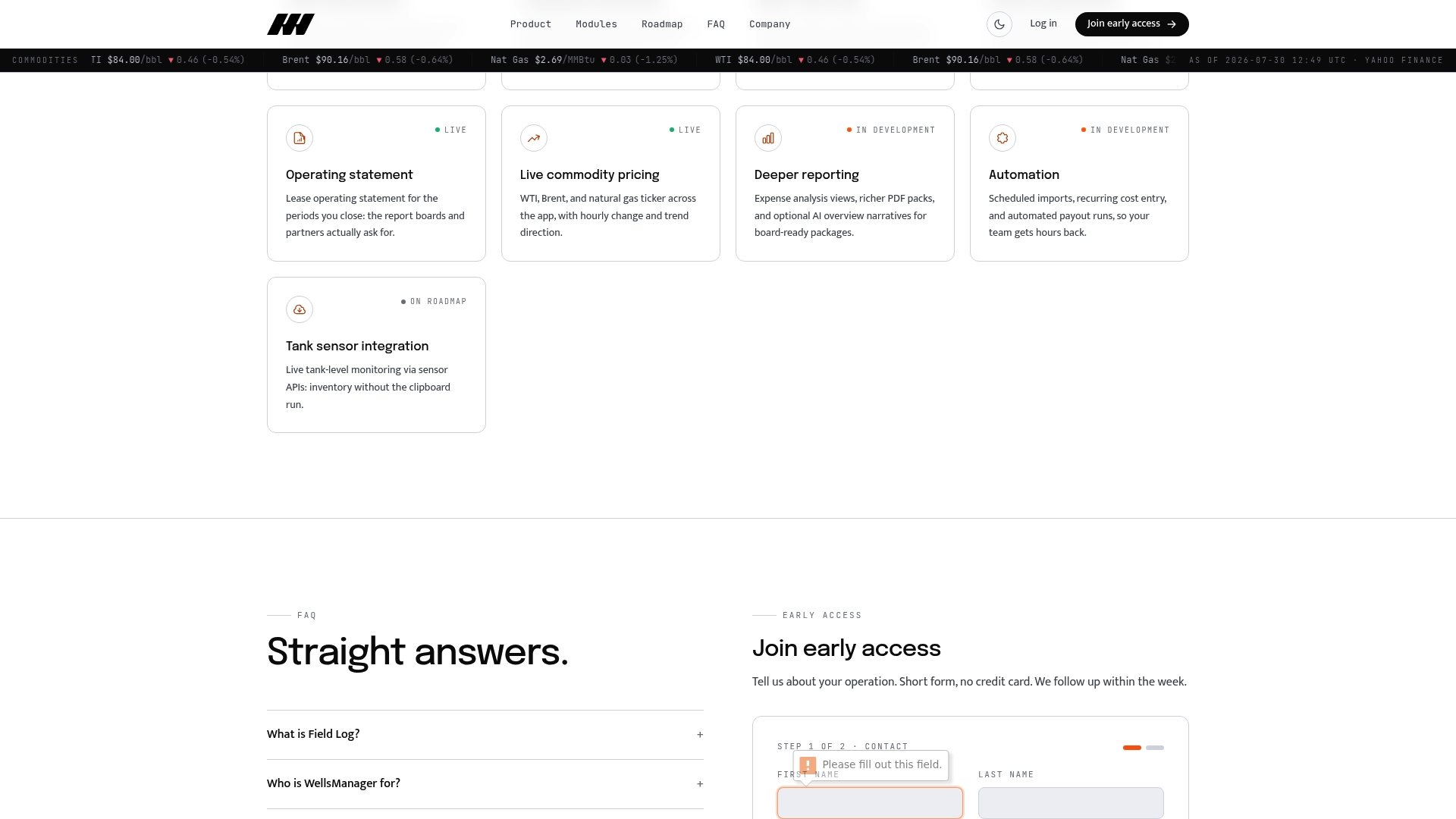
Wellsmanager gives upstream operators a centralized platform where field staff can log incident details, attach timestamped photos, and record NRC incident IDs the moment a call ends. The compliance notification module flags follow-up deadlines automatically, so a 24-hour online form or a 30-day written report does not slip through during a busy remediation. Audit trails are timestamped, version-controlled, and exportable for regulators on demand.
Relevant modules for spill response workflows:
- Incident logging with GPS, photos, and substance type fields
- Automated compliance notifications tied to state-specific follow-up deadlines
- Sample chain-of-custody tracking from field collection through lab confirmation
- Audit-ready export for written follow-up reports and inspection responses
Wellsmanager supports your reporting workflow. It does not replace on-scene safety actions or the immediate verbal notifications that federal and state law require.
Request access to Wellsmanager and see how the platform fits your existing incident response procedures.
Sources
Save these contacts and URLs in your company emergency response plan before you need them.
- When are You Required to Report an Oil Spill and Hazardous Substance Release? | US EPA
- Spill & Incident Reporting | Department of Mineral Resources, North Dakota
- STATE UNIFIED HAZMAT
- Field Guide For Reportable Surface Releases of Crude Oil in Non-Sensitive Areas
- How To Report A Release / Spill - HAZARD EVALUATION & EMERGENCY RESPONSE (HEER) OFFICE | HAZARD EVALUATION & EMERGENCY RESPONSE (HEER) OFFICE
Each source above covers a specific jurisdiction or federal baseline. For multi-state operators, build a jurisdiction-by-jurisdiction contact sheet and review it annually. Regulatory hotline numbers and online form URLs change more often than most compliance teams expect.
For additional guidance on upstream compliance workflows, the Wellsmanager blog covers notification procedures, audit trail management, and operational recordkeeping for independent operators.
This article is general information, not a substitute for advice from a qualified lawyer. Consult a qualified legal professional about your own circumstances before acting on anything here.