Calculate NRI Correctly: Permian Formula and Division Order Checklist

NRI equals working interest multiplied by one minus your total royalty burden, and that decimal tells you exactly what share of gross well revenue lands in your account. An NRI of 0.15 means you get about 15% of every production dollar before your own operating costs come out. To run the math yourself, you need your WI percentage, every royalty burden on the lease (lessor royalty, any overriding royalty, any NPRI), and, if the well sits in a pooled unit, the unit acreage figures.
TL;DR:
- Net revenue interest is always less than or equal to working interest and is calculated by multiplying WI by one minus the total royalty burden.
- Accurate calculation requires exact fractional-to-decimal conversions, summing all royalties and burdens, and carrying decimals to six or seven places before rounding.
- Discrepancies in division orders often stem from errors in acreage, unlogged overrides, or misapplied allocation factors, so owners should verify calculation bases before signing.
- For pooled units, NRI is derived by dividing net mineral acres by total acreage and multiplying by the lease royalty, which influences the expected payout.
- Consistent record-keeping and automated reconciliation are vital for managing multiple wells and owners, preventing recurring calculation errors and payment mismatches.
Table of Contents
- What NRI Actually Measures, and How It Differs From WI
- The Core Formula and How to Run It Step by Step
- Worked Examples: From a Simple Lease to a Pooled Unit
- ORRIs, NPRIs, and the Fraction Conversions Worth Memorizing
- How to Verify a Division Order Before You Sign
- Reconciling NRI in Day-to-Day Operations
- An Operator’s Take on Getting the Decimal Right
- Get Your Owner Payments Running on the Right Numbers
- Sources
- FAQ
What NRI Actually Measures, and How It Differs From WI
Net revenue interest is the percentage of production revenue you’re entitled to receive after every royalty and override on the lease has been carved out. It’s the number division orders run on, and the number that determines the size of your check.
Working interest is a different animal entirely. WI carries the obligation to pay for drilling, completion, and operating costs, and it does not by itself tell you what revenue share you keep. NRI is what’s left after the lessor’s royalty and other burdens are subtracted from that WI.
A few things to keep straight:
- Royalty interest owners get paid from gross revenue and never pay drilling or operating costs.
- Working interest owners pay costs but only collect the net revenue interest share of income.
- NRI is always less than or equal to WI. If somebody hands you a division order where NRI is higher than WI, something is wrong.
The Core Formula and How to Run It Step by Step
The formula itself is short: NRI = WI × (1 − total royalty burden). Running it correctly is where operators and owners trip up, usually on the fraction-to-decimal step or by missing a burden buried in an old assignment.
Work through it in this order:
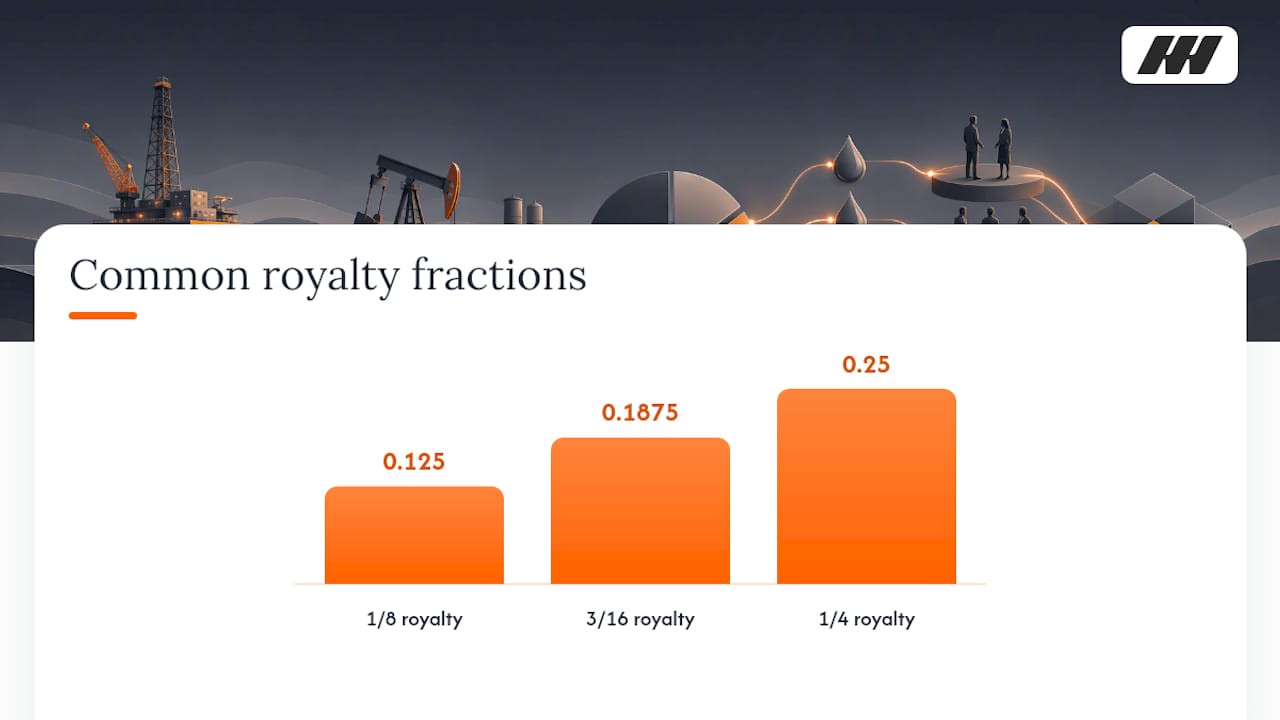
- Convert every lease fraction to a decimal. A 1/8 royalty is 0.125. A 3/16 royalty is 0.1875. A 1/4 royalty is 0.25. Don’t round these until the very end.
- Add up every royalty burden on the lease. That means the lessor’s royalty plus any overriding royalty interest (ORRI) plus any non-participating royalty interest (NPRI) stacked on top. Subtract that combined figure from 1.0 to get your net leasehold factor.
- Multiply the net leasehold factor by your WI. That product is your NRI, the exact decimal a division order should reflect.
The core formula is Working Interest NRI = Working Interest × (1 − total royalty burden), and it holds whether you’re looking at a single well or a multi-owner pooled unit.
Pro Tip: Carry your decimals out to six or seven places during the calculation, even if the division order rounds to four or five. Rounding early is one of the most common ways a small error turns into a real dollar discrepancy over a producing well’s life.
Keep full precision until you’re comparing your number against the operator’s stated decimal, then round to match their format for the comparison itself.
Worked Examples: From a Simple Lease to a Pooled Unit
Numbers make this concrete faster than any explanation. Here are three scenarios that cover the situations most Permian owners and operators run into.
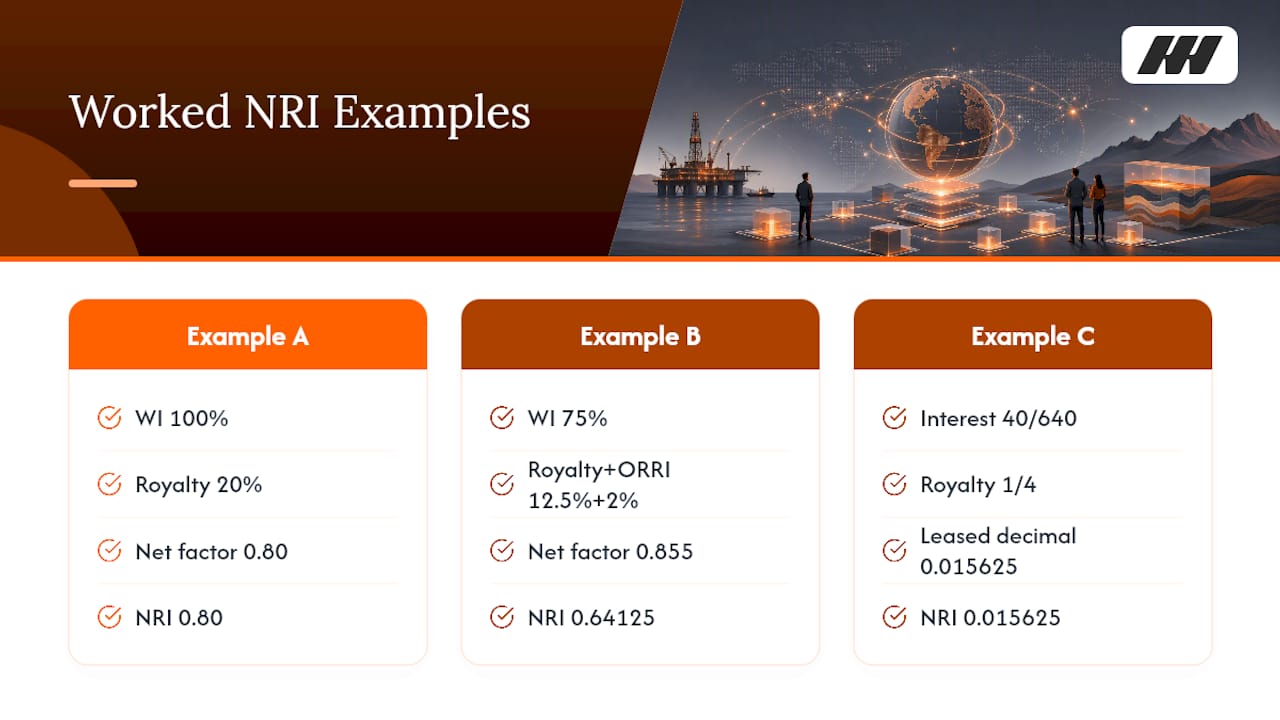
Example A: Straight WI with one royalty. You hold 100% WI on a lease with a standard 20% royalty. Net leasehold factor = 1 − 0.20 = 0.80. NRI = 1.00 × 0.80 = 0.80. On $100,000 of gross monthly revenue from that well, your share before operating costs is $80,000.
Example B: WI stacked with an override. You hold 75% WI, the lease carries a 12.5% lessor royalty, and there’s a 2% ORRI layered on from a prior assignment. Total burden = 0.125 + 0.02 = 0.145. Net leasehold factor = 1 − 0.145 = 0.855. NRI = 0.75 × 0.855 = 0.64125. On $50,000 of gross revenue, that’s $32,062.50.
Example C: Pooled unit, acreage-based. You own 40 net mineral acres (NMA) in a 640-acre drilling unit carrying a 1/4 royalty. Your leased-owner decimal is (40 ÷ 640) × 0.25 = 0.015625. On a well producing $500,000 gross, your royalty check equals $7,812.50, and confirming that 640-acre denominator is the whole game when a unit gets amended.
Once you’ve got your own NRI, use it to back-check what shows up on the check stub. Multiply your NRI by the reported gross revenue for the period. If the operator’s payment doesn’t land close to that number, the mismatch is either in the decimal, the reported volumes, or the price, and it’s worth asking which.
ORRIs, NPRIs, and the Fraction Conversions Worth Memorizing
Not every burden on a lease looks the same, and each one eats into NRI a little differently. An ORRI is carved out of WI, usually created when a lease gets assigned, and it rides on top of the lessor’s royalty. An NPRI is a royalty interest that doesn’t participate in bonus or lease negotiations. Production payments and sliding-scale royalties work similarly but often step up or down with price or volume, so the burden percentage isn’t fixed across the well’s life.
Fraction conversions worth having memorized:
- 1/8 = 0.125
- 3/16 = 0.1875
- 1/4 = 0.25
- 1/5 = 0.20
One distinction trips up a lot of owners: post-production deductions (gathering, compression, transportation) reduce the dollar amount you’re paid, but they don’t touch your NRI decimal itself. Royalty burdens change the decimal. Post-production costs change the check.
How to Verify a Division Order Before You Sign
A division order that lands in your mailbox with a decimal on it is a starting point, not a verdict. Before you sign anything, request the paperwork behind the number.
- Ask for the calculation basis the operator used, not just the final decimal.
- Request the unit or pooling order, if the well sits in a pooled unit, so you can confirm the acreage denominator.
- Pull your own recorded deeds and assignments to verify your NMA and any overrides you’re owed.
- Compare against the owner portal or statement if the operator provides one, since sometimes it reflects a corrected figure the paper division order hasn’t caught up to.
Most division order departments will respond to a direct written request along these lines: “Please provide the calculation basis for my decimal interest, including credited net mineral acres, the acreage denominator used, and the applicable royalty rate for well [name/API].”
The usual culprits behind a mismatch are wrong acreage figures, an ORRI that never got logged into the file, a misapplied allocation factor after a unit amendment, or simple rounding stacked across multiple transfers. If you find a real discrepancy, send your title documents (deed, assignment, probate record) directly to the operator’s division order team. That’s the fastest route to a corrected decimal, faster than waiting for the next check to just show up wrong again. For a deeper walkthrough of what to flag before signing, see this division order verification guide.
Reconciling NRI in Day-to-Day Operations
Getting the math right once is one problem. Keeping it right across dozens of wells and owners every month is a different one, and it’s where a lot of Permian operators lose time. WellsManager stores division-order evidence against each well so the calculation basis doesn’t live in a filing cabinet somebody has to dig through when an owner calls. Owner decimals get normalized through consistent formatting, which cuts down on the copy-paste errors that create decimal mismatches in the first place.
Distribution automation runs against minimum check thresholds, helping manage small pooled-unit checks to prevent delays or complications. A typical workflow looks like this: reconcile production against reported gross revenue, confirm the owner decimal against the stored division-order record, then run the distribution once the numbers agree. That sequence, done consistently, is what keeps owner relations manageable instead of a monthly fire drill.
An Operator’s Take on Getting the Decimal Right
Don’t sign a division order until you’ve run the math yourself. I’ve seen owners lose real money over years because they trusted a decimal that was off by a rounding error nobody caught. Keep your NMA figures, deeds, and assignments organized from day one. That paperwork is what settles a dispute fast instead of dragging it out for months. Run the checklist above every time a new division order shows up, and treat check reconciliation as a monthly habit, not a once-a-year scramble.
— Pedro
Get Your Owner Payments Running on the Right Numbers
Once you’ve got the NRI math sorted, the harder part is keeping every owner’s decimal correct month after month without it eating your week. WellsManager is built for exactly that grind: it stores your division-order records against each well, normalizes owner decimals through consistent API formatting, and automates distributions against minimum check thresholds so small pooled-unit payments don’t sit around risking escheatment. For a full picture of how per-well cost tracking feeds into what owners actually get paid, this upstream cost allocation guide walks through the mechanics. If you’re ready to stop reconciling owner checks by hand, take a look at WellsManager and see how it fits your operation.
This article is general information, not a substitute for advice from a qualified financial advisor. Consult a qualified financial professional about your own circumstances before acting on anything here.
Sources
- What Is Net Revenue Interest and How to Calculate It?
- Net Revenue Interest (NRI): Definition and Formula
- How to calculate net revenue interest — NARO guidance
- Net revenue interest, Oil & Gas Glossary | Oil Authority
FAQ
How is NRI calculated?
Multiply your working interest by one minus your total royalty burden: NRI = WI × (1 − total royalty burden). For example, a 75% WI with a 12.5% lessor royalty plus 2% ORRI equals a total royalty burden of 0.145, which gives an NRI of 0.64125.
How are NRIs taxed in the USA?
This article covers the mineral and royalty term “net revenue interest,” not the immigration or tax residency status sometimes abbreviated the same way; NRI income from oil and gas generally is taxed as ordinary income, with depletion deductions available to reduce the taxable portion.
How are NRI days calculated?
That question typically refers to nonresident alien day-counting for tax residency, which is unrelated to net revenue interest in oil and gas; if you’re asking about the production decimal, see the formula above instead.
How do I calculate my net revenue interest if my well sits in a pooled unit?
Divide your net mineral acres by the total unit acreage, then multiply by the applicable lease royalty rate. For 40 net mineral acres in a drilling unit about 640 acres in size with a royalty rate near 1/4, the leased-owner decimal is calculated by dividing the net acres by total unit acres and multiplying by the royalty rate.
What’s the difference between NRI and working interest?
Working interest carries the cost obligation for drilling and operating a well, while NRI is the revenue share left after royalties and overrides are subtracted from that working interest. NRI is always less than or equal to WI.