Avoid Escheatment: Permian Operators' $25–$100 Minimum Check Threshold

A minimum check threshold is the smallest dollar amount an operator will pay out to a partner before issuing a check, instead of holding the balance until it grows. Most Permian operators land somewhere between $25 and $100. The right move isn’t just picking a number. It’s pairing that number with an aging process so small balances don’t quietly turn into an escheatment problem months later.
TL;DR:
- Operators should set their minimum check threshold based on actual costs, typically between $25 and $100, considering payout frequency and owner expectations.
- Consistent monitoring of aging balances and owner contact attempts prevent small balances from turning into unclaimed property issues and avoid state escheatment.
- Clear stub language and a documented outreach process help maintain compliance and reduce owner complaints about held balances.
- Automated systems like Wellsmanager can streamline threshold enforcement, aging, and owner communication, reducing back-office workload.
- A regular review of thresholds and proper recordkeeping are critical to prevent thresholds from becoming legal risks.
Table of Contents
- Why Operators Use a Minimum Check Threshold in the First Place
- What Threshold Amount Actually Makes Sense for Your Wells
- How to Implement a Threshold Without Creating a Mess
- Policy Language and a Checklist for Your LOS
- Keeping Small Balances From Turning Into an Escheatment Problem
- What Most Operators Get Wrong About This
- How Wellsmanager Handles Investor Checks and Threshold Rules
- Sources
- FAQ
Why Operators Use a Minimum Check Threshold in the First Place
Cutting a check costs money, no matter how small the payout is. Postage, bank fees, staff time to process and mail it. If you’re writing a $4 check to a small royalty owner every month, you’re losing money on the transaction before the owner even opens the envelope.
Setting a threshold lets you batch those small amounts and pay them out less often, once the balance clears the number you’ve set. That’s basic administrative efficiency. But it only works if you keep it separate, in your head and in your ledger, from suspense.
Suspense and threshold holds look the same to an owner who hasn’t been paid. They are not the same thing operationally:
- Threshold holds are intentional and administrative. The owner’s decimal interest is clean, division orders are current, and the money is just accumulating until it clears your minimum.
- Suspense usually means something is broken. A title issue, a missing W9, a probate that hasn’t cleared, or a division order dispute.
Mixing the two in your own recordkeeping is how a routine threshold hold turns into a phone call from an angry owner, or worse, a compliance headache. Suspended royalty guidance from Allegiance Oil & Gas makes the same point: figure out which bucket a stopped payment falls into before you try to fix it, because the fix is different for each.
What Threshold Amount Actually Makes Sense for Your Wells
There’s no regulatory number here. Operators set thresholds based on what a check actually costs them to produce and mail, weighed against how often owners expect to see money.
Industry benchmarks commonly cited for minimum payment thresholds fall in the $25 to $100 range, and most independents in the Permian sit inside that band rather than at either extreme.
Pro Tip: If your per-check cost, postage, bank processing, and staff time, runs $3 to $5, a $25 threshold barely covers the overhead on marginal owners. Run the math on your own numbers before copying someone else’s default.
A few factors should drive where you land inside that range:
- Payout frequency. Monthly payers can justify a lower threshold because balances clear faster. Quarterly payers usually need a higher number, or owners wait too long between checks.
- Owner mix. A field with mostly working-interest partners who expect regular statements behaves differently than one with hundreds of small royalty owners who might not notice a missed month.
- Per-check cost. If your cost to produce and mail a check is closer to $5 than $1, a $25 threshold is barely worth having.
Some operators run two thresholds, a lower one for working-interest owners who watch their statements closely, and a higher one for scattered royalty interests where the administrative savings matter more than owner attentiveness. That’s a defensible split as long as you document why.
How to Implement a Threshold Without Creating a Mess
Picking a number is the easy part. Making it stick without generating owner complaints or an unclaimed-property problem takes a little more structure.
- Flag sub-threshold balances in your ledger. Whatever system you’re running, whether it’s a spreadsheet or dedicated software, tag any owner balance under the threshold so it’s visible at a glance, not buried in a general ledger line.
- Run a monthly aging report. Every held balance should show how many months it’s been sitting there. If you can’t answer “how old is this hold” in thirty seconds, your tracking isn’t tight enough.
- Build a quarterly escheatment-prep review. Pull every balance approaching your state’s dormancy period and confirm you have a current address, a valid tax ID, and no returned mail on file.
- Write clear stub language. Something as simple as “Balance held pending minimum payment threshold of $50” on the statement stops most owner calls before they start.
- Log returned mail immediately. A bounced check or undeliverable statement is a signal to update contact information now, not at year-end when you’re doing escheatment prep under a deadline.
- Re-check probate and title holds separately. If a balance is stuck because of an estate issue rather than the threshold itself, move it into your suspense workflow instead of leaving it mislabeled.
- Revisit the threshold annually. Check costs and mail rates change. A number that made sense three years ago might be costing you more in owner friction than it saves in postage today.
Owners rarely object to a threshold when they understand it. They object when a payment stops and nobody tells them why.
Policy Language and a Checklist for Your LOS
Copy-ready wording beats vague policy every time. Put something like this directly on your lease operating statement or investor check stub:
That single sentence does more to prevent owner confusion than any phone script.
A short checklist keeps the policy consistent across every LOS cycle:
- State the threshold dollar amount in plain language on every stub.
- Note the payout schedule (monthly, quarterly, or year-end catch-up) for held balances.
- Run an aging review before each distribution cycle, not just at year-end.
- Log every owner outreach attempt: date, method, and outcome.
- Confirm current mailing address and tax ID before a balance crosses into escheatment territory.
| Checklist item | Why it matters |
|---|---|
| Threshold stated on stub | Prevents owner confusion and repeat calls |
| Payout schedule noted | Sets owner expectations for when held funds arrive |
| Aging review each cycle | Catches balances drifting toward dormancy limits |
| Outreach log maintained | Documents due diligence if escheatment ever comes up |
| Address/tax ID confirmed | Reduces returned mail and delayed payments |
Documenting outreach isn’t busywork. If a state ever questions why a balance sat unpaid, a dated log of attempts to reach the owner is what separates a defensible process from a liability.
Keeping Small Balances From Turning Into an Escheatment Problem
A threshold hold becomes a legal problem the moment nobody’s watching the clock. States set dormancy periods for unclaimed property, and a small royalty balance that sits untouched long enough can trigger reporting obligations you didn’t plan for.
The fix is a rolling reconciliation habit, not a once-a-year scramble:
- Roll-forward aging reports. Track every sub-threshold balance month over month so you can see exactly how long it’s been held, not just that it’s held.
- Returned-mail logs. Cross-reference undeliverable statements against your aged-balance list. A returned envelope on an aging balance is your earliest warning sign.
- Escalation triggers. Set an internal flag when a balance approaches roughly 75% of your state’s dormancy timeline, giving you a real window to act before the deadline.
- Owner outreach sequence. Attempt contact by mail, then phone or email if you have it on file, and document every attempt before any balance moves toward escheatment.
Guidance on oil and gas revenue checks from Ranger Minerals makes the point plainly: a threshold only stays a cost-saving tool if someone is actively aging and monitoring the balances behind it. Left alone, it just becomes deferred risk. Recovery guidance from Buckhead Energy backs this up from the owner side. Most “missing check” complaints trace back to a threshold hold or returned mail, not lost money, and owner outreach resolves the majority of cases before a state ever gets involved.
What Most Operators Get Wrong About This
The mistake I see most often isn’t the threshold itself, it’s treating it as a policy you set once and forget. No aging process. Stub language that just says “balance held” with no dollar figure or explanation. Returned mail that sits in a drawer instead of triggering an address update.
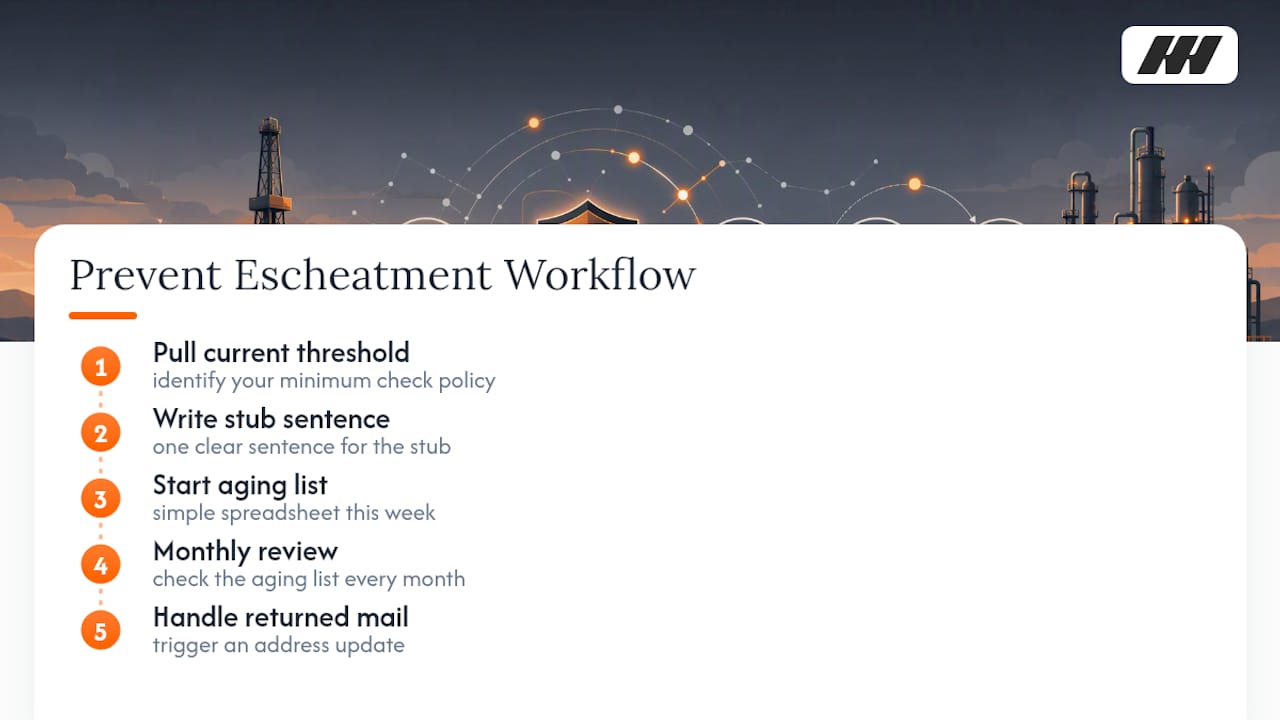
None of that takes much to fix. Pull your current threshold, write one clear sentence for the stub, and start a simple aging list this week, even a basic spreadsheet works. The operators who avoid escheatment headaches aren’t the ones with the fanciest systems. They’re the ones who check the aging list every month without being reminded.
If you want to see how other Permian operators structure this workflow, reach out. I’m happy to walk through examples.
— Pedro
How Wellsmanager Handles Investor Checks and Threshold Rules
Every step covered here, flagging sub-threshold balances, aging them monthly, and getting checks out without a month-end scramble, is exactly what Wellsmanager’s investor checks and lease operating statement module is built to handle. It applies your threshold rule automatically, batches held balances until they clear it, and keeps an aging record you can pull the moment a state dormancy question comes up. Pair that with Wellsmanager’s per-well cost book, so you can see what each well actually spent, and field work tickets that replace the notebook or group text. You’ve got the three jobs that matter most to an independent operator handled in one place, without hiring extra back-office staff to babysit spreadsheets. If you’re still tracking aged balances by hand, see how Wellsmanager runs investor distributions and get a look at the platform built specifically for Permian independents.
Sources
- BOEM — Price thresholds
- A complete guide to oil and gas revenue checks — Ranger Minerals
- Royalty checks stopped coming? Suspense, unclaimed funds & recovery — Buckhead Energy
FAQ
What Is a Minimum Check Threshold in Oil and Gas?
It’s the smallest dollar amount an operator will pay a partner before issuing a check, with anything below that number held and batched until it clears the limit, typically $25 to $100 depending on the operation.
What’s a Typical Minimum Payment Threshold for Small Operators?
Many independents set theirs between $25 and $100, based on per-check cost, payout frequency, and how many small royalty owners they manage.
How Is a Threshold Hold Different From Suspense?
A threshold hold is administrative and expected, the owner’s account is clean and the money is just accumulating. Suspense usually signals a real problem like a title issue, missing paperwork, or an unresolved probate.
Can a Minimum Check Threshold Lead to Escheatment?
Yes, if a held balance is never aged or monitored, it can drift past your state’s unclaimed-property dormancy period. Monthly aging reports and documented owner outreach are what prevent that outcome.
How Often Should I Review My Threshold Amount?
An annual review is reasonable for most operators, since per-check costs and owner expectations shift over time, but the aging reports behind the threshold should be run monthly.
Does Wellsmanager Manage Minimum Check Thresholds Automatically?
Wellsmanager’s investor checks and lease operating statement module applies your threshold rule, batches sub-threshold balances, and tracks their age so they stay visible instead of buried in a ledger line.