Severance Tax on Oil and Gas: A State-by-State Guide

A severance tax is a state-level excise on oil and gas as it comes out of the ground. There is no federal severance tax. Every dollar collected on extraction happens at the state level, and the rate you owe (or that gets withheld from your royalty check) depends entirely on where the well sits.
The range is wide. Texas charges a headline 4.6% on oil and 7.5% on gas, both based on market value. Louisiana runs higher on oil. North Dakota stacks a production tax on top of an extraction tax, pushing its combined effective rate above what a single-line severance tax might suggest. Nationally, state and local governments pulled in $11.8 billion in severance tax revenue in 2021, a figure that looks small next to total state budgets (about 0.3% of general revenue) until you zoom into Alaska, North Dakota, or Wyoming, where it funds a disproportionate share of the state’s operations.
If you’re an operator or a royalty owner trying to figure out what you actually owe or what’s being taken out of a check, do this first:
- Pull up your state’s revenue or tax agency page and confirm the current statutory rate.
- Look at your production or royalty statement for a line labeled “severance,” “production tax,” or “extraction tax.”
- Check whether your state taxes at the wellhead or after the product reaches market, because that single distinction can move your effective rate more than the headline number does.
Key Takeaways
Severance tax on oil and gas is a state-level excise with no federal counterpart, and the real cost to a royalty owner depends more on a state’s valuation rule than on its headline rate.
| Point | Details |
|---|---|
| No federal severance tax | Every rate, exemption, and filing deadline is set at the state level, so check the specific state agency page. |
| Valuation rule matters most | At-the-well states allow post-production cost deductions before royalty payout; marketable-product states limit them. |
| Rates vary widely | Texas charges 4.6% on oil and 7.5% on gas; other states stack multiple taxes or use flat volumetric charges. |
| Operators remit, owners pay | Severance tax appears as a separate line on royalty statements and reduces the net check directly. |
| Verify before you dispute | Confirm current rates and rules on the state revenue or oil and gas commission page before questioning a statement. |
Table of Contents
- What Is Severance Tax on Oil and Gas and How Is It Calculated?
- Severance Tax Rates by State: A Comparison of Major Producers
- Exemptions and Incentives That Change What You Actually Owe
- Who Actually Pays: Withholding and Reporting
- Filing Deadlines and a Compliance Checklist for Operators
- How to Verify Current Rates Before You File or Question a Check
- Centralizing Production Data to Reduce Severance Errors
- Historical Context and Trends in Severance Tax Rates
- Economic Impact of Severance Taxes on States and Producers
- Severance Tax vs. Other Oil and Gas Taxes and Fees
- Legal Challenges and Controversies Around Severance Tax Collection
- Get Ahead of Severance Errors Before They Hit a Royalty Check
- What the Rate Sheets Don’t Tell You
- Sources
- FAQ
What Is Severance Tax on Oil and Gas and How Is It Calculated?
Severance tax is calculated against a taxable base, and that base is either the volume produced (barrels of oil, thousand cubic feet or Mcf of gas) or the market value of that production. Most major producing states, including Texas, Oklahoma, and Louisiana, tax value rather than raw volume, which means the rate moves with commodity prices even when the statutory percentage stays fixed.
The harder question is where value gets measured. States generally follow one of two valuation approaches:
- At-the-well valuation. Tax is calculated on the value of the product as it exists at the wellhead, before gathering, processing, or transportation. Costs incurred after that point (often called post-production costs) can typically be deducted from the royalty owner’s share before the severance line is applied.
- Marketable-product valuation. Tax is calculated closer to the point where the product actually reaches a buyer, which limits how much of the post-production cost burden operators can pass on to royalty owners.
That distinction, drawn out in NCSL’s state-by-state severance tax analysis, can move a royalty owner’s net check by more than the severance rate itself does, because gathering and processing fees stack on top of the tax rather than instead of it.
Some states layer rates further. North Dakota applies both a production tax and an extraction tax on oil, and the combined bite depends on price triggers written into statute, not just a flat percentage. Oklahoma and a handful of other states offer temporary reduced rates for new wells, then step the rate up after a set production period or price threshold.
Worked example: Say a well produces oil valued at $70 a barrel, and the state severance rate is 5%. That’s $3.50 per barrel in tax. If the state also allows the operator to deduct $4 per barrel in post-production costs (gathering, dehydration, compression) before calculating the royalty owner’s share, the owner’s net check reflects both the tax and the deduction, sometimes losing more to post-production costs than to the tax itself. Buckhead Energy’s compilation of deduction rules shows this pattern repeating across at-the-well states, and it’s one of the most common sources of dispute between operators and mineral owners.
Severance Tax Rates by State: A Comparison of Major Producers
Rates and deduction rules vary enough state to state that comparing them side by side is the only way to see the real pattern. The table below reflects headline statutory rates; actual effective rates shift with price triggers, incentive certifications, and local fees layered on top.
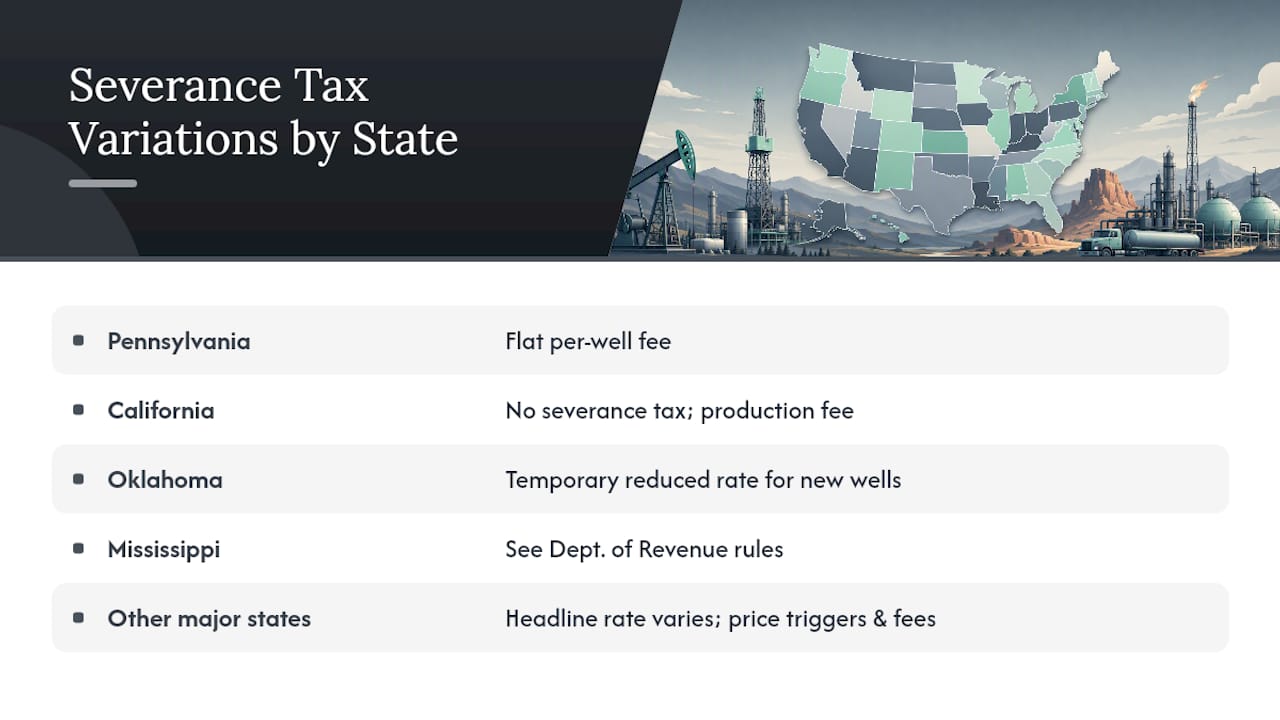
Pennsylvania is the outlier worth flagging on its own. Instead of a percentage-based severance tax, it levies a flat per-well impact fee that varies by well type and gas price, structured entirely differently from a value-based tax. California is another case that trips people up: it doesn’t impose a traditional severance tax at all, relying instead on an assessment tied to production that functions more like a regulatory fee than an excise tax.
Pro Tip: Don’t assume the headline rate is your effective rate. New wells in Oklahoma and several other states get a temporary reduced rate for a set window after first production, and it steps up automatically once that window closes. Mark the step-up date on your compliance calendar the day the well starts producing, not when you first notice the rate changed on a check.
Mississippi’s Department of Revenue page lays out its measurement rules and filing cadence directly, which is worth bookmarking if you operate there, since the state updates specific thresholds periodically.
Exemptions and Incentives That Change What You Actually Owe
Most producing states carve out exceptions for low-volume or aging wells, because a flat statutory rate applied to a marginal well can push it into the red faster than the well can recover.
- Marginal or stripper well programs reduce or eliminate severance tax for wells producing below a defined daily threshold, common in Texas, Oklahoma, and several Appalachian states.
- New-well incentive rates offer a temporary reduced percentage, often for a set number of months or until cumulative production hits a cap, then revert to the standard rate automatically.
- Formation-specific credits exist in some states for wells drilled in designated tight-formation or enhanced-recovery zones, requiring separate certification paperwork.
- Price-triggered relief kicks in in states like North Dakota, where a sustained low commodity price can drop the extraction tax rate for a defined window.
None of these apply automatically. Operators typically have to file certification paperwork (Texas requires Form ST-1 for several of its incentive categories) and keep supporting production records on hand in case of audit. Royalty owners should check their statements against the applicable state program, because an exemption the operator claims should show up as a lower effective severance line, not just a promise on paper.
Who Actually Pays: Withholding and Reporting
Operators remit severance tax to the state, but royalty owners bear the actual cost, because the amount comes straight out of the royalty check before it’s issued. Legal incidence and economic incidence split here in a way that surprises a lot of first-time mineral owners.
- Your royalty statement should show gross royalty value, a separate severance tax line, and the net check amount after both severance and any post-production deductions.
- If that severance line is missing or bundled into a vague “deductions” category, ask the operator for an itemized breakdown; some states require it by statute.
- 1099 forms from operators typically report gross royalty income, not the net after severance tax, so royalty owners need to track the tax paid separately for their own return.
For producers, severance tax generally counts as a deductible cost of production on federal returns, treated similarly to other production-level operating expenses. For royalty owners, the tax withheld reduces taxable royalty income, but the mechanics depend on how the operator reports it. This isn’t blanket tax advice. State severance tax revenue nationally still runs well under 1% of total state and local general revenue in most states, even though it can feel like a much bigger line item on an individual check.
Filing Deadlines and a Compliance Checklist for Operators
Filing cadence varies, but most producing states require monthly or quarterly returns tied closely to the production month, not the payment date. Mississippi, for example, requires returns by the 25th of the second month following production, a pattern that shows up with slight variations across other states as well.
- Confirm your filing frequency. Most states default to monthly filing for active wells, with quarterly options for marginal producers below a volume threshold.
- Locate the correct portal. Texas routes through the Comptroller’s e-filing system, while production and lease data get reported separately to the Railroad Commission.
- Capture production and price data in real time. Delayed field logs create downstream errors in the value calculation that trigger amended returns.
- Calculate withholding before disbursement, not after, so royalty checks reflect the correct net amount the first time.
- File and retain evidence. Keep production records, price documentation, and filed returns for at least the state’s statute-of-limitations window on audits, typically three to four years.
Missing a filing window doesn’t just risk a penalty. It often triggers a broader audit of prior periods, which is far more expensive than the original interest charge would have been.
How to Verify Current Rates Before You File or Question a Check
Start with the primary source every time: the state revenue department or comptroller page, plus the state oil and gas commission for production-specific rules. Cite the actual statute number if you’re documenting a position for an audit or a royalty dispute.
- Use NCSL’s compilation as a fast cross-state reference, then confirm against the specific state page.
- Check Tax Policy Center’s revenue data for fiscal context if you’re building a broader financial case.
- Cross-reference deduction rules against Buckhead Energy’s dataset before assuming an at-the-well or marketable-product default.
- Screenshot the agency page with the date visible, and call the agency directly if the language is ambiguous. Rates and rules change with legislative sessions more often than most people expect.
Centralizing Production Data to Reduce Severance Errors
Most severance miscalculations trace back to one problem: production and price data captured late, or captured in three different spreadsheets that don’t agree with each other. Wellsmanager centralizes the numbers that severance tax math actually depends on, so the calculation starts from one accurate source instead of a reconciled guess.
- A mobile field log lets field staff record production, downtime, and costs against a specific well the same day it happens, not weeks later during month-end cleanup.
- An AI connector lets a compliance staffer ask a plain-language question about a specific lease’s production history instead of digging through old spreadsheets.
- An invoice approval workflow keeps post-production cost documentation attached to the well it belongs to, which matters directly when a royalty owner disputes a deduction line.
- Every entry keeps an auditable history, so when a state agency asks for supporting records during an audit, the trail already exists.
Pro Tip: If you operate across multiple states with different valuation rules, tag each well with its state’s deduction methodology inside your operations system. It turns a manual lookup into a one-click check every time a new royalty statement goes out.
Historical Context and Trends in Severance Tax Rates
Severance taxes trace back to the early 20th century, when producing states realized extraction depleted a finite resource that would never generate property tax revenue once it was gone. Oklahoma and Texas were among the earliest adopters, and the basic structure, a percentage of value or a per-unit volumetric charge, has stayed remarkably stable for a century, even as rates and exemptions have shifted repeatedly around commodity price cycles.
The bigger trend has been toward complexity rather than higher headline rates. States increasingly layer temporary incentive rates for new wells, price-triggered adjustments, and marginal-well exemptions on top of a base rate that itself rarely moves. North Dakota’s combined production and extraction tax structure, born out of the Bakken boom, is a good example of legislators adding a second tax rather than simply raising the first one.
Price crashes tend to force the most visible policy changes. States with price-triggered relief provisions, North Dakota among them, saw those clauses activate during downturns, temporarily cutting effective rates to keep marginal wells producing rather than shutting in. That pattern repeats almost every commodity cycle: rates hold steady on paper, but the exemptions and triggers around them do the real work of adjusting the effective burden to match what the industry can actually bear.
Economic Impact of Severance Taxes on States and Producers
Severance tax revenue funds a disproportionate share of government operations in resource-heavy states, even though it accounts for a small slice of total state and local revenue nationally. Alaska, North Dakota, and Wyoming rely on it far more heavily than the national 0.3% average suggests, because their general fund and, in some cases, school funding formulas are built directly around extraction volumes.
For producers, severance tax functions as a direct cost of doing business, factored into drilling economics before a well is ever spudded. A marginal well that’s profitable at a 3% effective rate might not clear the bar at 7%, which is exactly why so many states carve out reduced rates for low-producing wells rather than losing that production entirely.
For local communities, the tax often funds infrastructure that extraction itself strains: roads built for light traffic suddenly carrying heavy trucks, water systems stretched by drilling operations, and emergency services scaled for a population the boom temporarily doubles. Several states earmark a portion of severance revenue specifically for these local impacts rather than routing it through the general fund, which is part of why the allocation formula matters as much as the headline rate when you’re evaluating a state’s overall tax burden on production.
Severance Tax vs. Other Oil and Gas Taxes and Fees
Severance tax is only one line in a stack of charges an operator or royalty owner might see, and confusing it with the others leads to real filing mistakes. Ad valorem or property tax applies to the value of the mineral interest or equipment itself, assessed separately by county in most states, and it runs on top of, not instead of, severance tax.
Conservation fees, common in states like Oklahoma and New Mexico, fund the regulatory agency’s oversight work and are typically a small, flat percentage separate from the severance calculation entirely. Pennsylvania’s impact fee replaces a traditional severance tax altogether, structured as a flat per-well charge tied to well type and average annual gas price rather than a percentage of value. Federal royalty rates on production from federal lands are a different mechanism altogether, negotiated as part of the lease terms rather than imposed as a state tax.
The practical takeaway: a royalty statement showing multiple deduction lines isn’t necessarily double taxation. It’s usually several distinct charges (severance, ad valorem, conservation fee, post-production costs) each doing a different job, and each one needs to be checked against its own statutory basis rather than lumped together as “taxes” when you’re auditing a check.
Legal Challenges and Controversies Around Severance Tax Collection
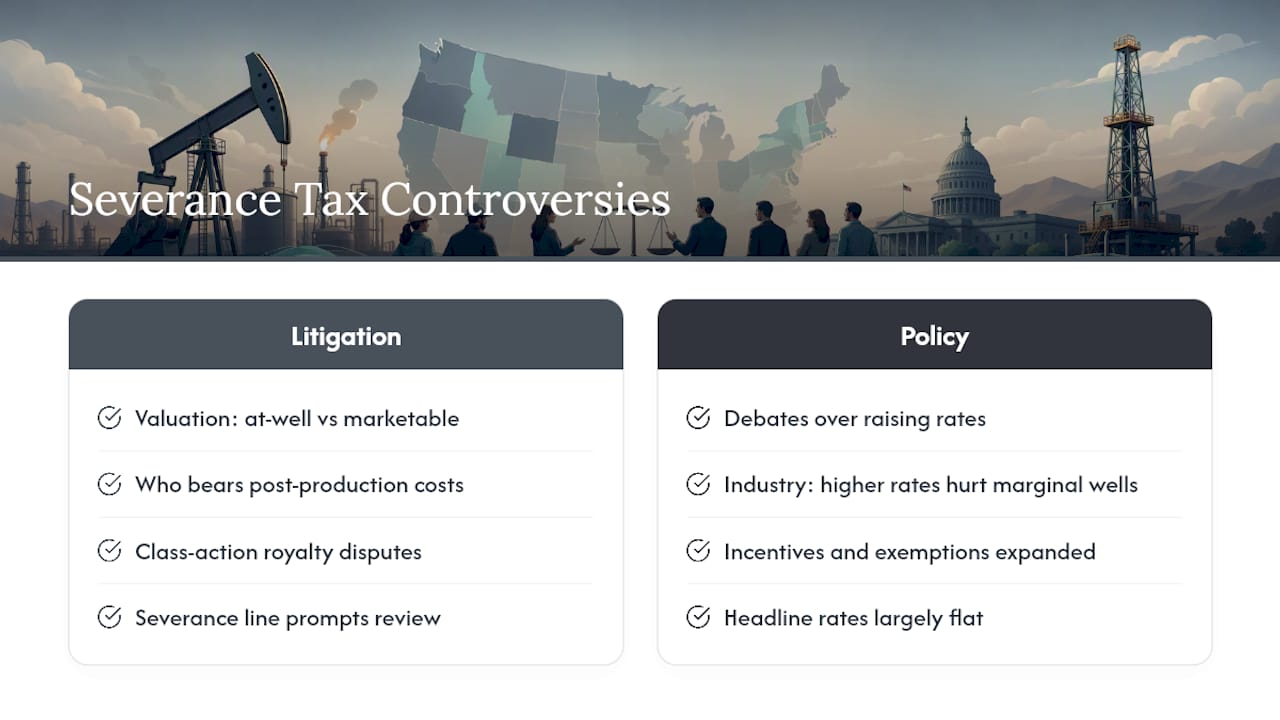
The most persistent legal fights over severance tax don’t involve the rate itself. They involve valuation, specifically whether a state or a specific lease requires at-the-well or marketable-product treatment, and who bears the post-production cost burden that flows from that answer. Court decisions in several states have gone different directions on functionally similar lease language, which is why NCSL’s practitioner guidance stresses checking case law alongside the statute.
Royalty owners have brought class-action style disputes in multiple producing states, arguing operators deducted post-production costs the lease language didn’t actually authorize. These cases hinge less on the severance tax rate than on contract interpretation, but the severance line often becomes the trigger that prompts an owner to scrutinize the rest of the statement.
There’s also a recurring policy fight at the legislative level: producing states periodically debate raising severance rates to fund budget shortfalls, and the industry response is consistent, that higher rates push marginal wells out of production and reduce overall tax revenue rather than increase it. That argument has shaped incentive programs in nearly every major producing state, which is part of why exemptions and reduced rates for new or marginal wells have expanded steadily even as headline rates have stayed largely flat.
Get Ahead of Severance Errors Before They Hit a Royalty Check
Reconciling severance withholding after the fact is far more expensive than catching an error at the source. If your team is still tracking well-level production, pricing, and post-production costs across disconnected spreadsheets, Wellsmanager gives operators a single system built around per-well P&L, real-time field logs, and audit-ready records, so the numbers feeding your severance calculation are right the first time. You can request access to see how it fits your current filing workflow.
What the Rate Sheets Don’t Tell You
Most severance tax coverage stops at the headline rate, which is exactly backward. The rate is the easy part; any state agency page hands it to you in one line. What actually determines whether a royalty owner gets a fair check or an operator gets audited is the valuation rule sitting underneath that rate, and almost nobody explains it clearly.
The conventional advice, “check your state’s severance tax rate,” treats this like a lookup problem. It isn’t. A 4.6% rate in an at-the-well state can cost a royalty owner more in practice than a 7% rate in a marketable-product state, because the deduction rule decides how much of the post-production cost burden lands on the owner before severance even enters the math. That’s the piece worth spending your time on, not memorizing a percentage you can find in thirty seconds.
If you take one thing from this: stop treating severance tax as a single number to look up once a year. Treat it as a data problem, production, price, and deduction records that need to stay accurate in real time, because that’s where the actual dollars move.
— Pedro
Sources
- How do state and local severance taxes work? — Tax Policy Center
- Texas severance tax incentives — Railroad Commission of Texas
- Brief: State oil and gas severance taxes — NCSL
- Oil & gas severance tax & post-production deductions by state — Buckhead Energy
FAQ
What is the severance tax rate on oil in Texas?
Texas charges 4.6% of market value on oil production and 7.5% of market value on natural gas, with incentive certifications available for qualifying wells.
How is severance tax calculated on oil and gas production?
Severance tax is calculated as either a percentage of the production’s market value or a flat rate per unit of volume, applied either at the wellhead or after the product reaches market depending on the state’s valuation rule.
Who pays 90% of the taxes in the US?
This question typically refers to federal income tax, where a small share of top earners pays a majority of federal income tax collected; it isn’t related to severance tax, which is a separate state-level excise on extracted resources.
Who has the highest fuel tax in the United States?
Fuel taxes (gasoline and diesel excise taxes) are a distinct tax category from severance tax, and rates vary significantly by state; check your state’s department of revenue for current fuel tax rates rather than confusing them with production-based severance taxes.
Does the federal government collect a severance tax on oil and gas?
No. There is no federal severance tax; all severance taxation in the United States happens at the state level, with rates and rules set individually by each producing state.