Division Order Basics for Permian Owners: The 3 Things You Must Verify

A division order tells the operator who to pay, how much, and where to send it. It does not transfer your minerals and does not change your lease. Before you sign anything, check three things: your decimal interest, your name and tax ID, and the property description. That’s the whole job, and skipping it is how owners end up chasing money for months.
TL;DR:
- Confirm your decimal interest by cross-checking acreage and royalty rate calculations with your deed, unit size, and operator’s documents before signing.
- Texas law prohibits division orders from amending your lease or changing mineral ownership, but signing binds you to the stated decimal interest going forward.
- Key fields to verify on a division order include the well name, API number, effective date, decimal interest, payee name, and valuation language, ensuring they match your records.
- If your calculated interest differs from the order or any fields seem incorrect, request clarification, review the operator’s title opinion, and avoid signing until discrepancies are resolved.
- After signing, your decimal interest drives your payments, but you can revoke the order later; however, correcting past underpayments requires a separate legal process.
Table of Contents
- What Is a Division Order and Why Do Operators Use It?
- What Texas Law Actually Requires (and What It Doesn’t)
- Anatomy of a Division Order: The Exact Fields to Check
- How to Verify Your Decimal Before You Sign
- What Happens After You Sign
- Red Flags That Should Stop You From Signing
- Operator Workflow: Keeping Division Orders and Payments Straight
- A Note From an Operator’s Perspective
- How WellsManager Keeps Owner Payments Accurate
- Sources
- FAQ
What Is a Division Order and Why Do Operators Use It?
An operator issues a division order to confirm your decimal interest in a well and to get your payment instructions on file, your legal name, mailing address, and tax ID. It’s administrative paperwork that sits downstream of your lease, not a substitute for it. Under Texas law, a division order does not convey mineral rights or amend an existing lease, no matter what language shows up in the fine print.
Operators have their own reasons for wanting this document signed, as seen in the details about Contango Oil and Gas’s post-merger status and valuation. It protects them from paying the wrong party, lets them point to a signed record if a dispute comes up later, and often spells out valuation and sale terms that the original lease left vague. That last part causes real friction. When a lease says nothing about deduction methods or point-of-sale valuation, the division order becomes the de facto rulebook, and owners frequently discover the terms don’t match what they expected when the lease was signed.
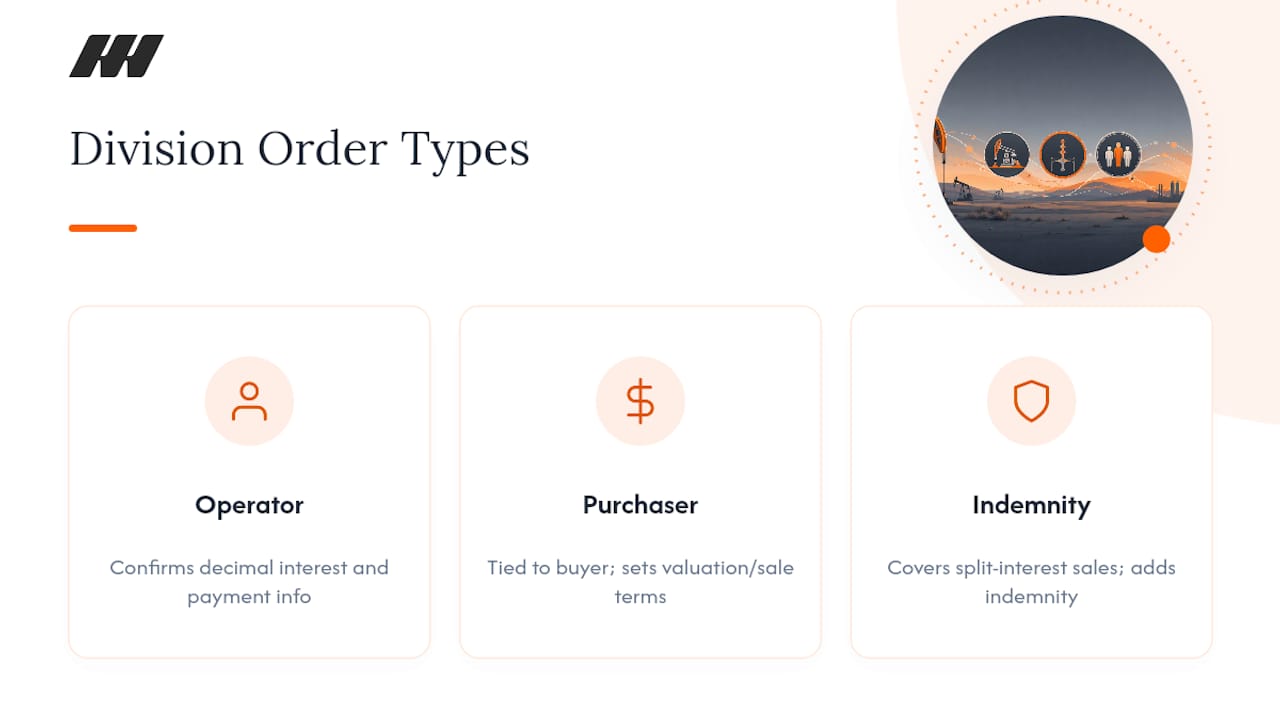
You’ll typically run into three flavors: one from the operator or lessee, one tied to a purchaser buying the production, and sometimes an indemnity or third-party version covering split-interest sales. The mechanics are the same across all three. Someone wants your signature confirming a number, and that number determines your check.
What Texas Law Actually Requires (and What It Doesn’t)
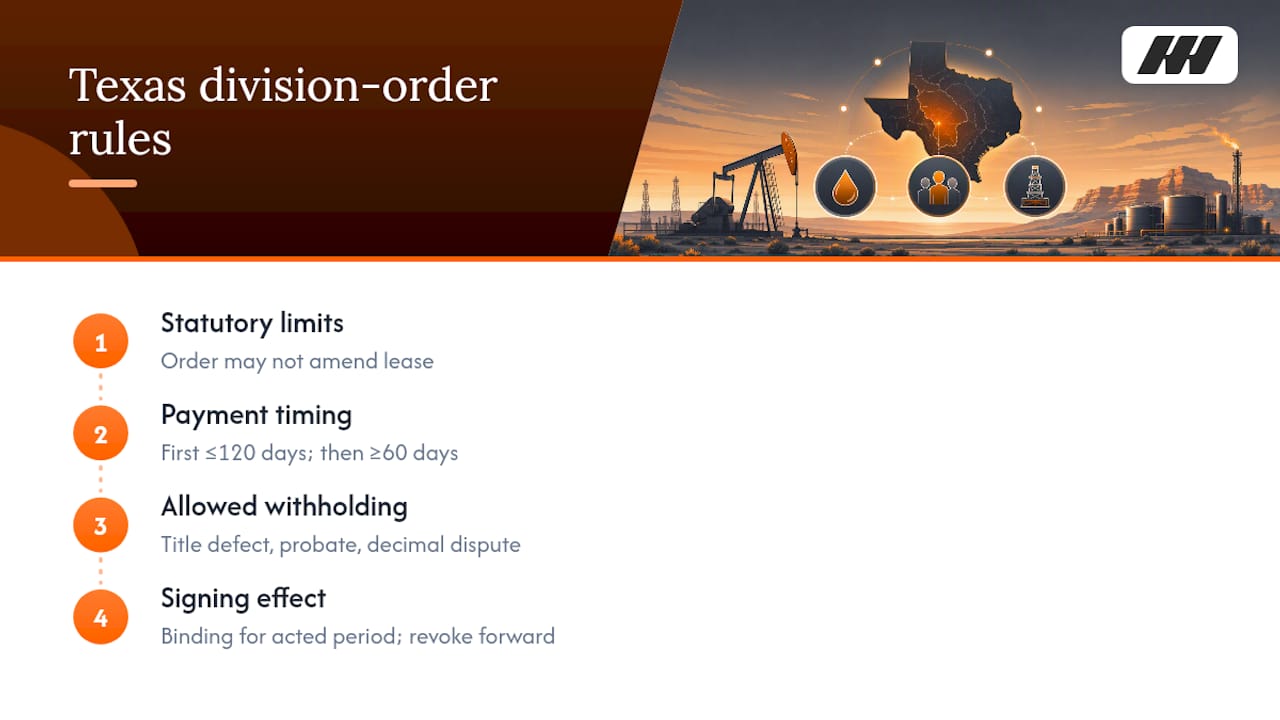
Texas doesn’t leave division orders to guesswork. Texas Natural Resources Code §91.402 spells out what a payor can require in the order and, just as important, what the order cannot do: it cannot amend your lease. That single sentence in the statute settles a lot of arguments before they start.
The same statute sets payment timing. First proceeds from a well are generally due within 120 days of first sale, with subsequent payments due at least every 60 days after that for larger interests. Operators can lawfully withhold payment for specific reasons, like a title defect, a pending probate, or a dispute over the decimal, but they can’t just sit on your money because paperwork is slow.
Here’s the part that trips people up: once you sign and the operator acts on it, courts generally treat that division order as binding for the period it was acted on. Texas case law has wrestled with this for decades, and the practical result is that signing carries real weight even though it doesn’t touch ownership. You can revoke a division order going forward. Undoing what already got paid is a separate, harder fight. That’s why checking the number before you sign beats fighting about it after.
Anatomy of a Division Order: The Exact Fields to Check
Every division order has the same skeleton. Learn to scan it in the same order every time, and errors jump out faster.
- Well name and operator property number, plus the API number. The API is the most reliable cross-check because it’s tied to the specific well and unit, unlike internal property numbers that vary between operators.
- Effective date, which tells you when this decimal starts applying, and matters if there’s been a recent unitization or a new well spaced into an existing unit.
- Decimal interest, usually carried to eight decimal places (something like 0.00456789). A missing digit here isn’t rounding error, it’s real money.
- Interest type code, RI for royalty interest, ORRI for overriding royalty, WI for working interest. Confirm it matches what your deed or lease actually grants you.
- Payee name and TIN, matched against your W-9. A typo here delays or misroutes checks.
- Valuation and timing language, spelling out how the operator prices your production and when they cut checks.
- Indemnity and suspension clauses, the fine print about what happens if the decimal turns out wrong later.
If any of these fields look unfamiliar or don’t match your own records, that’s your cue to stop and ask before you sign.
How to Verify Your Decimal Before You Sign
The math behind your decimal isn’t complicated, and you don’t need a landman to run it. The formula is net mineral acres divided by unit acres, multiplied by the royalty rate. If you own 40 net mineral acres in a 640 acre unit with a 1/4 royalty, that’s 40 ÷ 640 × 0.25, which comes out to 0.015625. Compare that number against what’s printed on the division order.
- Pull your deed or the probate document that establishes your interest, and confirm the acreage figure matches.
- Get the unit order or pooling order for the well, which sets the total unit acreage the operator used in their math.
- Check the operator’s title opinion if you can get a copy. It’s the document their own attorneys relied on.
- Cross-reference the API number against the Railroad Commission’s public database or a similar state oil and gas system, to confirm you’re looking at the correct well and unit.
- If your math doesn’t match theirs, write down the discrepancy in plain terms (your acreage, their acreage, the unit size, the rate) and send it to the operator’s owner relations contact before you sign.
Pro Tip: Keep a folder, physical or digital, with your deed, every division order you’ve ever signed, and your own decimal math for each well. When a new order shows up years later with a different number, you’ll spot the change in thirty seconds instead of thirty phone calls.
If your own numbers match theirs, sign it and move on. If they don’t, don’t sign under pressure. A short delay while you get an answer costs you nothing; a wrong decimal locked into the operator’s pay deck can cost you years of underpayment.
What Happens After You Sign
Once you sign, the operator loads your decimal into their pay system, and it starts driving your share of every check. That’s it, that’s the mechanism. No mystery, no extra approval step.
If your interest is small, you may land in suspense, an account the operator holds until your accrued balance clears a minimum threshold or you request payment directly. This is legal under accrual and suspense rules tied to state statute, and small-interest owners are the ones most likely to get stuck there indefinitely if they never ask.
You can revoke a division order at any time going forward. Recovering money already paid under a wrong decimal is harder. Courts sometimes allow recovery through an unjust enrichment claim, but it’s a separate legal action, not an automatic refund. If you think you’ve been underpaid, request a written accounting from the operator. Put it in writing, reference the well and API number, and ask for the calculation behind your decimal. A documented request is far more likely to get a real answer than a phone call.
Red Flags That Should Stop You From Signing
Most division orders are routine. A few aren’t, and you can usually spot the difference in under a minute.
- A decimal that’s noticeably larger or smaller than what you calculated, with no explanation for the change.
- A legal description that doesn’t match your deed, wrong section, block, or survey.
- Indemnity language demanding you personally guarantee repayment of any overpayment, without a cap or time limit.
- A shift in valuation method (say, from wellhead price to a netted-back price with new deductions) that wasn’t in your original lease.
If you see any of these, don’t sign. Request the operator’s title work, send them copies of your deed or probate documents, and ask for a written explanation of the change. If the response is vague or the number stays wrong after you’ve pushed back twice, bring in an experienced attorney or a landman before you sign anything.
Operator Workflow: Keeping Division Orders and Payments Straight
Small operators lose more money to messy paperwork than to bad decimals. Keep an owner master list keyed by API number and by deed, and version every division order so you can see exactly what changed and when. Tie that list directly to your lease operating statement, so a decimal mismatch shows up before checks go out, not after an owner calls angry.
A per-well cost book paired with scheduled investor check runs catches most errors automatically. Scan every signed division order into one central folder, log the effective date, and reconcile payments against the LOS every cycle. It’s not complicated. It just has to happen every time.
A Note From an Operator’s Perspective
Most division-order disputes I’ve seen trace back to a decimal nobody checked, not fraud. Owners who keep their deed and their own math handy catch problems in minutes. Operators who tie division orders to a real cost book and a versioned owner record avoid most of the calls in the first place.
— Pedro
How WellsManager Keeps Owner Payments Accurate
WellsManager reduces the manual errors that cause bad decimals in the first place by tying your owner register, per-well cost book, and investor checks together instead of running them off separate spreadsheets and a notebook. Field work tickets feed the cost book, the cost book feeds your lease operating statement, and investor checks run against numbers that already reconcile, so a wrong decimal gets caught before it hits a payee’s mailbox instead of after. For an independent operator in Midland or Odessa running a handful of wells and a growing owner list, that’s the difference between a five-minute review and a month of phone calls. Take a look at WellsManager and see how it handles your next investor check run.
Sources
Start with Texas Natural Resources Code §91.402 and the Railroad Commission’s royalties FAQ for the statutory model.
FAQ
What Is a Division Order?
A division order is a payment authorization document where you confirm your decimal interest in a well and give the operator your payment instructions; it does not transfer mineral ownership or change your lease.
What Is a Division Order for Mineral Rights?
For a mineral owner, it’s the form that sets your royalty decimal and payment details on file with the operator; Texas law requires it to match the specific fields set out in statute and bars it from amending your lease.
How Do I Calculate My Decimal Interest?
Divide your net mineral acres by the total unit acres, then multiply by your royalty rate, for example 40 net acres ÷ 640 unit acres × 0.25 royalty equals a 0.015625 decimal.
Can I Get Paid If I Never Sign the Division Order?
Sometimes, but many operators place unsigned or disputed interests in suspense until the paperwork is resolved, so it’s better to verify the decimal quickly and sign than to let payments sit indefinitely.