Joint Interest Billing: A Practical JIB Workflow for Operators

Joint interest billing (JIB) is the operator-run monthly process that charges each working-interest owner their proportional share of authorized well and facility costs under the Joint Operating Agreement (JOA) and COPAS accounting procedures. If you are running or reviewing a JIB cycle right now, three things deserve your attention before anything else:
- Confirm AFE approvals. Pull every active Authorization for Expenditure and verify that costs coded against it have a signed approval. Unsigned AFEs are the fastest path to a disputed invoice.
- Reconcile field invoices to cost objects. Match each vendor invoice to its well, cost center, and AFE number before the month closes. Invoices sitting in suspense inflate your aging and expose you in an audit.
- Generate a draft JIB with supporting detail. Run a preliminary statement before the final close date so your team can catch wrong working-interest (WI) decimals, duplicate entries, and missing overhead charges while there is still time to correct them.
The operator’s accounting team owns the first two steps. Non-operators own the review and exception-raising that follows. A missed step at either end compounds: late statements age into collection problems, and unsupported charges become audit findings.
Key Takeaways
A clean JIB program depends on three things executed consistently: accurate cost coding before the month closes, overhead rates that match the current JOA exhibit, and supporting documents that are organized and accessible before the statement goes out.
| Point | Details |
|---|---|
| Code before you close | Every invoice needs a well ID, cost type, and AFE number before month-end — not after. |
| COPAS exhibit governs | The JOA’s accounting exhibit controls chargeability; internal practice does not override it. |
| Overhead escalation matters | Verify annual rate adjustments each January; missed escalations are unrecoverable after the audit window closes. |
| Dispute prevention beats dispute response | A monthly WI decimal check and duplicate-invoice scan eliminates the two most common exception types before the statement issues. |
| Wellsmanager automates the high-error steps | Per-well P&L, AFE linkage, and audit-trail exports replace the manual rekeying that drives most JIB exceptions. |
Table of Contents
- What does the operator actually do vs. the non-operator in a JIB cycle?
- How do AFEs control what you can bill to partners?
- How to prepare a monthly JIB statement from close to delivery
- Which overhead allocation method fits your JOA?
- How JIB output feeds lease operating statements and per-well P&L
- How to handle chargeability disputes and prevent them from recurring
- What software features does a JIB automation tool actually need?
- How Wellsmanager supports the full JIB workflow
- What operators consistently get wrong about running a JIB program
- Wellsmanager puts your JIB program on a repeatable cycle
- Sources
What does the operator actually do vs. the non-operator in a JIB cycle?
The operator controls the entire cost-capture and billing side. That means coding every vendor invoice to the correct well, AFE, and cost center; calculating overhead per the JOA exhibit; generating the monthly JIB statement with full supporting documentation; issuing cash calls against active AFEs; and maintaining the work papers that survive a partner audit. JV accountants on the operator side also carry month-end close, partner account reconciliations, and variance documentation as core responsibilities.
Non-operators review the statement, compare billed amounts against their WI percentage, and either remit the cash call or raise a formal exception within the window the JOA specifies. They can also exercise non-consent options on new AFEs, which changes their billing status for that project going forward.
The COPAS Model Form Accounting Procedure is the governing standard most JOAs attach as an exhibit. It defines what the operator may charge directly, what must go through overhead, and what the non-operator’s audit rights are. When a dispute escalates, the exhibit language controls — not internal practice, not verbal agreements, and not how a prior operator handled it. Operators who skip the exhibit review before issuing a JIB are billing on assumptions.
A practical monthly timeline looks like this: the operator closes costs on a fixed date (commonly the last business day of the month), issues the JIB statement within 15–20 days of close, and gives non-operators a defined window of time under standard JOAs to raise exceptions. Late payments typically accrue interest per the JOA, and the operator may net unpaid balances against the non-operator’s revenue distributions. Escalation beyond that usually means arbitration under the JOA’s dispute-resolution clause.
Both parties should expect access to supporting documents — vendor invoices, field tickets, AFE approvals, and allocation worksheets — as a baseline. Operators who restrict document access invite disputes; non-operators who ignore the audit window waive their right to contest.
How do AFEs control what you can bill to partners?
An Authorization for Expenditure is the pre-approval mechanism that authorizes spending on a specific drilling, completion, workover, or capital project. Before an operator can bill a partner for a capital cost, that cost must tie to an approved AFE. Without that link, the charge is presumptively non-billable under most COPAS exhibits.
The AFE lifecycle runs from estimate preparation through final cost reconciliation. A well-managed AFE includes a detailed cost estimate broken into categories (tangible equipment, intangible drilling costs, surface facilities), approval signatures from all working-interest partners above their consent threshold, version control when the scope changes, and a budget-to-actual reconciliation at project close. Skipping any of those steps creates billing exposure.
A few distinctions matter for billing. Capital costs tied to an AFE (casing, wellhead equipment, completion hardware) are billed as direct charges and typically capitalized on each partner’s books. Operating costs (chemicals, routine maintenance, compression fees) flow through the monthly JIB as lease operating expenses without an AFE reference. Mixing the two — billing an operating cost under an AFE number, or billing a capital item as a routine LOE charge — is one of the most common audit findings.
Pro Tip: Add a standard exhibit to every AFE that specifies the cost-code structure, the overhead rate that applies, and the billing cutoff date. When partners sign the AFE, they are also signing off on those parameters. That single step eliminates most of the “we didn’t agree to that overhead rate” disputes that surface six months later.
Operators should also set a pre-approval cutoff: any invoice dated after the AFE’s authorization period requires a supplemental AFE before it can be billed. Enforcing that cutoff consistently is far easier than defending a late charge in arbitration.
How to prepare a monthly JIB statement from close to delivery
A repeatable monthly workflow is the difference between a JIB program that survives audits and one that generates a stack of exceptions every quarter. Valor’s JIB guidance frames this well: close costs on a fixed date, code every invoice to well and AFE, generate statements with supporting detail, and maintain audit-ready work papers each month.
Step 1: Close the month. Lock the accounting period on a fixed date. Post all vendor invoices, accruals, and journal entries before the cutoff. Any invoice that misses the cutoff goes into the next cycle — do not hold the statement for stragglers.
Step 2: Capture and code invoices. Every vendor invoice needs four codes: well identifier, AFE number (if capital), cost center, and cost type (direct, overhead, LOE). An invoice approval workflow that routes each invoice through field supervisor and accounting approval before posting eliminates most miscoding at the source.
Step 3: Calculate overhead. Apply the overhead rate from the JOA exhibit to the appropriate cost base. Verify that the rate reflects any annual escalation adjustment. Overhead left uncalculated or under-applied is revenue the operator never recovers.
Step 4: Generate the JIB with supporting detail. The statement should show every line item at the gross amount, each partner’s WI percentage, and the net billed amount. Attach or link the supporting documents for each line.
A draft reconciliation run the day before final issuance catches most errors.
Step 6: Issue to partners and track responses. Send the statement with a clear due date. Log each partner’s receipt confirmation, payment, or exception notice. Apply payments or net against production distributions per the JOA.
A sample JIB line item contains the following fields:
| Field | Description |
|---|---|
| Invoice Ref | Vendor invoice number or internal reference |
| Invoice Date | Date of the vendor invoice |
| Well / Cost Object | Well API or cost-center identifier |
| Cost Type | Direct charge, overhead, or LOE |
| AFE Number | Linked AFE (capital items only) |
| Gross Amount | Total cost before WI split |
| WI % | Partner’s working-interest decimal |
| Billed Amount | Gross amount × WI % |
| Supporting Doc ID | File reference or document link |
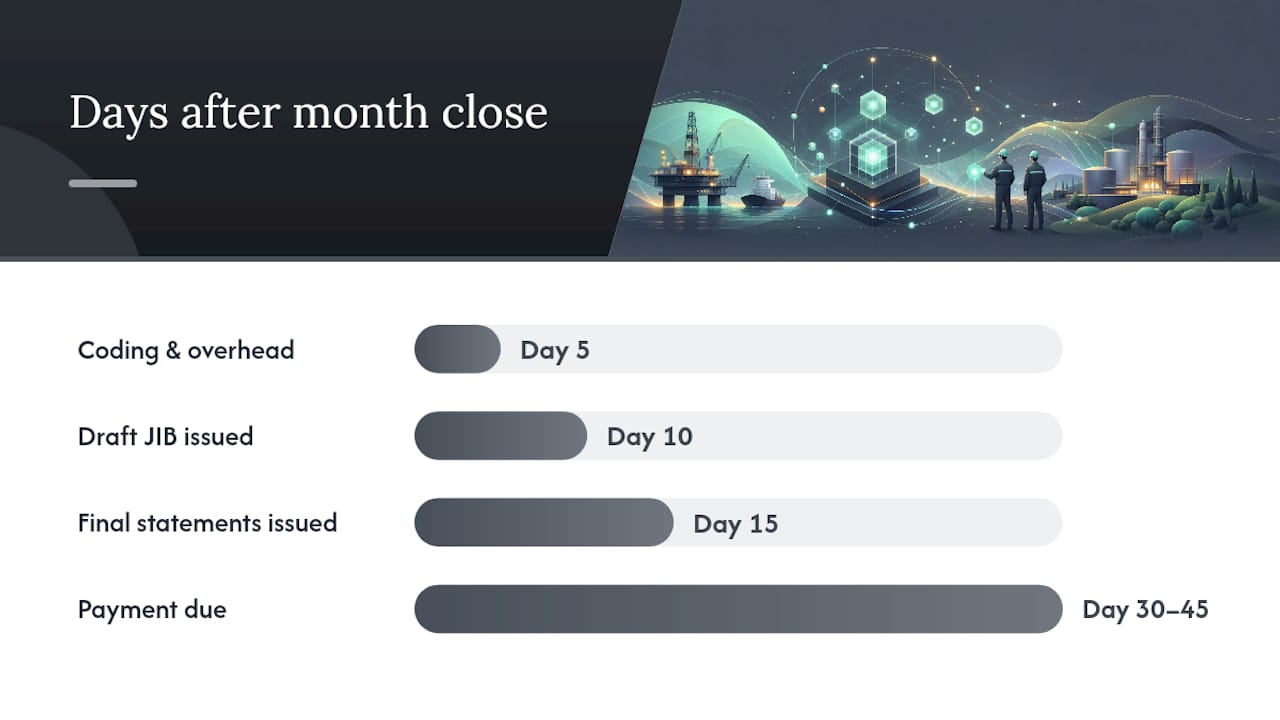
A realistic monthly timeline: close by the last business day of the month, complete coding and overhead by day 5, issue the draft JIB by day 10, send final statements by day 15, and set a payment due date of day 30–45. Operators who consistently hit day 15 for issuance report materially fewer aging exceptions than those who drift past day 25.
Before final issuance, run these reconciliation checks: confirm no items remain in suspense, verify no invoice number appears twice, confirm WI decimals on every well sum to exactly 1.000000, and tie total billed amounts back to the general ledger. Standard operator outputs should also include revenue distributions, owner statements, suspense reports, and 1099 reconciliation alongside the JIB — treating those as a package rather than separate deliverables keeps your records consistent.
Which overhead allocation method fits your JOA?
Overhead allocation is where operators most often leave recoverable dollars uncollected — either by applying the wrong method or by failing to escalate rates annually as the JOA requires.
Three methods cover most US upstream JOAs:
- Fixed per-well (COPAS fixed-rate). A flat dollar amount per well per month, differentiated by well status (drilling, producing, shut-in). The COPAS 2005 model form describes this structure, with rates that adjust by an index annually. Simple to administer, easy for partners to audit, but it can under-recover on high-cost wells.
- Percentage-of-cost. Overhead is calculated as a percentage of direct charges. It scales with activity, which benefits operators on high-spend months, but partners scrutinize it more closely because the base can be inflated.
- Production-volume allocation. Shared facility or cost-center costs are split by each well’s proportional production contribution (BOE or MCF). This method is most defensible for infrastructure costs that genuinely vary with throughput, such as compression or water disposal.
A simple example: an example of a monthly cost-covering three wells illustrates how costs can be allocated equally per well or based on production volume, affecting cost shares differently. The right choice depends on what the JOA exhibit specifies, not on which method recovers more.
Pro Tip: Track overhead per well as a monthly KPI and compare it against budget. A sudden drop in overhead recovery on a producing well usually means the well status was not updated in the billing system after a workover or status change. Catching that in month one costs nothing to fix; catching it in a partner audit costs credibility.
For allocation health, watch two metrics: monthly variance between budgeted and actual overhead recovery per well, and the overhead-per-well trend over rolling 12 months. A rising trend on a stable well count signals a rate escalation that was applied correctly. A flat trend when rates should have escalated signals a missed adjustment.
How JIB output feeds lease operating statements and per-well P&L
The JIB statement is not the end product — it is the input to the lease operating statement (LOS) and per-well P&L that operators and partners actually use to evaluate well economics. Getting the mapping right is what keeps your LOS consistent with your JIB and your production data.
A standard LOS includes production revenue, royalties, lease operating expenses (LOE), overhead, workover costs, and net income per well. JIB lines map into that structure as follows:
- Direct vendor charges (chemicals, saltwater disposal, compression) map to LOE.
- AFE-linked capital costs map to workover or capital expenditure lines, not LOE.
- Overhead charges map to the overhead line at the rate specified in the JOA exhibit.
- Production revenue and royalties come from the revenue accounting system, not the JIB, but they must reconcile to the same well identifier.
Non-operators typically request a specific package of backup documents with each LOS: the vendor invoice, the field ticket or work order, the AFE approval (for capital items), and the allocation worksheet showing how shared costs were split. Packaging those documents by well and by billing period — rather than sending a bulk file — cuts the time partners spend on review and reduces the back-and-forth that delays payment.
Reporting cadence matters. The LOS should be issued on the same schedule as the JIB, using the same cost data, so partners can reconcile the two without requesting additional information. When the LOS and JIB are generated from different data sources or at different times, discrepancies appear that neither party can explain quickly — and those discrepancies are the most common trigger for a formal audit request.
How to handle chargeability disputes and prevent them from recurring
Most JIB disputes trace back to a small set of recurring causes. Wrong WI decimals are the most common: a transposed digit in the partner’s interest percentage generates an overbilling that the non-operator catches immediately. Unsupported vendor invoices — charges with no field ticket, no work order, and no AFE reference — are the second most frequent dispute trigger. Double-billing (the same invoice posted twice under different reference numbers) and mis-applied overhead (wrong rate, wrong base, or missed escalation) round out the top four.
The COPAS Model Form Accounting Procedure is the primary chargeability reference. It defines what the operator may charge directly, what must flow through overhead, and what the non-operator’s audit rights are. When a JOA’s accounting exhibit incorporates COPAS, that exhibit language governs — and operators who ignore it or apply internal shortcuts routinely face recoverable exceptions in partner audits.
A preventive control checklist worth running every month:
- Verify WI decimals against the JOA’s ownership schedule before generating the JIB.
- Pair every direct-charge invoice with its field ticket or work order before posting.
- Run a duplicate-invoice check by vendor and invoice number before close.
- Confirm overhead rates match the current-year escalated rate from the JOA exhibit.
- Tie every capital charge to a signed, in-scope AFE before billing.
When an exception does arrive, the response workflow should be consistent:
- Log the exception with a date stamp, the partner’s name, the disputed line item, and the dollar amount.
- Respond within the window the JOA specifies (commonly 30 days for an initial response).
- Either issue a credit memo for valid disputes or provide the supporting documentation that resolves the exception.
- If the dispute cannot be resolved, escalate to the JOA’s arbitration or dispute-resolution process.
- Close the exception log entry with the resolution date and outcome.
Under most standard JOAs, non-operators have an audit window of a couple of years from the date of the JIB statement. Operators who maintain complete, organized work papers for that full period face far fewer unresolved exceptions than those who rely on reconstructed records.
Cash-call non-payment carries its own set of remedies. LegalClarity’s overview documents the standard options: interest accrual on unpaid balances, netting against the non-operator’s revenue distributions, and contractual liens per the JOA. Operators who enforce these remedies consistently — rather than letting balances age — maintain healthier cash positions and signal to partners that the billing program is managed seriously.
What software features does a JIB automation tool actually need?
Paper JIBs and spreadsheet-based billing programs fail at scale for a predictable reason: manual rekeying of invoice data, WI decimals, and overhead calculations introduces errors that compound month over month. Automation targets the three highest-error points — invoice capture, well/AFE coding, and partner statement generation.
A feature checklist for any JIB automation tool:
- Per-well and per-AFE cost coding with configurable cost-type hierarchies
- Multi-partner WI allocation engine that enforces decimal validation
- COPAS-configurable overhead module (fixed per-well, percentage-of-cost, or production-volume)
- Audit trail linking each JIB line to its source invoice and supporting document
- JIB statement export in both PDF (for partner delivery) and CSV (for partner import into their own systems)
- Approval workflows for invoice coding and statement release
- Aging and receivables management with automated follow-up triggers
- Secure partner portal or document-sharing capability for supporting documents
Integration is where most implementations stall. A JIB tool that does not connect to the general ledger creates a reconciliation burden that offsets the automation gains. The minimum integration map:
- Accounts payable: invoice data flows from AP into the JIB coding workflow without rekeying.
- General ledger / ERP: posted costs reconcile to the GL automatically; platforms like NetSuite can serve as the GL backbone with JIB data flowing in via API or file import.
- Production data: BOE or MCF volumes feed production-based allocations and LOS generation.
- Bank / payment system: cash-call receipts post against open JIB receivables without manual matching.
Pro Tip: Scope your automation pilot to a defined well set — 10 to 20 wells is a workable range — and measure three KPIs over the first 90 days: days from month close to JIB issuance, number of exceptions received per billing cycle, and percentage of cash calls collected within payment terms. Those three numbers tell you whether the tool is working before you commit to a full rollout. Also confirm that the platform’s access controls meet your security requirements: partners should see only their own well data, not the full operator ledger.
Field-to-finance data flows, including equipment downtime and facility cost chargebacks, also feed cost-center allocations in JIBs. A platform that captures equipment downtime data at the field level and routes it into the cost-center allocation engine eliminates a manual reconciliation step that most operators currently handle in spreadsheets.
How Wellsmanager supports the full JIB workflow
Wellsmanager is built specifically for upstream operators, and its feature set maps directly to the JIB lifecycle described in this guide. The platform covers:
- Per-well P&L tracking that ties every cost to a well identifier, giving operators and partners a single source of truth for LOS and JIB reconciliation.
- AFE linkage that connects capital invoices to approved AFEs and flags any invoice that exceeds the authorized amount before it is posted.
- Approval workflows for invoice coding that route each charge through field and accounting sign-off, reducing miscoding at the source.
- Audit trail with vendor invoice links, so every JIB line can be traced back to its source document without a separate document request.
- JIB exports in formats partners can import directly, cutting the manual data-entry step on the non-operator side.
- Investor distribution automation and compliance notifications that keep the broader reporting cycle on schedule alongside the JIB.
A pilot on a 15-well operated portfolio using Wellsmanager’s modules for expense tracking, AFE management, and LOS generation illustrates the operational impact: operators report fewer billing exceptions per cycle, a shorter days-to-bill timeline, and a reduction in the manual reconciliation work that typically consumes accounting staff time in the days before statement issuance. The platform’s AI-generated executive briefs also give finance managers a summary view of JIB status without requiring them to pull raw data.
For operators evaluating JIB automation, the practical next step is a hands-on demo scoped to your actual well count and JOA structure. Request access to Wellsmanager to see the per-well P&L, AFE workflow, and JIB export features against your own data.
What operators consistently get wrong about running a JIB program
The conventional wisdom on JIB accuracy focuses almost entirely on the statement itself: get the WI decimals right, attach the invoices, send it on time. That framing misses where most programs actually break down.
The real failure point is upstream of the statement. By the time an operator is generating the JIB, the errors are already baked in — wrong cost codes applied at invoice entry, overhead rates that were never escalated after the first year, AFE numbers that got reused across projects because no one set up version control. The statement is just where those errors become visible to partners.
The operators who run clean JIB programs treat the monthly close checklist as a control document, not a to-do list. Every step has an owner, a deadline, and a sign-off. The checklist does not change month to month unless the JOA or COPAS exhibit changes. That consistency is what makes the program auditable, because an auditor reviewing 18 months of work papers wants to see the same process executed the same way, not a different approach each quarter.
One practical tip worth institutionalizing: pull a random sample of five to ten JIB lines each month and trace them all the way back to the source — vendor invoice, field ticket, AFE approval, and GL posting. That 30-minute exercise catches systematic errors before they compound into a formal audit finding. It also builds the institutional knowledge your team needs to defend the billing program when a partner does request an audit.
Wellsmanager puts your JIB program on a repeatable cycle
Operators running JIBs on spreadsheets spend the last week of every month reconciling errors that a purpose-built platform catches automatically. Wellsmanager gives you per-well P&L, AFE-linked invoice approval, audit-ready work papers, and JIB exports — all in one place, without the manual rekeying that drives exceptions.
The platform is built for independent upstream operators who need a complete operations and accounting system, not a generic ERP that requires months of configuration to handle well-level cost allocation. Operators who implement Wellsmanager’s expense tracking and JIB workflow modules report fewer exceptions per billing cycle and a faster collection timeline — because the data is clean before the statement is generated, not after.
Schedule a demo at Wellsmanager and see the per-well P&L, AFE workflow, and JIB export features running against a real well portfolio. The demo is scoped to your operation — bring your well count and JOA structure and the team will show you exactly where the platform fits.
Sources
The following references were used in preparing this guide and are worth bookmarking for ongoing JIB program management:
- Joint Interest Billing in Petroleum Accounting | COPAS
- Joint Interest Billing: How JIB Works in Oil and Gas - LegalClarity
- Joint Interest Billing (JIB) & Revenue Accounting | Oil & Gas | Valor
This article is general information, not a substitute for advice from a qualified financial advisor. Consult a qualified financial professional about your own circumstances before acting on anything here.