What Is a Lease Operating Statement and Why It Matters

A lease operating statement (LOS) is a monthly asset-level report that ties together production volumes, gross revenue, and operating expenses for a specific well, lease, or field. It is the primary document accountants, engineers, operators, and investors check to answer one question: is this asset making money right now, and if not, where did it go wrong?
Unlike a company-wide profit and loss statement, an LOS stays scoped to the property. It strips out corporate overhead, interest, and taxes that live on the P&L and focuses only on what that lease earned and spent that month.
The LOS matters because it surfaces exceptions fast:
- A spike in water disposal costs on a single well
- A royalty calculation that doesn’t match the division order
- LOE per BOE creeping upward month over month before it becomes a budget crisis
Key Takeaways
Accurate lease operating statements depend on matching production data to accounting entries every month and separating fixed from variable LOE for meaningful trend analysis.
| Point | Details |
|---|---|
| LOS is asset-level, not corporate | It excludes corporate G&A, interest, and taxes to isolate a lease’s real profitability. |
| LOE per BOE is the benchmark | Typical LOE runs $5 to $15 per BOE depending on basin and well age. |
| Timing gaps cause most errors | Match invoice dates and production run dates carefully to avoid misstated months. |
| Automation catches anomalies early | Connecting field and accounting data flags cost spikes before the statement publishes. |
| Wellsmanager streamlines field-to-finance | Its mobile Field Log and per-well P&L reduce manual reconciliation and speed investor distributions. |
Table of Contents
- The Core Components Of A Lease Operating Statement
- How Do You Produce An Accurate LOS Each Month?
- Using LOS Data For LOE Budgeting And Variance Analysis
- What Automation Adds To LOS Reporting
- A Sample LOS Layout And Worked Example
- What I Prioritize When Designing An LOS
- Get Faster, More Accurate LOS Reports With Wellsmanager
- Sources
- FAQ
The Core Components Of A Lease Operating Statement
Every LOS starts with production volumes and the realized price per barrel or Mcf. Multiply the two and you get gross revenue, the top line everything else gets measured against. From there, the statement subtracts royalties and production taxes, sometimes shown net of revenue and sometimes broken out as separate line items depending on the operator’s reporting preference.
Lease operating expenses (LOE) make up the bulk of the deductions, and they deserve their own breakdown rather than a single lump figure:
- Labor and supervision
- Repairs and maintenance
- Electricity and fuel
- Chemicals and treating costs
- Water disposal and hauling
- Workover expense (when it doesn’t get capitalized)
Gathering, processing, and transport (GP&T) usually sits below LOE as its own category, since it’s tied to moving product rather than running the well. Field-level general and administrative expense shows up too, but it excludes anything corporate, a distinction industry practice draws intentionally so the LOS reflects the lease’s actual economics rather than the parent company’s overhead allocation.
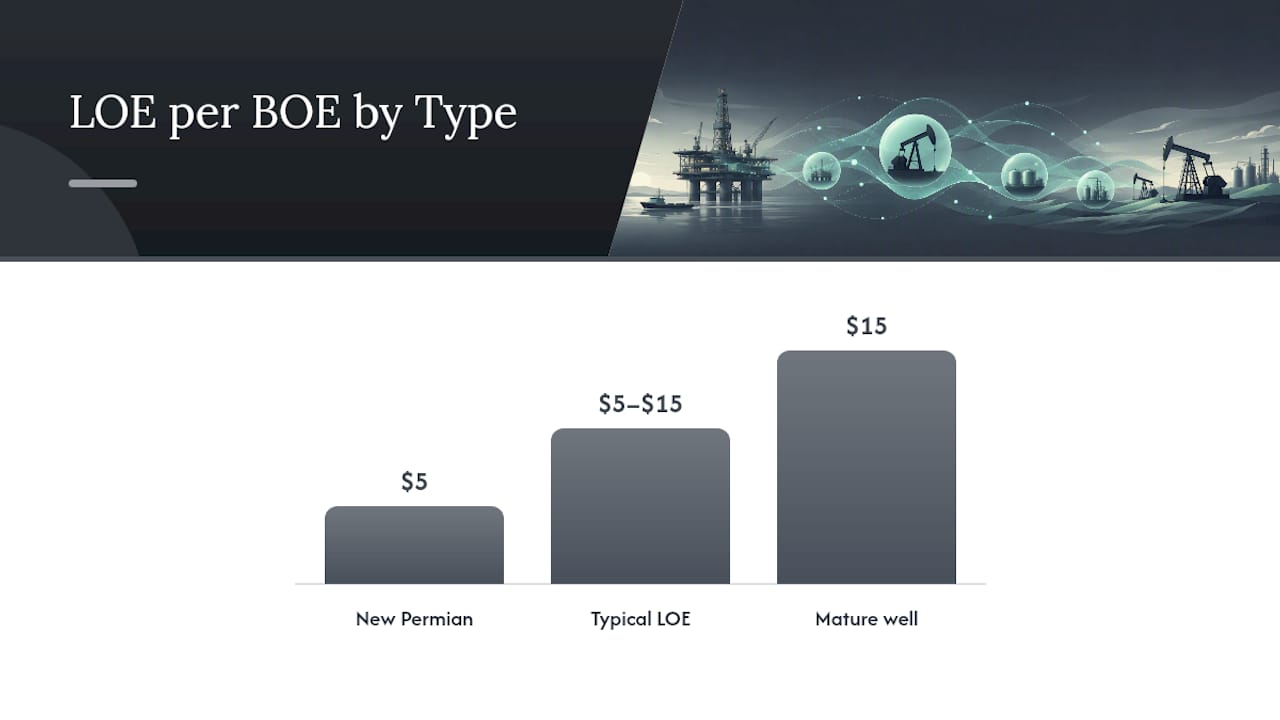
LOE typically runs $5 to $15 per BOE, though the range shifts significantly by basin and well age. A new Permian well often starts near the low end and climbs as artificial lift and water handling costs increase with age. That per-BOE figure, not the raw dollar total, is what lets you compare a stripper well to a new completion on equal footing.
How Do You Produce An Accurate LOS Each Month?
Building a reliable LOS starts with five inputs: vendor invoices, production run tickets, purchaser statements, division orders, and the realized price for the period. Miss one and the statement either won’t balance or will quietly misstate a well’s profitability.
The monthly workflow generally runs in this order:
- Collect invoices, run tickets, and purchaser statements as they arrive.
- Map each transaction to the correct well, lease, or cost center using a consistent chart of accounts.
- Match production volumes to purchaser-reported sales, since the two rarely land on identical dates.
- Allocate shared invoices (a pad-level workover crew, a shared saltwater disposal contract) across the wells that benefited.
- Investigate exceptions: negative LOE, missing volumes, or costs booked to the wrong well.
- Publish and distribute the finished LOS to accounting, operations, and investors.
Timing gaps cause most of the headaches. A workover invoice dated in March for work finished in February needs to land in the February statement, not wherever the invoice happened to arrive. Mid-month production shipments create a similar mismatch: a purchaser might report sales on the 28th for oil that sat in a tank since the 22nd. JIB accountants who review invoices at the well, field, and district level catch most of these inconsistencies before they reach the final report, but that review takes real hours every month without some form of automated matching.
Pro Tip: Build your LOS template with a fixed row order (production, revenue, royalties, LOE by subcategory, GP&T, field G&A, netback) and never let a well skip a row just because the cost was zero. A blank row is easy to spot as an error; a missing row hides one.
Using LOS Data For LOE Budgeting And Variance Analysis
LOE splits into fixed costs (pumper salaries, base electricity load) and variable costs that move with production or well condition (chemical treating volume, water hauling frequency, repair frequency). Budgeting starts by separating the two, then building per-well forecasts off the engineering production curve rather than a flat average.
Once you have actuals, the real work is variance analysis. Three categories explain almost every LOE surprise:
- Volume variance, when actual barrels differ from forecast and change the per-unit cost base
- Price variance, when a vendor rate or chemical cost shifts month to month
- Maintenance variance, when an unplanned repair or workover blows past the budgeted line
LOE per BOE is the number that ties this together. A well running $9 per BOE that jumps to $14 the next month didn’t necessarily get more expensive to operate; it might have simply produced less oil against the same fixed cost base. Trending LOE per BOE over several months separates a genuine cost problem from a production decline problem, and that distinction determines whether the fix is a workover or a price renegotiation.
These variance patterns feed directly into next year’s budget and into what investors see in their distribution reports. A lease that consistently overshoots its LOE forecast needs either a revised budget or an operational fix, and the LOS is the only document granular enough to show which.
What Automation Adds To LOS Reporting
Manually reconciling production and accounting data every month is where most LOS errors originate, not in the formulas themselves. Automated platforms that connect field data directly to accounting systems close that gap by:
- Cutting month-close time from days to hours
- Letting accountants drill down from a summary line to the source invoice
- Flagging cost anomalies (a water hauling bill triple the trailing average) before the statement publishes
- Keeping templates consistent across dozens or hundreds of wells instead of rebuilding spreadsheets each month
Research on AI-augmented LOS platforms shows that connecting production telemetry with expense data can detect anomalies earlier and materially improve budget planning compared to manual, spreadsheet-driven processes. That shift moves LOS reporting from a rearview mirror to something closer to a dashboard.
Wellsmanager builds toward exactly this workflow. Its mobile Field Log captures maintenance costs at the well site in real time, so a repair invoice doesn’t wait three weeks to surface in the statement. Its AI connector lets accountants ask plain questions about a well’s cost history, and its per-well P&L and investor distribution automation carry the LOS output straight into the reports investors actually see.

Pro Tip: Before automating, confirm your chart of accounts maps cleanly to well-level cost centers and that field staff have permission to log costs against the correct lease. Automation amplifies a clean data structure; it also amplifies a messy one.
A Sample LOS Layout And Worked Example
A minimal LOS reads top to bottom in this order: production volume, realized price, gross revenue, royalties and production taxes, LOE by subcategory, GP&T, field G&A, and operating netback.
Here’s a simplified single-well example for one month:
LOE per BOE here comes to $9.50, squarely in the typical range for a mature well. For pooled or pad-level reporting, the same layout works. Just sum production and expenses across wells before calculating the per-BOE figures, and keep a separate tab for each individual well if investors expect that granularity.
What I Prioritize When Designing An LOS
The single biggest failure point in any LOS isn’t a formula error. It’s two departments working from two different versions of the truth, one dataset in the field log, another in the accounting system, neither reconciled until month end forces the issue.
Get operations and accounting on the same well-naming convention and the same monthly cutoff date, and half your exceptions disappear before they start.
Get Faster, More Accurate LOS Reports With Wellsmanager
Spreadsheet-built LOS reports mean someone is manually re-entering invoice data that already exists somewhere else in your systems. Wellsmanager closes that gap by connecting field cost capture directly to per-well P&L and investor distribution, so the numbers only get entered once.
The mobile Field Log lets pumpers and operators log maintenance costs the moment work happens, not three weeks later when the invoice finally arrives. The AI connector lets your accounting team ask direct questions about well history instead of digging through old statements. Investors get distributions built straight from reconciled LOS data instead of a delayed summary.
If your month-close still runs on spreadsheets and email chains, request access to Wellsmanager and see what a field-to-finance workflow looks like on your own wells.
Sources
- Lease Operating Statement Definition | Law Insider
- Automated Lease Operating Statements for Cost Optimization and Reserve Evaluation Using Artificial Intelligence
- Reading E&P Financial Statements | Energy IB Guide
FAQ
Can You Give An Example Of An Operating Lease?
In oil and gas, the LOS itself is the reporting document for a producing lease. A single well producing 1,000 BOE at a $65 realized price with $9,500 in LOE, shown earlier in this article, is a working example of how that report reads.
How Do You Record An Operating Lease In Accounting?
Production revenue and operating expenses get booked against the specific lease or well cost center, with royalties and production taxes deducted separately from LOE so each category stays visible for analysis.
What Does An Operating Lease Mean In Oil And Gas Accounting?
It refers to the leasehold interest in a producing property, where the LOS aggregates all production, revenue, and expense activity tied to that specific interest each month.
How Does GAAP Treat Operating Leases?
GAAP treatment of leases generally concerns the balance sheet recognition of lease rights and obligations, which is separate from the LOS itself. The LOS is an operational and financial reporting tool used alongside, not as a substitute for, GAAP-compliant financial statements.
What’s The Difference Between An LOS And A P&L?
An LOS stays scoped to a single lease or well and excludes corporate items, while a P&L rolls up the entire company including overhead, interest, and taxes that the LOS intentionally leaves out.