Get an Answer in Days: Owner Relations for Oil and Gas Royalty Owners

Owner Relations is your operator’s official contact point for royalty and ownership issues, and the fastest way through it is a single, complete routing packet: your owner number, lease or well API, and the exact payment line in question. Send that in one message instead of a vague inquiry, and most operators can route and acknowledge it within days. If you don’t hear back on a reasonable timeline, escalate using the steps later in this article.
TL;DR:
- Most operator responses are faster when owners provide a complete routing packet with owner number, lease or well API, and payment line details to avoid delays.
- Address and ownership change requests require specific documents such as recorded deeds, trust instruments, or probate papers, and incomplete submissions cause processing delays.
- Payment issues often stem from sales versus payment month confusion, minimum thresholds, deductions, or bank setup errors, and checking production records beforehand can clarify missing payments.
- Queries about decimals or title disputes should include supporting evidence and expect resolution times of weeks, as these often need detailed reviews and title checks.
- Using modern systems like WellsManager, which integrate production and payment data in real time, significantly speeds up owner responses compared to outdated or disconnected systems.
Table of Contents
- Owner Relations Oil and Gas Contacts: Phone, Email, Mail, and Portals
- What Does Owner Relations Handle? Payments, Address Changes, and 1099s
- Why Your Royalty Check Was Late (and How to Fix It)
- Transferring Ownership: Documents You Need for Sales, Trusts, and Estates
- What Is a Division Order and How Do Decimals Work?
- How to Get Your Operator to Actually Answer You
- How to Update Payment Preferences or Bank Details
- Security and Privacy in Owner Relations Communications
- How to Access Your Production Statements and Explanations
- What Actually Fixes Owner-Relations Delays
- Why Operators on WellsManager Answer Owners Faster
- Where to Go for Tax, Escheat, and Direct Operator Help
- Sources
- FAQ
Owner Relations Oil and Gas Contacts: Phone, Email, Mail, and Portals
Your check stub, division order, or the operator’s website usually lists a direct phone line and email for Owner Relations. Larger operators split the function into separate desks for revenue, land and division orders, and joint interest billing, so the front-line triage unit that answers your first call will often forward you internally rather than solve everything on the spot.
Pick your channel based on what you need documented:
- Phone: fastest for simple status checks, like confirming a check was mailed.
- Email: best default for anything with attachments or a paper trail you want preserved.
- Certified mail: use for legal notices, formal disputes, or any statutory demand where you need proof of delivery.
- Online portal: increasingly common for address updates, direct deposit enrollment, and pulling old statements yourself.
A reasonable acknowledgment standard to expect is a timely response confirming your inquiry was received and routed, even if the actual resolution takes longer. After that first contact, most operators open an internal ticket. Ask for a reference number so you can follow up without repeating your entire story.
What Does Owner Relations Handle? Payments, Address Changes, and 1099s
Owner Relations resolves the routine account issues that make up most owner inquiries, but each one requires specific facts to move quickly.
- Payment questions: give the check date, payment number, sales month, and the specific line item you’re asking about. A generic “I didn’t get paid” message forces the rep to guess what you mean.
- Address or ownership changes: the paperwork depends on the scenario. A sale needs a recorded deed. A trust needs the trust instrument. A death needs probate documents (covered in detail below).
- Lost or stale checks: report these promptly. Checks that go too long unclaimed can eventually be reported to state unclaimed property programs, so don’t let an old check sit in a drawer.
- 1099 corrections: your 1099 comes from the operator’s revenue accounting system based on payments made in the calendar year, not sales month. If the amount looks wrong, ask for a payment detail report to compare against your own records before assuming an error. The IRS publishes the forms and instructions you’ll need to cross-check reporting.
Why Your Royalty Check Was Late (and How to Fix It)
Owners often confuse the sales month, the month oil or gas actually sold, with the payment date, when the check or deposit arrives. Operators typically pay a couple of months behind the sales month to allow time for volume reporting and accounting, so a check dated in March usually covers January production. That lag alone explains a lot of “missing payment” calls that aren’t actually missing anything.
Pro Tip: Before calling Owner Relations, check your state oil and gas commission’s production records for your well. If production wasn’t reported for that sales month, the well may be shut in or the report may simply be delayed, and no payment is coming yet.
Other common causes of a delayed or missing check:
- Minimum pay threshold: many operators hold small balances until they accumulate to a set minimum payment threshold before cutting a check.
- Suspense: funds get held when there’s a title question, a missing W9, or unresolved ownership documentation.
- Deductions: post-production costs, taxes, or marketing fees can shrink a check without anything being “wrong.”
- Direct deposit setup errors: a bounced or misrouted deposit can look like a missed payment when it’s really a bank detail mismatch.
Direct deposit enrollment usually happens through the owner portal or a form mailed with your division order packet. After enrolling, verify your first deposit against your statement rather than assuming it went through correctly. Operators that publish clear acknowledgment standards and log every inquiry tend to generate fewer escalations, largely because owners get a documented answer instead of a guessing game.
1099s typically go out by the end of January for the prior calendar year, following IRS guidelines. If yours looks wrong, request a corrected form in writing and include the payment detail report so accounting can identify exactly where the discrepancy sits.
Transferring Ownership: Documents You Need for Sales, Trusts, and Estates
Ownership changes fail to process fast almost always for the same reason: incomplete documentation. Each scenario has its own required paperwork, and operators can’t act on a request they consider legally incomplete.
- Sale: a recorded deed or assignment, filed with the county where the property sits.
- Gift: a recorded deed showing the transfer, plus a completed W9 for the new owner.
- Divorce: a certified copy of the divorce decree, plus a deed if the settlement reassigns interest.
- Trust administration: the trust instrument or a certificate of trust, showing the trustee’s authority to act.
- Probate or estate: a death certificate, letters testamentary or letters of administration, and often an affidavit of heirship if there’s no will.
Legal names and effective dates matter more than owners expect. A middle initial that doesn’t match county records, or a transfer dated after a payment was already issued, can bounce the whole request back to you for correction. Double-check both before submitting anything.
Pro Tip: Send transfer documents by certified mail and keep copies of everything, including the mailing receipt. If the packet gets lost or a rep claims they never received it, you’ll have proof it was sent and when.
Understanding what you actually hold matters here too. A mineral interest owner holds the full bundle of subsurface rights and can lease, negotiate, and collect bonuses and rentals. A royalty interest owner holds a narrower, cost-free right to a percentage of production revenue, with no say in leasing decisions. Knowing which one you have changes what documentation actually applies to your transfer.
What Is a Division Order and How Do Decimals Work?
A division order is the document that confirms your ownership percentage, called your decimal interest, and authorizes the operator to pay you accordingly. Signing one is an acknowledgment of the stated interest, not a sale of your minerals or a waiver of your right to dispute the number later.
Your owner decimal appears on both the division order and your check stub, usually expressed as a long fraction like 0.00123456. That number, multiplied by total well revenue, produces your check. A small-looking decimal error compounds over months of production, so it’s worth verifying against your lease’s stated royalty fraction.
To request a copy or dispute a decimal:
- Call or email Owner Relations and ask specifically for a “division order copy” and the decimal calculation backup.
- If the decimal looks wrong, request a formal decimal review and state your expected fraction based on your lease.
- Include supporting evidence: the recorded lease, a prior division order showing a different number, or a title opinion if you have one.
- Expect resolution to take weeks rather than days, since decimal reviews often require a title check.
How to Get Your Operator to Actually Answer You
Most unanswered owner inquiries fail for one of four reasons, and a repeatable diagnosis finds which one applies before you pick up the phone:
- Identity: does the operator have your current legal name, address, and owner number on file?
- Status: is the well producing, shut in, or newly connected?
- Calculation: does your decimal match your lease’s stated fraction?
- Authority: does the operator have the legal document, deed, probate letters, trust certificate, needed to act on your request?
Build a routing packet with your owner number, lease or well API, the specific payment line, your legal name, your relationship to the account, and scanned copies of any supporting documents. Send it once, completely, rather than in three follow-up emails.
Pro Tip: If certified mail doesn’t get a response within your state’s statutory notice period, that silence itself becomes leverage for a formal complaint or legal escalation.
Operators running on a single source-of-truth system, the kind WellsManager provides, resolve these lookups faster because owner numbers, decimals, and payment history live in one place instead of scattered spreadsheets.
How to Update Payment Preferences or Bank Details
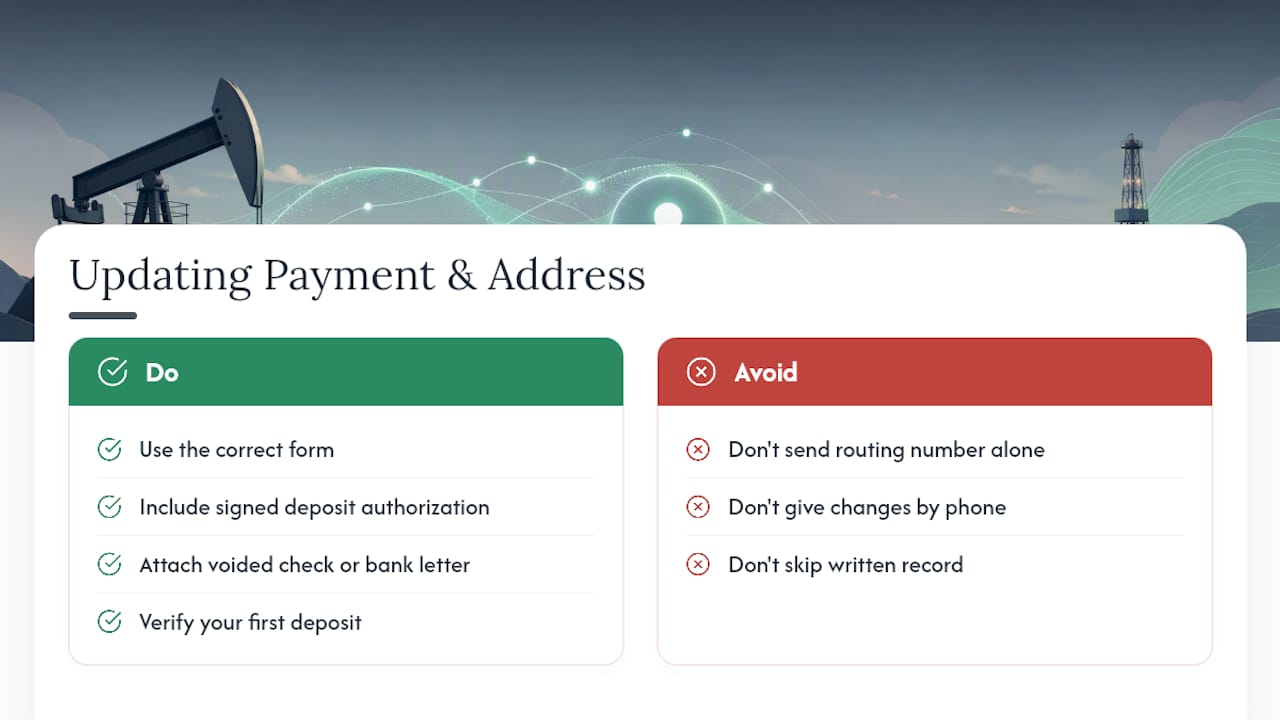
Changing your direct deposit account or mailing address is usually the simplest request you’ll ever send Owner Relations, provided you use the right form. Most operators require a signed direct deposit authorization form, sometimes notarized, along with a voided check or a bank letter confirming the account number and routing number. Submitting a routing number without the voided check backup is one of the most common reasons these requests bounce.
If your operator offers an owner portal, updating bank details there is typically faster than mailing a form, since the change routes directly into the payment system without a data-entry step on the operator’s end. Still verify your first deposit after any bank change. A single transposed digit in an account number can send a payment into suspense rather than bouncing back immediately, which delays your next check without you knowing why.
For address changes tied to a move rather than an ownership transfer, a simple written request with your owner number is usually sufficient, no notarization needed. But if the address change accompanies an ownership change (a sale, a trust transfer, a new heir), it needs the same supporting documentation covered in the ownership section above. Don’t submit a bank or address change verbally over the phone if you can avoid it. Get it in writing, even if that writing is just an email, so there’s a record of exactly what you requested and when.
Security and Privacy in Owner Relations Communications
You’re sending sensitive information, Social Security numbers, bank account details, legal documents, through a channel that needs to protect it. Before emailing anything with a Social Security number or bank routing number attached, confirm you’re using the operator’s official domain and, where offered, an encrypted portal upload rather than a plain email attachment.
Phishing attempts targeting mineral owners have grown more common as ownership records become easier to find through county deed searches. A legitimate Owner Relations rep will never ask you to confirm your full bank account number over an unsolicited phone call. If you receive a call or email that feels off, hang up and call the number listed on your official check stub or division order instead of any number the caller provides.
Keep copies of everything you send, but store them somewhere secure, not a shared inbox or an unlocked drawer. If you’re transferring ownership through a trust or estate, redact Social Security numbers on document copies you don’t strictly need to share, and ask the operator what identity verification they require before releasing account details over the phone. That verification step protects you as much as it protects the operator from paying the wrong person.
How to Access Your Production Statements and Explanations
Your monthly or quarterly owner statement should show, at minimum, the well or lease name, the sales month, gross volume, your decimal interest, price received, deductions, and net payment. If your statement doesn’t break out deductions clearly, that’s worth flagging. You’re entitled to understand what’s being subtracted from gross revenue before it reaches your check.
Most operators now post statements through an owner portal where you can pull historical records going back several years, which beats waiting on mailed paper copies if you need to reconcile several months at once. If you can’t find a portal or your login isn’t working, Owner Relations can typically send a duplicate statement, though older records sometimes take longer to retrieve from archived systems.
If your statement doesn’t make sense, don’t guess. Call and ask specifically what a line item represents. Terms like “adjustment,” “prior period,” or “regulatory deduction” mean different things at different companies, and a two-minute phone call clears up confusion that would otherwise take three rounds of emails to resolve.
What Actually Fixes Owner-Relations Delays
Most of the owner complaints I’ve seen boil down to one thing: a vague request meeting an overloaded desk. Send “I think my check is wrong” and you get a form-letter response weeks later. Send your owner number, the sales month, and the exact decimal you expected, and you get a real answer, often within days.
That’s not a knock on the people answering phones. Most Owner Relations reps handle hundreds of accounts with incomplete records inherited from mergers, transfers, and decades-old leases. Your documentation is doing half their job for them.
For anything involving probate, a contested decimal, or a multi-state trust, hire a landman or an oil and gas attorney rather than fighting it alone. DIY works fine for address changes and payment questions. It rarely works for title disputes.
— Pedro
Why Operators on WellsManager Answer Owners Faster
The operators who respond fastest to owner inquiries usually aren’t answering faster by working harder. They’re working from better systems. WellsManager gives independent operators a single source of truth for field logs, lease operating statements, and investor distributions, so when Owner Relations pulls up your account, your decimal, your payment history, and your production data all live in one record instead of three disconnected spreadsheets.

That matters directly to you as an owner. A mobile Field Log means production and cost data reaches the office in real time instead of weeks later, which cuts down on the “we’re still waiting on field data” delays that stall payment questions. An AI connector lets staff query your account history in plain language instead of digging through old files, and automated distribution workflows reduce the manual errors that cause suspense in the first place.
If you’re an owner dealing with an operator on outdated systems, you can’t fix that directly, but you can ask whether they’re modernizing. Operators curious about what that looks like can see the WellsManager platform or request access to evaluate it for their own owner base.
Where to Go for Tax, Escheat, and Direct Operator Help
For 1099 corrections, start with IRS forms and instructions, and pair that with FieldVest’s guide to oil sector tax forms for context specific to royalty income. If a check went unclaimed, search your state’s listing through the National Association of Unclaimed Property Administrators before assuming it’s gone. NARO and the Mineral Rights Podcast remain solid ongoing resources for owner-specific questions beyond what any single operator’s Owner Relations desk can answer.
Sources
- Mineral interest vs royalty interest — Lovell Law
- Owner relations oil & gas — ZipRecruiter explanation
- IRS forms and instructions
- MRP 343: How to get your operator to actually answer you — Mineral Rights Podcast
FAQ
What does owner relations mean in oil and gas?
Owner Relations is the department that handles royalty and working-interest owner inquiries: payment questions, ownership changes, tax documentation, and address updates, routing complex issues to land, revenue, or legal teams as needed.
How do I contact an operator’s owner relations department?
Check your check stub or division order for a direct phone number and email, or search the operator’s website for an “owner relations” or “investor relations” contact page; most operators also offer an online portal for routine requests.
What is a royalty owner in oil and gas?
A royalty owner holds a cost-free right to a percentage of production revenue without bearing drilling or operating expenses, distinct from a mineral owner who holds the full bundle of rights, including the ability to lease.
What is the average royalty paid for oil and gas production?
Royalty rates vary by lease and negotiation, commonly falling within a typical range depending on lease terms and market factors, so your specific rate depends entirely on what’s written in your lease agreement.
How long does it take to get a response from owner relations?
A reasonable standard is acknowledgment within 48 hours of contact, though full resolution of complex issues like decimal disputes or probate transfers can take several weeks depending on documentation.