Audit Ready Investor Distribution Statements for Permian Operators

Every investor distribution statement needs to answer one question without a follow-up call: how much am I getting paid, and why that number? That means naming the pay period and record date, showing gross production revenue next to itemized deductions for LOE, taxes, and royalties, disclosing any reserves held back, and landing on net distributable cash multiplied by each partner’s exact decimal, with a reference to the documents that back it up.
TL;DR:
- Precise record-keeping of sales, deductions, reserves, and partner interests ensures quick, accurate audits and minimizes disputes.
- Proper documentation of reserves and holdbacks before calculation helps maintain trust and avoids last-minute errors.
- Using integrated systems like WellsManager reduces manual reconciliation and streamlines the workflow from field tickets to investor checks.
- Distribution statements should clearly show gross revenue, itemized deductions, reserves, net cash, and partner-specific amounts with exact dollar and decimal details.
- Operators should retain source documents and reconciliation records for several years, with file naming that facilitates rapid access during audits.
Table of Contents
- What Line Items Go Into an Investor Distribution Statement?
- How Do You Prepare the Inputs Before Running Numbers?
- How Do You Calculate and Present Distributions?
- How Do You Keep Distribution Statements Audit Ready?
- Where Does WellsManager Fit Into This Workflow?
- An Operator’s Take on Getting This Right
- Get Templates and Automation for Investor Checks
- Sources
- FAQ
What Line Items Go Into an Investor Distribution Statement?
Investors and auditors read a distribution statement looking for the same handful of lines. Skip one, and you get a phone call instead of a signed-off partner. Here’s what belongs on the page.
- Gross production revenue. State the volumes sold, the price realized, and the measurement basis (meter run, LACT unit ticket, or purchaser statement) for the exact period covered. If two purchasers paid for the same lease in one month, show both.
- Deductions, itemized separately. Lease operating expenses, severance and other state production taxes, third-party fees (gathering, compression, marketing), and any royalty adjustments each get their own line, and each one should trace back to a specific invoice or settlement statement. State severance tax rules vary widely, so check the state-by-state severance guide before you finalize the deduction.
- Reserves or holdbacks. Show the dollar amount held, the reason (plugging liability, a pending JIB dispute, an AFE overrun), who approved it, and when the partnership expects to release it.
- Net distributable cash. This is gross revenue minus every deduction and reserve above, and it should reconcile to a single number that appears nowhere else on the statement without explanation. The SandRidge Permian Trust exemplifies this approach: distributable income is defined plainly as revenue less expenses and liabilities, adjusted for reserve changes.
- Partner allocation. List each partner’s working interest decimal, the resulting dollar amount, your rounding method, and where retained fractions of a cent go (usually rolled into the next period).
- Tax treatment note. A short line clarifying that cash paid this period may not match what shows up on that partner’s Schedule K-1, since depletion and other tax items get calculated separately.
How Do You Prepare the Inputs Before Running Numbers?
Distribution day goes smoothly only when the inputs are already sitting in one place. Chasing a purchaser statement on the same day you’re supposed to cut checks is how errors creep in.
- Pull sales remittances and settlement advices for the exact period, matched against your division order file.
- Export well cost book entries that feed LOE and other operating deductions for that period, well by well.
- Gather JIB and invoice backup, plus division-order confirmations, to double-check every partner decimal before you multiply anything.
- Compute severance and state deductions, flagging any royalty overrides that changed mid-period.
- Decide on reserves or holdbacks with a documented approval, noting how the amount will be accounted for and when it’s expected back.
- Set the record date and confirm payee mailing or ACH details are current, so a check doesn’t bounce back three weeks later.
Pro Tip: Build your reserve decision before you touch the calculation, not during it. A holdback added at the last minute, with no paper trail, is the single fastest way to turn a routine statement into an uncomfortable partner conversation.
How Do You Calculate and Present Distributions?
The math itself isn’t complicated. Getting it in the right order, and showing your work, is what makes a statement defensible.
- Start with gross receipts for the period.
- Subtract itemized deductions (LOE, severance and other taxes, fees, royalty adjustments).
- Apply any reserve or holdback adjustment.
- The result is net distributable cash.
- Multiply that figure by each partner’s decimal interest.
- Apply your rounding rule and reconcile the sum of all partner payments back to the net distributable total.
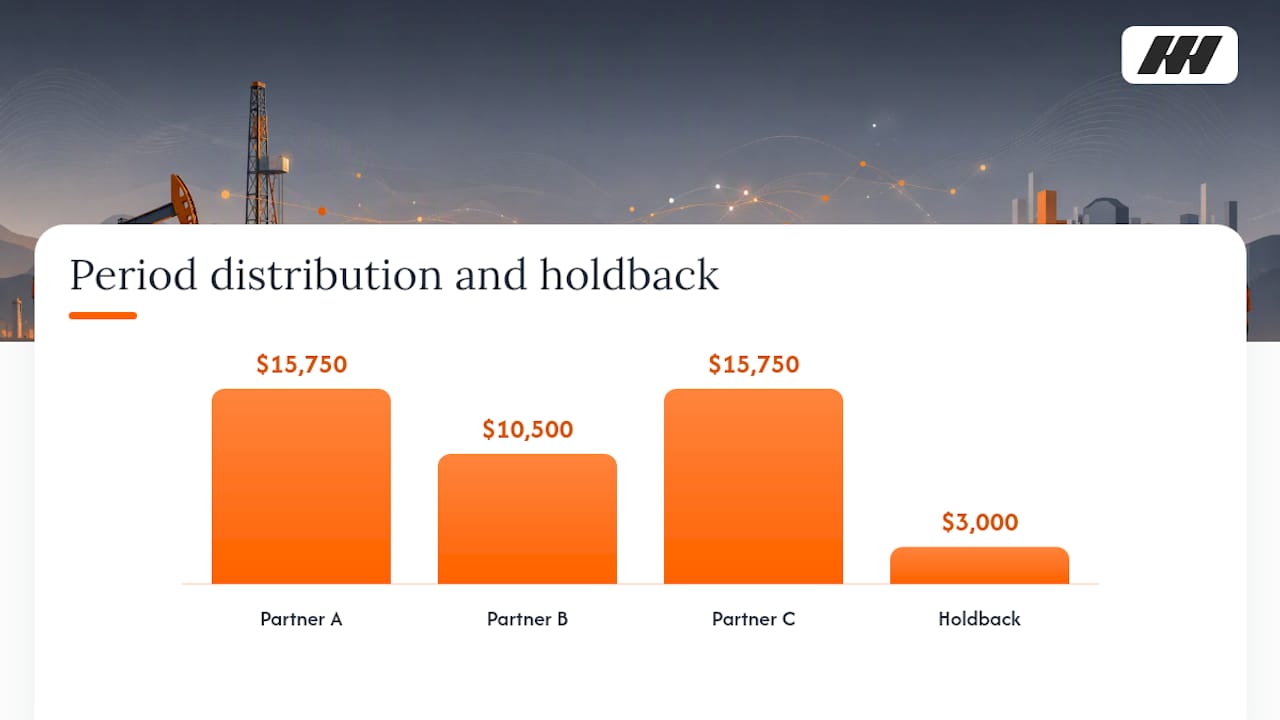
A quick example. Say a well group nets $42,000 in distributable cash for the month after deductions and a $3,000 holdback for a pending workover. Partner A holds a 0.375000 decimal, Partner B holds 0.250000, and Partner C holds 0.375000. Partner A gets $15,750, Partner B gets $10,500, Partner C gets $15,750. That totals exactly $42,000, no rounding residue, because the decimals happened to divide cleanly. When they don’t, note the fractional cent retained and where it rolls forward on the statement.
One line item does double duty here: the reserve amount affects the cash a partner receives this period, but it has no bearing on that partner’s K-1. The K-1 reflects gross income and deductions allocated under the partnership agreement, not the timing of when cash actually lands.
How Do You Keep Distribution Statements Audit Ready?
An auditor, or a partner’s accountant, should be able to trace every number on a statement back to a source document in minutes, not days.
- Retain and index sales advices, settlement PDFs, vendor invoices, JIB backup, field tickets, division orders, and any approval emails tied to reserve decisions.
- Build one reconciliation schedule that links net distributable cash to its supporting files by name and date, so nobody has to reconstruct the trail from memory.
- Timestamp every statement, record who approved it, and keep version history if a number gets corrected after issuance.
A reconciliation schedule that names its supporting files directly is the fastest way to close out an audit question before it becomes a dispute. As a general rule, keep period-of-production source documents and reconciliations for several years, and confirm the exact window with your tax counsel since retention needs vary by entity structure.
Pro Tip: Name your files the way you’d want to find them in a hurry: well name, period, document type. “Reeves_23_Apr2026_JIB.pdf” beats “Scan0047.pdf” every time an auditor asks a question.
Where Does WellsManager Fit Into This Workflow?
Most of the manual work in a distribution statement isn’t the math, it’s chasing down the paper. WellsManager stores field tickets, well cost book entries, and investor checks with the lease operating statement in one system so the numbers feeding your distribution are already reconciled by the time you run it.
- Field tickets logged during the month roll straight into the well cost book, so LOE deductions don’t require a separate spreadsheet pull.
- Division-order decimals and joint-interest billing data remain linked to the well, helping to catch mismatched decimals before issuing partner checks.
- Investor checks and the lease operating statement generate from the same underlying records, cutting the manual reconciliation that eats a bookkeeper’s week.
Operational examples and templates for division orders and JIB workflows are covered on the WellsManager blog, if you want to see how the pieces fit before setting up your own.
An Operator’s Take on Getting This Right
Three rules hold up regardless of well count. First, every line on a statement should trace to exactly one file, not a memory or a verbal agreement. Second, decide reserves ahead of time and write down why, because a surprise holdback erodes trust faster than a slow check. Third, tell partners when to expect payment and who to call with questions, before they have to ask.
— Pedro
Get Templates and Automation for Investor Checks
Building distribution statements by hand in a spreadsheet works fine until you’re managing a dozen wells and three sets of partners with different decimals. WellsManager was built for exactly the workflow described above: field tickets feed the well cost book, costs attach to the specific well that incurred them, and investor checks plus the lease operating statement generate to the same standard, gross revenue, itemized deductions, reserves, and partner decimals, without a spreadsheet rebuild every month. If you’re tired of the month-end scramble to get partners paid on time, visit the WellsManager product page to see how the field-ticket-to-investor-check pipeline works and request a demo.
Sources
FAQ
What Must an Investor Distribution Statement Show?
At minimum, the pay period and record date, gross production revenue, itemized deductions, any reserves held back, net distributable cash, and each partner’s decimal interest with the exact dollar amount owed.
How Often Should Operators Issue Distribution Statements?
Most independent operators distribute monthly, though some partnerships and trusts use a less frequent schedule; whichever cadence you pick, state the record date clearly so partners know when their interest was measured.
Does a Distribution Statement Match a Partner’s K-1?
Not necessarily. Cash distributed this period reflects reserves and timing decisions, while the Schedule K-1 reports gross income and deductions the partner uses to compute depletion, which can produce a different taxable figure than the cash received.
What Causes Most Errors in Investor Distribution Statements?
Rounding mismatches on partner decimals, deductions applied without a source document, and reserves added at the last minute without documented approval account for most disputes operators see.
How Long Should Operators Keep Distribution Records?
Retain source documents and reconciliation schedules for several years at minimum, and confirm the exact retention period with your tax counsel since requirements can vary by entity structure and state.