Storing 1,320 Gallons? SPCC for Permian Oil and Gas Operators
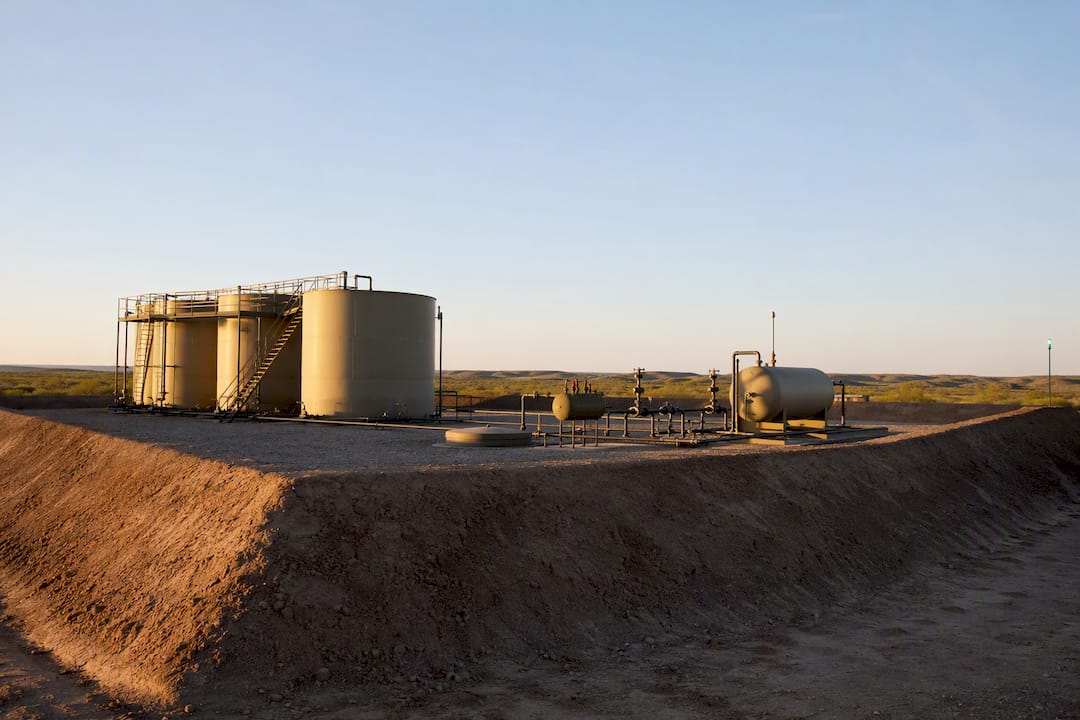
An SPCC Plan is required once a production facility’s aggregate aboveground oil storage tops 1,320 gallons, or buried storage exceeds 42,000 gallons, and a discharge could reasonably reach navigable waters or an adjoining shoreline. The immediate move is simple: walk the site, inventory every container 55 gallons or larger, and trace where oil would flow if a tank or flowline failed. If you’re over the threshold, or your EPA Regional Administrator says you need one, you write and implement a Plan, either self-certified or stamped by a Professional Engineer depending on your tier.
TL;DR:
- Most operators must inventory containers of 55 gallons or more and compare the total against 1,320 gallons to determine if an SPCC Plan is required.
- Proper documentation is crucial, including site maps showing drainage, detailed container inventories, operating procedures, secondary containment details, and inspection schedules.
- Flowlines, produced water vessels, and condensate tanks must be included in the Plan, especially when they handle oil or are difficult to contain physically.
- Small facilities under 10,000 gallons of storage and no spill history can self-certify, but larger or disqualified sites need a Professional Engineer’s review and stamp.
- Ongoing inspection, recordkeeping, and incident reporting must follow strict schedules, with immediate notification required for spills over 1,000 gallons or multiple spills of over 42 gallons within a year.
Table of Contents
- What Is an SPCC Plan Under Federal Law?
- How Do You Know if Your Facility Needs an SPCC Plan?
- What Must an SPCC Plan Include Under §112.7?
- How Are Production Facilities Treated Differently Under §112.9?
- Can You Self-Certify, or Do You Need a Professional Engineer?
- What Inspection and Maintenance Routine Keeps a Plan Compliant?
- What Are the Reporting Thresholds and Timelines for a Spill?
- What Does a Practical SPCC Checklist Look Like for a Permian Operator?
- An Operator’s Honest Take on SPCC Priorities
- Where WellsManager Fits Into Your SPCC Recordkeeping
- Where to Read the Actual SPCC Rules
- Sources
- FAQ
What Is an SPCC Plan Under Federal Law?
The Spill Prevention, Control, and Countermeasure rule comes out of the Clean Water Act, and it exists for one reason: keep oil out of water that connects to the rest of the country’s water supply. EPA wrote the operational details into 40 CFR Part 112, and that’s the document that governs everything from tank battery containment to who’s allowed to sign the Plan.
Part 112 isn’t one rule. It’s a set of them, and the sections matter for oil and gas specifically:
- §112.3 covers when a Plan must be prepared and how quickly.
- §112.6 lays out qualified facility criteria, meaning who can self-certify instead of hiring a Professional Engineer.
- §112.7 is the general content requirement, the backbone of every SPCC Plan regardless of industry.
- §112.9 is the production facility overlay, the section that actually addresses flowlines, tank batteries, and produced water containers the way an operator experiences them.
If you want the actual regulatory text, read it on eCFR or govinfo.gov, both of which mirror the Federal Register version. EPA’s own SPCC program page for the upstream sector translates the legal language into something closer to plain operating guidance, and it’s worth bookmarking alongside the regulation itself.
Here’s the part a lot of operators get wrong: nobody at EPA reviews and approves your Plan before you start operating. You, the owner or operator, decide whether the rule applies to your facility, and you build the Plan accordingly. That determination doesn’t go unchecked, though. The EPA Regional Administrator can review your applicability call and require a Plan even if you concluded you were exempt. That’s not a hypothetical. RAs have pushed back on operators who assumed small battery counts or intermittent production put them outside the rule.
The practical takeaway is this: SPCC compliance in Midland or Odessa isn’t about waiting for someone to tell you a Plan is due. It’s a standing obligation the moment your storage crosses the threshold, and the burden of proof sits with you, not the agency.
How Do You Know if Your Facility Needs an SPCC Plan?
Applicability comes down to counting containers correctly, then asking one honest question about drainage. Get the counting wrong and you’ll either write a Plan you didn’t need or, worse, skip one you did.
Step 1: Count every container 55 gallons or larger. Only containers at or above 55 gallons count toward your aggregate aboveground total. A five-gallon bucket of hydraulic oil in the shop doesn’t count. A 500-barrel stock tank absolutely does. Add up every qualifying container on the site, tank batteries, chemical totes, lube oil drums, skid tanks, the works.
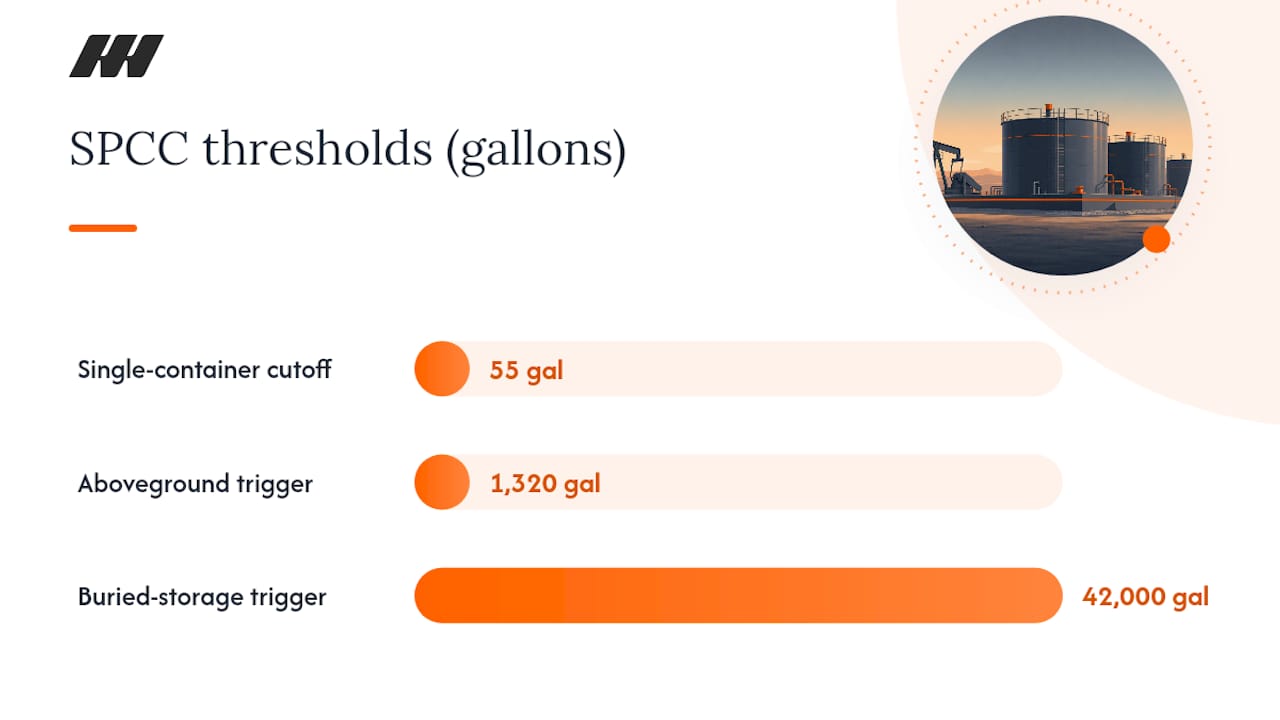
Step 2: Compare the total against 1,320 gallons aboveground. That’s roughly 31.4 barrels. A single stock tank on most Permian leases blows past that number on its own, so if you’re running any production battery at all, you’re very likely over the line already. Buried storage runs on a separate, much higher threshold: 42,000 gallons.
Step 3: Check for exemptions before you assume you’re covered. A few categories don’t count toward your total or get a pass entirely:
- Motive power containers (the fuel tank on a truck or generator that’s actually mobile equipment).
- Permanently closed containers, meaning taken out of service, drained, and disconnected, not just idle.
- Certain underground storage tanks already regulated under a different program.
- Containers holding substances that aren’t oil under the rule’s own definition.
Step 4: Evaluate reasonable expectation of discharge. This is where a lot of operators stop too early. Being over 1,320 gallons doesn’t automatically trigger the rule. The regulation also asks whether a discharge could reasonably reach navigable waters, including intermittent streams, playas, or a ditch that only runs after a hard rain. If your site drains toward a draw that feeds a creek fifteen miles later, that counts. West Texas is dry most of the year, but “dry most of the year” isn’t the same as “no reasonable expectation.”
- Walk the site and map every point where a spill would travel if containment failed.
- Note distance to the nearest named or unnamed drainage, even a dry arroyo.
- Check whether existing berms or grading would actually stop flow, or just slow it.
- Document your reasoning in writing, whatever conclusion you reach.
- Keep that documentation on file, because an RA can ask for it.
Pro Tip: Document your “no reasonable expectation of discharge” conclusion even when you’re confident you’re exempt. Regional Administrators have discretionary authority to require a Plan regardless of your internal call, and a written record of how you evaluated drainage paths is the difference between a defensible position and a guess.
The exemptions list looks generous until you actually try to apply it in the field. A lot of Permian batteries have a mix of active tanks, idle tanks that haven’t been formally closed, and a chemical tote or two that everyone forgets to count. Do the inventory literally, container by container, rather than estimating from memory or an old plat.
What Must an SPCC Plan Include Under §112.7?
Every SPCC Plan, regardless of industry, has to satisfy the general requirements in §112.7, and this is where a lot of Plans go from “technically exists” to “actually useful during an inspection.” The required elements aren’t abstract. Each one maps to something you already do, or should be doing, on a Permian lease.
A compliant Plan needs to include:
- A facility diagram showing tank locations, capacities, flow direction, and drainage routes.
- A complete container inventory listing every tank and its capacity, tied to the count you did during the applicability check.
- Written operating procedures for routine tasks like tank gauging, truck loading, and produced water transfers, the moments where most spills actually happen.
- Secondary containment description, dikes, berms, or catchment basins, for each tank battery, plus documentation anywhere containment is impractical.
- Countermeasures and cleanup procedures, including who does what in the first hour after a discharge.
- A contact list covering internal responders, spill response contractors, and the National Response Center.
- A schedule for periodic inspections and integrity testing of tanks, valves, and containment structures.
The diagram and inventory are the easy part. Most operators already have a plat or a facility map lying around; the work is making sure it actually shows drainage direction and container capacities, not just well locations.
Operating procedures are where Plans get generic and useless. “Follow safe handling practices” isn’t a procedure. A real procedure says who checks tank levels before a hauler arrives, what the maximum fill level is, and what happens if a valve is left open overnight. Write it the way you’d explain it to a new pumper on their first week.
Secondary containment is the section that generates the most disagreement during inspections. A dike or berm around a tank battery is the default expectation. If full containment isn’t practical, and sometimes it genuinely isn’t on a tight older pad, you have to document why, not just skip the section.
A number worth remembering: 1,000. A single discharge of more than 1,000 gallons to navigable waters triggers mandatory federal reporting, and that number shapes how seriously your countermeasures section needs to be written. If your biggest tank holds more than that, your Plan needs a real answer for what happens when it fails, not a placeholder paragraph.
Your contact list should include your spill response contractor, your PE if the Plan is PE-certified, and the National Response Center’s number, printed and posted where field hands can find it without hunting through a binder. Integrity testing frequency isn’t fixed by the rule at a specific interval for every tank type, so document your own inspection schedule and stick to it consistently. Consistency is what an inspector is actually checking for.
How Are Production Facilities Treated Differently Under §112.9?
Section 112.9 exists because a wellsite doesn’t look anything like a refinery or a bulk terminal, and EPA wrote a separate set of expectations to match. If you’re only reading the general §112.7 requirements, you’re missing the parts that actually govern most of a Permian lease.
The biggest difference is flowlines. Flowlines and intra-facility gathering lines have to be documented in the Plan even when secondary containment around them isn’t practical, which it usually isn’t for buried or semi-buried line. That means your Plan needs an inventory of flowline routes and a maintenance/inspection program for them, plus a written explanation of why containment isn’t feasible and what you’re doing instead, pressure monitoring, regular walking inspections, whatever your actual practice is.
Condensate is the second trap. Natural gas itself isn’t oil under SPCC, but condensate is, because it’s liquid at ambient temperature and pressure. That means:
- Condensate tanks count toward your 1,320-gallon aboveground threshold, same as crude stock tanks.
- A dry gas facility with genuinely no condensate storage may fall outside SPCC entirely, but that’s a conclusion you need to document, not assume.
- Mixed production leases (oil, gas, and condensate on the same pad) need every condensate vessel counted, not just the obvious crude tanks.
A lot of operators run the math on their crude tanks, forget the condensate knockout vessel sitting off to the side, and come in under threshold on paper when they’re actually over it.
The third piece is produced water and flow-through process vessels. Produced water itself typically isn’t “oil” for SPCC purposes, but separators, heater treaters, and other flow-through vessels that handle an oil/water mix during processing usually do fall under the rule, and they need to show up in your container inventory and operating procedures the same as a stock tank.
Practically, this means your production facility SPCC Plan carries more moving inventory than a simple storage-only facility would. You’re not just listing static tanks; you’re mapping a system of flowlines, separators, and tanks that all connect, and the Plan has to reflect how oil actually moves across the pad, not just where it sits still.
Can You Self-Certify, or Do You Need a Professional Engineer?
Not every Plan needs an engineer’s stamp, and knowing which category you fall into up front saves real money and real time.
- Determine your Tier. A qualified facility with 10,000 gallons or less of aggregate aboveground oil storage, no discharge history above certain thresholds, and no individual tank over 5,000 gallons generally qualifies for self-certification treatment under the rule’s Tier framework.
- Confirm the discharge history test. Even a small facility loses qualified status if it has a reportable discharge history that disqualifies it, so check your own spill record before assuming you’re in the clear.
- If you qualify, self-certify the Plan. A qualified facility at or under the 10,000-gallon aboveground threshold may self-certify instead of hiring outside help, provided the owner or operator has the technical knowledge to attest the Plan meets the rule’s requirements.
- If you’re over threshold or disqualified, get a PE. Larger batteries, multi-well pads with significant aggregate storage, or any site with a relevant discharge history typically need full PE certification, and that Professional Engineer has to review the containment design, the flowline documentation, and the technical adequacy of the whole Plan, not just sign the cover page.
Pro Tip: Before you contract a PE, hand them your completed container inventory and flowline map, not a blank slate. A PE who’s starting from your own site data instead of building it from scratch will move faster and charge less, and you’ll end up with a Plan that actually reflects how your pad operates.
Self-certification isn’t a lesser standard, it’s a faster path for smaller sites. But it puts the technical judgment call squarely on you as the operator, so don’t self-certify a Plan you don’t fully understand just to skip the PE fee. That’s the fastest way to end up with a Plan that falls apart during an actual inspection.
What Inspection and Maintenance Routine Keeps a Plan Compliant?
A Plan sitting in a drawer doesn’t protect anyone, and it definitely doesn’t hold up if an inspector shows up asking for records. The rule expects ongoing inspection and testing, and the practical question for a Permian operator is how often and what to log.
Tanks, valves, and containment structures need a routine visual inspection, weekly is a reasonable baseline for an active battery, with a more thorough integrity check on a longer cycle, often quarterly or annually depending on your Plan’s own schedule. Flowlines get walked or checked on whatever interval your Plan specifies, and on episodic or low-attendance leases, that interval needs to account for the gaps between visits, not assume daily eyes on the pad.
Secondary containment needs its own attention separate from the tanks themselves. Berms erode. Catchment basins fill with debris or rainwater and lose capacity. Check containment integrity on the same visit as your tank inspection, and note dirt berm height or catchment basin condition specifically, not just “containment okay.”
Recordkeeping is where most of the real inspection risk lives:
- Log every inspection with date, inspector name, and specific findings, not just a checkmark.
- Keep flowline inspection records even on days with limited site attendance, a brief note beats no note.
- Retain inspection and maintenance records long enough to demonstrate a consistent pattern, several years is the safe practice most operators follow.
- Store records somewhere accessible on short notice, because an inspector asking for two years of tank inspection logs wants them that day, not next week.
Pro Tip: Tie every inspection entry back to a specific Plan section number. When an inspector asks how you’re meeting the §112.7 containment inspection requirement, being able to pull the matching field ticket instantly is worth more than a perfectly written Plan with no paper trail behind it.
The pattern that gets operators in trouble isn’t a bad Plan. It’s a good Plan with no evidence anyone actually followed it. Field tickets, inspection logs, and dated photos are what turn a Plan from a document into a defense.
What Are the Reporting Thresholds and Timelines for a Spill?
Two numbers govern federal reporting, and both are worth having memorized rather than looked up mid-incident.
- A single discharge over 1,000 gallons to navigable waters or an adjoining shoreline triggers mandatory reporting to the National Response Center.
- Two discharges, each over 42 gallons, within any 12-month period also trigger reporting, even though neither one alone crosses the larger threshold.
- Notify the National Response Center immediately once you know a reportable discharge has occurred; that’s a federal hotline, and the call needs to happen without delay, not after cleanup starts.
- Your EPA Regional Administrator may also require notification within a set window, commonly discussed as 60 days for certain follow-up documentation, so check your Plan’s own RA notification section for the specific deadline that applies to your facility.
42 gallons is roughly one drum. That’s the number that trips people up, because a couple of minor drum spills in the same year can add up to a reportable event even when nobody thought either one, alone, was serious.
On-site response priorities in the first minutes matter more than the paperwork that follows. Stop the source if it’s safe to do so, contain the spread with whatever berm or absorbent is on hand, and get people clear of any vapor hazard before worrying about documentation. Once the immediate danger is handled, start the incident log: time discovered, estimated volume, source, and who was notified and when.
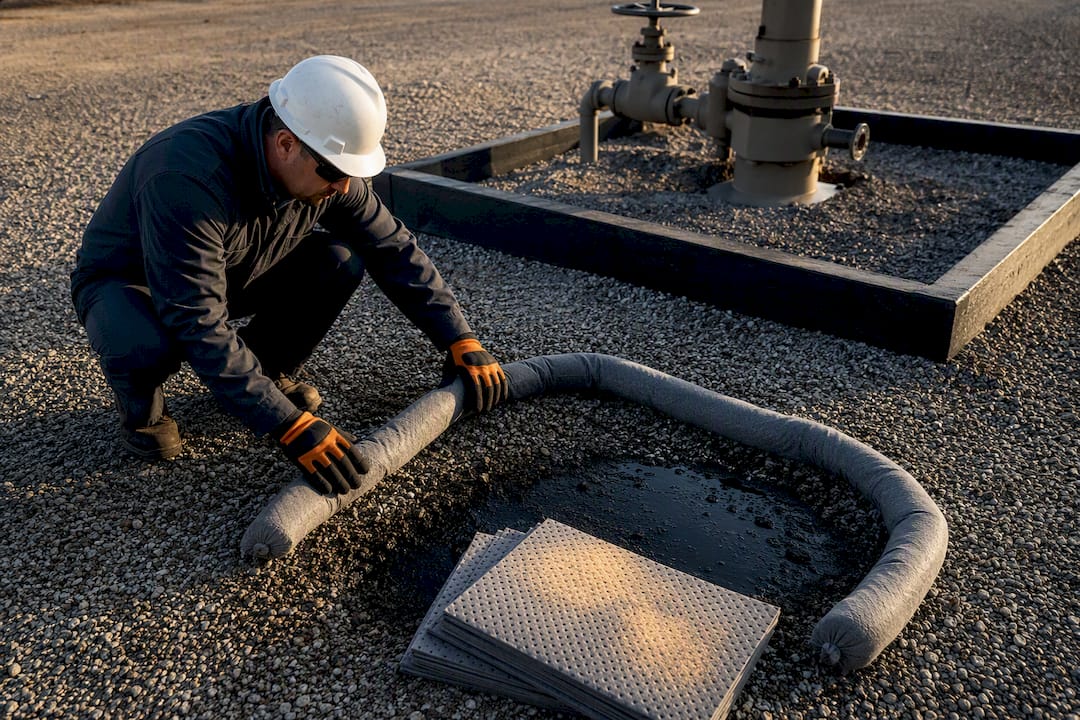
A useful incident reporting checklist covers exactly this kind of field-ticket structure, time, volume, cause, containment action, notification made, so the record exists in real time instead of getting reconstructed from memory a week later. That log becomes the backbone of your after-action report and, eventually, your evidence that you responded the way your Plan says you would.
What Does a Practical SPCC Checklist Look Like for a Permian Operator?
Regulatory text is one thing. Making it work on a pad outside Midland with a skeleton crew and three other leases to check that same day is another. Here’s where the Plan actually earns its keep, or doesn’t.
Start with a site inventory template that captures more than just tank counts. For every container, you want capacity, contents, GPS coordinates or pad ID, install date if known, and current condition. That template becomes the backbone of your §112.7 inventory requirement, and it’s the same data you’d want handy if a PE ever needs to review the site.
Field tickets are your real evidence. A daily or per-visit ticket that notes tank levels, any leaks or drips observed, containment condition, and flowline status does double duty: it’s operational data you’d want anyway, and it’s the documentation an inspector will ask for when checking whether your Plan is more than a filing cabinet exercise. Structuring well production and inspection records consistently across leases makes this far less painful when you’re managing more than a handful of pads.
Common mistakes worth naming directly:
- Undercounting containers by only tallying stock tanks and skipping totes, drums, and the condensate knockout vessel.
- Ignoring flowlines entirely because they’re buried and out of sight, when the rule expects them documented regardless.
- Treating “no containment” as the end of the analysis instead of documenting why containment is impractical and what alternative measure is in place.
- Losing track of PE communications, no record of what the PE reviewed, approved, or flagged for follow-up.
Pro Tip: When you document containment impracticability, write the specific physical constraint, tight pad footprint, shared battery with a neighboring lease, terrain that won’t hold a berm, not a generic line like “not feasible.” A specific reason survives an inspection; a vague one invites a follow-up question you don’t want to answer on the spot.
Corrective steps for each of these mistakes are usually cheaper than the mistake itself. A full container walk-through with a printed inventory sheet catches undercounting in an afternoon. Adding flowline routes to your existing site map costs nothing but time. The PE communication gap gets solved by simply keeping a dated email folder for every exchange, no special software required.
An Operator’s Honest Take on SPCC Priorities
Most SPCC guidance buries the two things that actually matter under a pile of regulatory language: count your containers honestly, and know where the oil goes if something fails. Everything else, the certification tier, the exact containment design, the inspection interval, follows from getting those two things right first. Get them wrong and no amount of PE polish saves the Plan.
The rule doesn’t require you to send anything to EPA for approval. Your Plan lives at the facility, and that’s exactly where it needs to stay, accessible, not buried in a corporate office three hundred miles away. If an inspector shows up at a Midland pad and the Plan is sitting in a Houston filing cabinet, you’ve already lost the argument regardless of how well the document is written.
Field tickets are what turn a Plan from a legal formality into something defensible. An inspector doesn’t just want to read your inspection schedule, they want to see it happened. That means your daily records matter as much as the Plan itself, maybe more.
For a small independent running two or three leases, prioritize in this order: inventory and drainage assessment first, containment and operating procedures second, certification tier last. You can’t certify a Plan you haven’t actually built on accurate numbers.
— Pedro
Where WellsManager Fits Into Your SPCC Recordkeeping
WellsManager doesn’t write your SPCC Plan and won’t replace your PE, but it solves the part of compliance that trips up more operators than the regulation itself: proving the Plan is actually being followed. Field tickets logged in WellsManager capture tank checks, containment condition, and flowline notes tied to a specific well or pad, the exact kind of dated record an inspector wants to see when checking whether your inspection schedule is real or aspirational. Your container inventory and per-well cost data live in one place instead of scattered across notebooks and text threads, so when a PE or an RA asks for site history, you’re not reconstructing it from memory.
Where WellsManager doesn’t help: it won’t stamp your Plan, evaluate your drainage paths, or make the qualified-facility certification call. That’s still PE or environmental consultant territory. What it does is make sure the operational evidence behind your Plan, the inspections, the incident logs, the day-to-day field work, actually exists and is retrievable when you need it.
If you’re running field tickets on paper or in a group chat right now, take a look at WellsManager and see whether it fits how your Permian leases actually operate.
Where to Read the Actual SPCC Rules
Skip the secondhand summaries when you need the real language. These are the documents worth keeping bookmarked:
- 40 CFR Part 112 on eCFR: the actual regulatory text, including §§112.3, 112.6, 112.7, and 112.9, and the version that governs any dispute over what’s required.
- EPA’s SPCC upstream sector page: plain-language overview built specifically for oil exploration and production facilities.
- SPCC 101 for Onshore Oil Production, Drilling and Workover Facilities: a practical walkthrough aimed at production sites, with worked examples.
- SPCC Guidance for Regional Inspectors: the interpretive document inspectors themselves use, which makes it the best predictor of how an actual inspection will go.
This article is general information, not a substitute for advice from a qualified lawyer. Consult a qualified legal professional about your own circumstances before acting on anything here.
Sources
- Spill Prevention, Control, and Countermeasure (SPCC) for the Upstream (Oil Exploration and Production) Sector | US EPA
- 40 CFR Part 112 – Oil Pollution Prevention (eCFR)
- SPCC 101 for Onshore Oil Production, Drilling and Workover Facilities | US EPA
- SPCC Guidance for Regional Inspectors, December 16, 2013
FAQ
Which Oils Are Covered Under an SPCC Plan?
SPCC covers petroleum oils including crude oil and condensate, along with oil-based products and animal or vegetable oils, since the rule’s definition of oil is broad. Natural gas itself is not covered, but condensate that’s liquid at ambient conditions is treated as oil and counts toward your storage thresholds.
Is SPCC a Federal or State Requirement?
SPCC is a federal requirement under the Clean Water Act, enforced through 40 CFR Part 112 and administered by EPA Regional Administrators, though some states layer additional spill prevention rules on top of it.
How Many Gallons of Storage Trigger an SPCC Plan?
A Plan is required once aggregate aboveground oil storage exceeds 1,320 gallons, counting only containers 55 gallons or larger, or when buried storage exceeds 42,000 gallons, provided a discharge could reasonably reach navigable waters.
Who Does the SPCC Rule Apply To?
SPCC applies to any non-transportation-related facility, including oil production sites, that stores oil above the applicable threshold and could reasonably discharge it to navigable waters or adjoining shorelines. The owner or operator determines applicability, subject to review by the EPA Regional Administrator.
Do I Need a Professional Engineer to Certify My SPCC Plan?
Qualified facilities with 10,000 gallons or less of aggregate aboveground storage and no disqualifying discharge history can generally self-certify. Facilities above that threshold, or with a relevant spill history, typically need a licensed Professional Engineer to certify the Plan.