Working Interest vs NRI: Permian Operators' Tax and JIB Checks

Working interest tells you who pays the bills and who has a say in operations. Net revenue interest tells you what share of the actual production dollars land in your account after royalties come off the top. Check your working interest to know your cost exposure. Check your NRI decimal to know what a barrel of oil is actually worth to you.
TL;DR:
- Checking the division order decimal against lease royalty and override details ensures you accurately understand your true revenue share.
- Costs for drilling, completion, and operation are billed monthly through joint interest billing, often before revenue payments arrive.
- Recurring disputes often stem from mismatched decimals caused by pooling, overrides, or title errors that need clarification with the operator.
- Understanding the difference between working interest and net revenue interest helps evaluate both your potential upside and cost risks effectively.
- Maintaining an organized cost book and regular reconciliation prevents cash flow surprises and supports timely, accurate payments.
Table of Contents
- Working Interest vs NRI: The Terms You Need Straight
- How to Calculate NRI: Formula and Worked Examples
- Who Pays What: Cost Obligations Behind Every WI Check
- Tax Treatment: Depletion, IDCs, and the Passive-Activity Exception
- Reading Your Division Order and Catching Payment Errors
- Before You Buy or Accept a WI or NRI: The Checklist
- Reconciling WI and NRI in Your Cost Book and Investor Reports
- An Operator’s Take on Working Interest and NRI
- Get Your Cost Book and Investor Checks Off the Notebook
- Sources
- FAQ
Working Interest vs NRI: The Terms You Need Straight
Every ownership stick in a well breaks down into a handful of interests, and mixing them up is how new investors get burned. Working interest (WI) is the operating stake in a lease. It carries the right to drill and produce, and it carries the obligation to pay a proportional share of drilling, completion, and operating costs. If you own working interest, you owe a proportional share of the joint interest billing every month, regardless of oil prices.
Mineral interest is ownership of the oil and gas interest in the ground itself, separate from any lease. Royalty interest is the revenue share a mineral owner keeps when they lease to an operator, free of drilling and lease operating costs. Overriding royalty interest (ORRI) is a royalty carved out of the working interest, usually granted to a landman, broker, or a prior working interest owner who wanted revenue without ongoing cost exposure. Non-participating royalty interest (NPRI) is a royalty severed from the minerals that carries no right to bonus or lease negotiation, just a revenue share.
Net revenue interest (NRI) is what remains after every royalty and override comes out of the working interest. Because royalties and overrides always subtract from the top, NRI is always less than or equal to working interest, never greater. A 100% working interest owner with no burdens still holds a 100% NRI, but that scenario is rare outside company-owned minerals.
These terms show up in three places you will actually read them:
- The lease defines the royalty rate the mineral owner negotiated.
- The division order lists the exact WI and NRI decimals the operator will pay you on.
- The title chain (runsheets, assignments, unit orders) shows how those decimals got calculated and whether anyone carved out an override along the way.
If your division order decimal doesn’t match what your lease and title documents suggest it should, that’s the first place to start asking questions.
How to Calculate NRI: Formula and Worked Examples
The math behind NRI isn’t complicated, but it trips people up because they forget to net out every burden, not just the base royalty. The standard formula is:
NRI = WI × (1 − total royalty burden)
Total royalty burden means every royalty and override stacked on that lease, added together as one decimal.
Here’s how that plays out in practice:
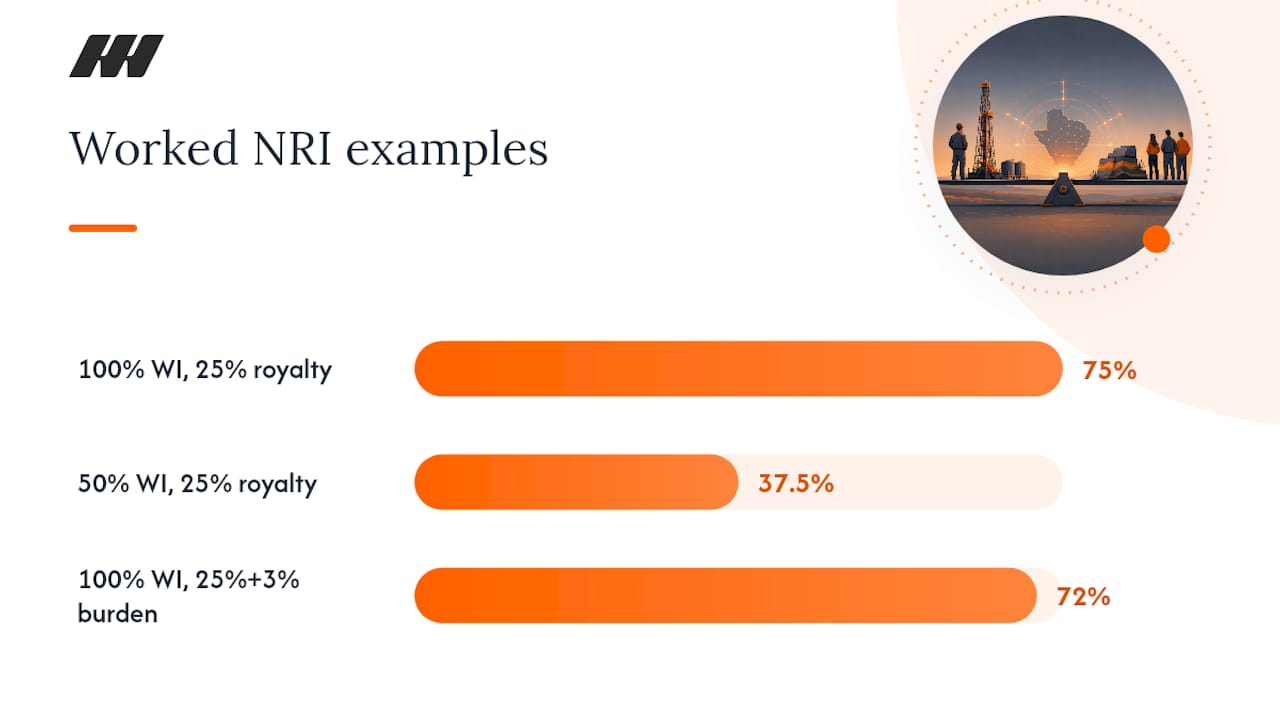
- Simple lease, no override. You hold 100% working interest on a lease with a 25% royalty. NRI = 1.00 × (1 − 0.25) = 0.75, or 75%. Every dollar of gross revenue, you keep 75 cents before your own costs come out.
- Two-partner split. You and a partner each hold 50% working interest on that same 25%-royalty lease. Each of you gets NRI = 0.50 × (1 − 0.25) = 0.375, or 37.5%. Mineral View’s worked examples confirm this proportional split is standard: the remainder after royalty divides exactly the way the working interest divides.
- Lease with an ORRI layered on top. Say the same 100% WI lease carries a 25% lease royalty plus a 3% override a broker retained from a prior deal. Total burden is 0.28. NRI = 1.00 × (1 − 0.28) = 0.72, or 72%. That extra 3 points doesn’t sound like much until you’re modeling a $40 million-a-day field.
Pro Tip: Watch what happens when a well gets pooled into a unit. Unitization can change the acreage basis behind your decimal even when your lease royalty never changes. Always confirm the unit designation filed with the state commission before you trust a decimal on paper.
Royalty owners, by contrast, never touch this formula from the cost side. They receive revenue free of drilling and operating costs entirely. That’s the trade: working interest owners take on cost risk for a bigger share of the pie, royalty and NPRI owners take a smaller guaranteed slice with none of the downside.
Who Pays What: Cost Obligations Behind Every WI Check
Owning working interest means you’re on the hook for cash calls whether or not the well is having a good month. That obligation to pay costs due runs on a different schedule than receiving revenue based on your NRI.
A working interest owner typically pays a proportional share of:
- Drilling and completion costs, billed against the authorization for expenditure once the well spuds.
- Lease operating expenses (LOE): pumping, chemicals, workovers, electricity, saltwater disposal.
- Capital calls for recompletions, artificial lift upgrades, or facility repairs.
- Plugging and abandonment costs when the well reaches the end of its life.
The timing mismatch is what catches new WI owners off guard. Costs get billed monthly through the joint interest billing (JIB), often arriving before the revenue check for that same production month does. You might owe your JIB share on the 25th while your NRI-based revenue check doesn’t land until closer to the end of the following month. If you’re not tracking both sides in the same ledger, you can end up short on cash even on a well that’s profitable on paper.
Operators, who hold working interests and run day-to-day operations, control drilling decisions and timing. Non-operating working interest owners pay their share of costs but typically have limited control, as governed by operating agreements.
Pro Tip: Never judge a well’s health from the revenue check alone. Pull the JIB and the check side by side every month. A well that looks fine on NRI revenue can be quietly bleeding you on LOE if nobody’s watching the cost side.
Tax Treatment: Depletion, IDCs, and the Passive-Activity Exception
The IRS treats working interest and royalty income differently, and the gap is bigger than most first-time investors expect.
Working interest owners can typically deduct intangible drilling costs (IDCs) in the year incurred rather than capitalizing them, and both working interest and royalty owners can claim a depletion allowance against production income. Royalty and NRI-only owners generally sit outside the operating cost deductions since they never fund drilling or LOE in the first place.
The bigger wrinkle is Section 469. Working interest income normally escapes the passive-activity loss limitations that apply to most other investments, letting active losses offset other income. But that exception has a catch: if you hold your working interest through an entity structure that limits your personal liability, such as certain LLC or limited partnership arrangements, the IRS may treat the interest differently for passive-activity purposes. IRS private letter ruling 0952054 analyzes how liability-limiting entity structures can affect whether an interest qualifies as a working interest under §469©(3) for passive activity loss rules.
- Working interest owners: IDC deductions, depletion, and typically non-passive treatment (absent a limited-liability structure).
- Royalty/NRI-only owners: depletion allowance, but no drilling cost deductions and generally passive treatment.
A related ruling, IRS private letter ruling 0953011, shows the IRS treating a retained net profits interest as nonoperating for tax purposes in a specific fact pattern after a working interest conversion. Private letter rulings bind only the taxpayer who requested them. Treat them as illustrative of IRS reasoning, not as settled law for your own situation, and run your structure past a tax professional who knows oil and gas before you assume either treatment applies to you.
Reading Your Division Order and Catching Payment Errors
Your division order is the document that turns all this math into an actual check every month, and it’s worth reading line by line the first time you receive one.
- Check the decimal against your own math. Recalculate NRI = WI × (1 − total burden) using the lease royalty and any ORRI you know about, and compare it to the decimal printed on the order.
- Look for every burden line, not just the lease royalty. Overrides, non-participating royalties, and any prior assignments can each shave a fraction of a point off your number.
- Confirm the unit designation matches the state filing. NARO’s operator guidance points out that pooling changes the acreage basis behind your decimal, and relying on lease acreage alone when a unit has been formed is one of the most common sources of NRI errors.
- Trace mismatches to their source. A decimal that shifted from what you expected usually traces back to one of three things: a pooling or unitization order, an override nobody told you about, or a title error somewhere in the chain of assignments.
If your check doesn’t match your math, call the operator’s owner relations desk first and ask for the current division order and the unit order it’s based on. If the numbers still don’t reconcile, request the runsheet or a copy of the title opinion covering your tract. Our guide to division order basics for Permian owners walks through the three checks worth running before you sign anything.
Before You Buy or Accept a WI or NRI: The Checklist
Before money changes hands on any working interest package or royalty acquisition, get these items in writing.
- Full decimal package. WI, NRI, and the complete royalty stack (lease royalty plus every ORRI and NPRI) broken out separately, not bundled into one number.
- Recent LOS and JIB history. At least six months of lease operating statements and joint interest billings, so you can see actual cost trends instead of a pro forma.
- Pooling and unit orders. Confirmation of the acreage basis behind the decimal you’re being quoted, filed with the state, not just described in a marketing packet.
- Realistic production modeling. Run mid-case and worst-case decline scenarios against your LOE history, and stress-test whether you can cover a capital call if a workover comes up.
- Title and division order sanity check. Have someone confirm the seller’s decimal matches current title, not a decimal that predates a recent assignment or override.
- Proof of prior payment. Ask for wire confirmations or bank statements showing the seller actually received checks at the decimal claimed.
Pro Tip: If a seller won’t produce six months of LOS and JIB history, that’s the answer to whether you should buy. Real operators keep this paperwork organized because they need it themselves every month.
Reconciling WI and NRI in Your Cost Book and Investor Reports
Every dispute over a division order decimal eventually comes down to one question: can you prove your numbers? Operators who keep a clean per-well cost book answer that question in minutes. Operators who don’t spend weeks digging through old invoices and text messages trying to reconstruct what actually got spent.
A per-well cost book ties every dollar of drilling, completion, and LOE spend to the specific well and the specific month it hit. When that book is current, reconciling a JIB charge against a partner’s expected pro rata share takes minutes instead of days, and organized JIB workflows can cut reconciliation cycles that used to run for months down to a routine monthly task.
That organization pays off twice. First, on the cost side: when a non-operating partner questions a JIB charge, you pull the well cost book and show them the invoice, not a guess. Second, on the revenue side: when a lease operating statement and investor checks are generated from the same clean numbers every month, partners get paid on schedule instead of waiting on a month-end scramble to reconstruct what everyone owes and what everyone’s owed.
- A current well cost book prevents JIB disputes before they start.
- Timely JIB tracking ties cost charges directly to each partner’s WI decimal.
- Clean LOS generation makes NRI-based investor checks predictable instead of a monthly fire drill.
Good owner relations isn’t a personality trait. It’s a paperwork habit, and it shows up first in how fast your checks go out.
An Operator’s Take on Working Interest and NRI
Working interest is your upside and your exposure in the same number. NRI is your floor, the revenue share that shows up whether the well has a good month or a rough one. Neither number tells the whole story alone, and anyone selling you a deal based on just one of them is selling you half a picture.
If you take one thing from this and do it today, do this: pull your most recent division order, recalculate the NRI decimal from the lease royalty and any override you can find, and confirm the unit filing behind it with the state. Most disputes I’ve seen traced back to someone who never checked.
— Pedro
Get Your Cost Book and Investor Checks Off the Notebook
Reconciling working interest costs against NRI-based revenue every month is a paperwork problem, and paperwork problems compound when they live in a notebook or a group text. Wellsmanager runs three jobs for independent operators in Midland and Odessa: field work tickets that log well work and costs as they happen, a well cost book that shows what each well actually spent, and investor checks paired with a lease operating statement so partners get paid without a month-end scramble. It’s built for operators who already run wells, not for enterprise accounting departments. If your JIB reconciliation and division order checks are eating a week every month, see how Wellsmanager handles the cost book and investor checks and get a walkthrough of the modules that fit your operation.
This article is general information, not a substitute for advice from a qualified financial advisor. Consult a qualified financial professional about your own circumstances before acting on anything here.
Sources
- IRS private letter ruling 0952054
- Net revenue interest, Oil Authority (glossary)
- Net Revenue Interest (NRI): Definition and Formula | Mineral View
FAQ
What Does Working Interest Mean?
Working interest is an ownership stake in an oil and gas lease that carries the right to drill and produce and the obligation to pay a proportional share of drilling, completion, and operating costs.
What Is the Difference Between Interest and Royalties?
Working interest owners fund drilling and operating costs and control (or share control of) operations, while royalty owners receive a revenue share free of those costs but have no say in how the well is run.
How Do I Calculate Working Interest for an Oil and Gas Property?
Working interest is set by the lease, assignment, or joint operating agreement covering the property, expressed as the percentage of the operating cost and revenue burden you’ve agreed to carry, not something you calculate from other numbers.
How Do You Calculate NRI?
Multiply your working interest by one minus the total royalty burden to get NRI: NRI = WI × (1 − total royalty burden). For example, a full working interest on a lease with a royalty burden yields an NRI equal to the remainder after the royalty.