Operator Ready AI Executive Brief: 6 Step Pilot for Permian

An AI executive brief is a one-page, exception-focused summary of field work tickets, per-well costs, and pending investor distributions that lets you act without opening a single raw ticket. It’s ready to use once your data refreshes daily and your well IDs and cost codes match across every source. Done right, it replaces a folder of tickets and spreadsheets with a page you can read in three minutes and act on immediately.
TL;DR:
- An AI executive brief ranks exceptions by dollar impact, focusing on the highest-cost issues like delayed workovers or chemical treatment backorders.
- All data used must be timestamped, linked to a source, and validated, with clear ownership assigned to exceptions and change logs maintained.
- The brief should be produced daily for operations, weekly for costs and payments, and monthly for comprehensive investor reporting, with access restricted based on role.
- Initial pilots should target a small scope, such as one pad or ten wells, and run parallel for 30 days to identify gaps and fine-tune exception thresholds before full rollout.
- Trust builds when field teams participate in setting thresholds, see the brief catch issues manually overlooked, and are transparent about data freshness and source limitations.
Table of Contents
- What Goes in an AI Executive Brief Template
- Where Should Brief Data Actually Come From?
- Data Quality Checklist Before You Automate Anything
- How Often Should Briefs Go Out, and to Whom?
- A Sample One-Page Brief You Can Copy
- How Do You Pilot Your First AI Executive Brief?
- What Should You Verify Before Trusting a Brief?
- Presenting Insights Without Burying the Decision
- Keeping Sensitive Operational Data Secure
- Getting Your Team to Actually Trust the Brief
- Why Operator-Ready Briefs Change the Week
- How WellsManager Handles the Three Jobs Behind Every Brief
- Sources
- FAQ
What Goes in an AI Executive Brief Template
The brief only works if it forces a decision and not a scroll. Every section should answer one question: does someone need to act today, or can this wait until the weekly roll-up?
Start with a headline summary, one line stating the change versus the prior period in dollars, not percentages. “Lease operating costs increased notably versus last week, driven by two workover jobs on the Reeves pad” tells a superintendent more in five seconds than a page of tables.
Below that, add an operating intent statement. This is a single sentence that limits scope: “This brief covers wells 12 through 24 on the Spraberry unit, workover and maintenance activity only.” Without it, readers assume the brief covers everything, and gaps get read as errors instead of scope limits.
Then rank your top exceptions, ordered by dollars at risk, not by well number or alphabetical vendor name. Ranking exceptions by economic impact is what actually cuts decision time in the field, because crews stop chasing low-dollar noise and go straight to the item that costs the most if ignored.
Round out the page with:
- A per-well cost snapshot showing month-to-date and rolling 12-month spend
- Investor distribution status (paid, pending, or held for reconciliation)
- Three to five key metric bullets: production trend, workover count, AFE variance if applicable
Keep the whole thing to one page. If it runs longer, you’re including detail that belongs in the underlying ticket, not the brief.
Where Should Brief Data Actually Come From?
Every line in the brief needs a traceable source, or nobody will trust the number when it’s wrong.
Field tickets generate your exceptions. A pumper logs a downed unit or an unplanned workover, and that ticket becomes the raw material for whatever ranks at the top of tomorrow’s brief. Your well cost book generates per-well cost snapshots, pulling actual spend against AFE or budget by well and by cost code. Accounts payable and vendor invoices tell you what’s pending, what’s overdue, and what just posted, which drives the investor distribution status line.
Public sources fill gaps internal records can’t cover on their own:
- The Texas Railroad Commission publishes monthly production volumes and completion reports, useful for cross-checking your own production data against filed numbers
- FracFocus discloses total proppant and fluid volumes per well, which lets you calculate proppant loading and fluid intensity when you pair it with lateral length, a combination that sharpens completion-cost context beyond what internal records alone show
Note freshness explicitly. Field tickets and production counts can be same-day. AP data often lags two to five days behind actual vendor billing. Public RRC filings run weeks behind real time. Label each figure with how current it is, or someone will treat a three-week-old number as this morning’s truth.
Data Quality Checklist Before You Automate Anything
Standardized, timely field data is the actual bottleneck in automated reporting, not the software generating the brief. Skip this checklist and every brief downstream inherits the mess.
- Standardize well identifiers and cost codes. Pick one naming convention for every well and cost category, and apply it everywhere, from the field ticket app to the cost book to the LOS.
- Timestamp every record and map it to its source. A cost figure with no timestamp is a guess dressed up as a fact.
- Build validation rules. Flag duplicate tickets, negative-cost entries, and outlier charges that sit far outside a well’s normal range. Decide in advance how to handle invoices that post after the brief already ran.
- Assign an owner to every exception category. Someone specific approves workover overages; someone specific approves AFE variances. No owner means no accountability when the number is wrong.
Pro Tip: Run your validation rules against last month’s data before you trust this month’s brief. If the rules had caught last month’s billing error, they’re ready. If they wouldn’t have, tighten the thresholds before you go live.
How Often Should Briefs Go Out, and to Whom?
Match the cadence to the decision it drives, not to a fixed reporting calendar.
- Daily: operations exceptions go to the field superintendent and lead pumpers. This is the ranked list of what’s over budget or off schedule right now.
- Weekly: per-well cost roll-ups and pending partner payments go to operations and finance together, so nobody discovers a cost overrun for the first time at month-end.
- Monthly: a consolidated brief feeds directly into the lease operating statement and investor distributions, giving partners a clean number instead of a scramble.
Route each cadence through a channel that matches its sensitivity. Daily exception lists can go over a group text or shared inbox. Anything touching investor payment status needs role-based access, since not every field hand needs visibility into what a partner is owed.
A Sample One-Page Brief You Can Copy
Here’s what a working brief actually looks like on the page, stripped down to what matters.
Headline: Lease operating costs increased noticeably this week, driven by a rod failure on Well 14 and a delayed chemical delivery on Well 22.
Exception 1: Well 14, rod parted Tuesday. $6,100 at risk in deferred production. Recommended action: dispatch workover crew today, vendor already confirmed available.
Exception 2: Well 22, chemical treatment delayed three days by vendor backorder. $1,800 at risk in corrosion exposure.
Investor status: October distributions calculated and pending final approval; expected release Friday.
That’s the whole page. No narrative padding, no raw ticket dumps, just what changed and what to do about it.
How Do You Pilot Your First AI Executive Brief?
Don’t roll this out across your whole asset base on day one. Prove it on a slice first.
- Pick a narrow scope. Choose one pad or your top 10 wells by cash contribution, not your entire field.
- Write your operating intent and exception thresholds. Decide what dollar amount triggers a flag before you automate anything.
- Map your inputs and run the quality checklist from the section above against real data.
- Run the brief in parallel with your current process for 30 days. Compare it against what you’d have caught manually and log every discrepancy.
- Tune your thresholds based on what the pilot missed or over-flagged.
- Decide whether to expand to the rest of your wells or hold at current scope.
Operators who validate one high-value stream before expanding see fewer surprises and less pushback from the field team once the pilot data proves out.
What Should You Verify Before Trusting a Brief?
The most common failure isn’t a bad number, it’s a number nobody can trace back to its source. Inconsistent formats between field apps and the cost book, invoices that post after the brief already ran, and production data that’s a week stale all quietly erode trust until someone catches a bad decision made off a bad brief.
Require these before you rely on any brief:
- Every figure links back to a source record, not just a total
- Every snapshot carries a timestamp showing how current it is
- Every brief has a named approver who signs off before it goes out
- A change log tracks what got corrected and why
Pro Tip: If a number in the brief can’t be traced to a specific ticket, invoice, or cost book entry in under 60 seconds, that number isn’t ready for a brief. Fix the source mapping first.
Governance matters here too. Decide who can override a flagged exception and require that override to get logged, not just verbally approved. An unrecorded override defeats the entire point of an audit trail.
Presenting Insights Without Burying the Decision
A brief fails the moment the reader has to think about how to read it. The headline number goes first, always, in dollars, with enough context to explain the swing in one breath. Bury it under three paragraphs of throat-clearing and you’ve lost the person who only has ninety seconds before the morning call.
Rank everything by dollars at risk, not by well number, alphabetical order, or chronology. A $40 discrepancy on Well 3 does not belong above a $6,000 exception on Well 17, no matter which well ticket came in first. Readers scan top to bottom and act on what they see first, so the order of the page is itself a decision tool.
Use plain language for the recommended action on every exception. “Dispatch workover crew today” beats “operational intervention advised” every time. Nobody needs a translation layer between the brief and the field.
Keep the visual format boring on purpose. A short table for per-well costs, a few ranked bullets for exceptions, one line for investor status. Charts and color-coded dashboards look impressive but slow down a reader who needs a yes-or-no in the next thirty seconds. Save visualization for a monthly or quarterly deep dive, not the daily or weekly operating brief.
Finally, separate what changed from what stayed the same. If eight of ten wells performed exactly as expected, say so in one line rather than listing them individually. The brief’s entire value is in what it lets you skip reading.
Keeping Sensitive Operational Data Secure
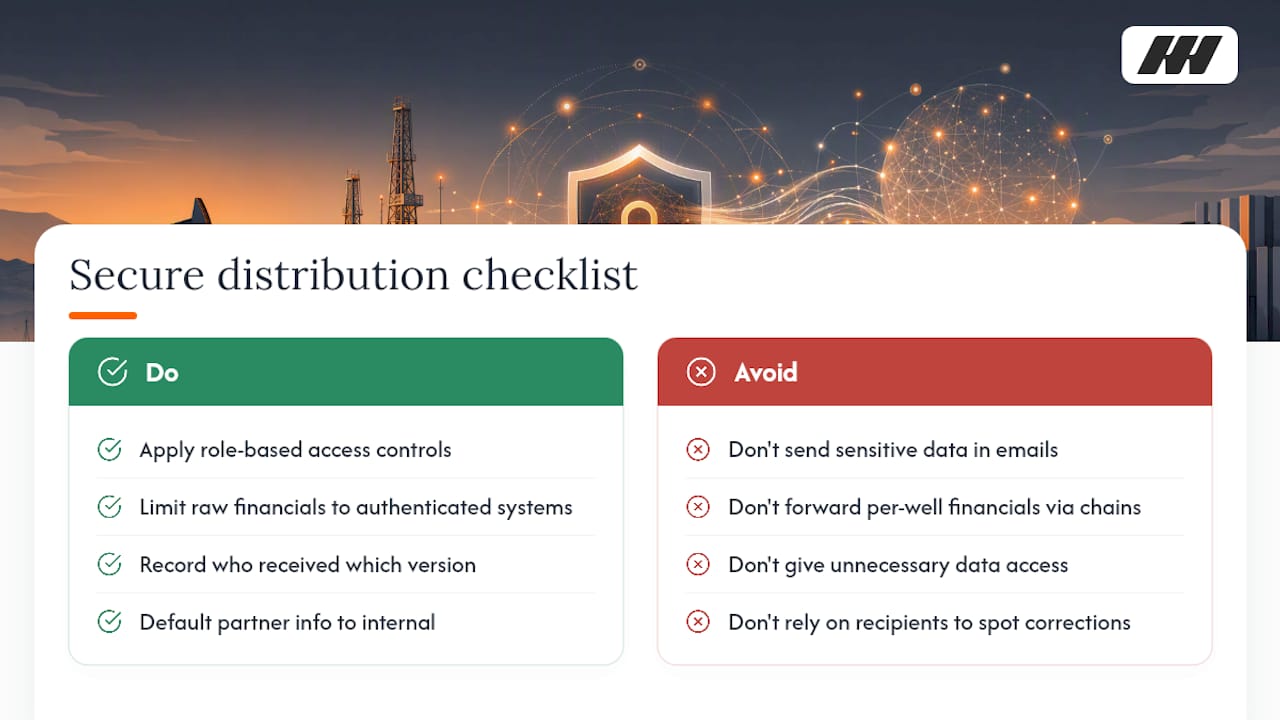
An executive brief concentrates the most sensitive numbers in your operation onto a single page. Per-well costs, vendor pricing, and investor distribution amounts are exactly the kind of data you don’t want sitting in an unprotected inbox or a shared spreadsheet link.
Apply role-based access so field leads see operational exceptions without seeing investor payment amounts, and finance sees payment status without needing raw field ticket detail they don’t act on. Not every recipient needs the same page in full.
Control distribution channels deliberately. A daily exception list can move fast over a work channel or shared inbox. Anything touching partner distributions or per-well financials belongs behind an authenticated system, not a forwarded email chain that anyone downstream can screenshot and pass along.
Keep a record of who received which version of the brief and when. If a number changes after distribution, whether from a late invoice or a corrected ticket, you need to know exactly who saw the outdated figure so you can follow up directly instead of hoping they notice the correction on their own.
Finally, treat vendor and contractor names, pricing terms, and investor identities as information that stays internal by default. A brief built for quick decisions is not the place to relax on who gets to see partner-level financial detail.
Getting Your Team to Actually Trust the Brief
The brief only earns its place once the field superintendent stops double-checking it against the paper tickets. That trust gets built, not assumed.
Start by involving the people who’ll actually read the brief in setting the exception thresholds. A superintendent who helped decide that $2,000 triggers a flag is far more likely to act on that flag than one who inherited a threshold set by someone in an office three counties away.
Run the parallel period from the pilot section long enough that skeptics see the brief catch something they’d have caught manually anyway. That’s the moment resistance usually breaks. One accurate flag that saves a crew a wasted trip does more for adoption than any amount of explanation.
Be transparent about the brief’s limits early. If it’s built on data with known freshness gaps, say so on the page itself rather than letting someone discover the gap during a dispute. A brief that admits what it doesn’t know keeps more trust than one that pretends to be complete.
Assign a single owner who can update thresholds and fix source mapping issues as they surface. Adoption stalls fast when the first reported error takes two weeks to resolve because nobody owns the fix.

Why Operator-Ready Briefs Change the Week
The real value of a brief isn’t the format, it’s the hour it gives back at month-end. Every operator I’ve talked to about this describes the same pattern: less time reconciling who said what happened on which well, more time actually deciding what to do about it. Standardizing field tickets against the cost book removes the guesswork that turns month-end into a scramble instead of a routine close.
Skeptics are right that most “AI” pitches in this space overpromise. But a scoped brief covering tickets, costs, and distributions isn’t magic. It’s structure applied to information you already have.
— Pedro
How WellsManager Handles the Three Jobs Behind Every Brief
WellsManager is built around the same three jobs this article covers: field work tickets logged instead of scattered across a notebook or group text, a well cost book that shows what each well actually spent, and investor checks paired with a lease operating statement so partners get paid without a scramble. The brief templates above work because they’re built on those same inputs, standardized and time-stamped instead of pieced together at month-end.
If you’re running these jobs manually across spreadsheets and texts right now, the fastest way to see the difference is to pilot WellsManager on your highest-value wells first, the same scoped approach the pilot checklist above recommends. Schedule a walkthrough at the WellsManager site and bring your current cost book. You’ll see within one session whether it maps cleanly to your existing well IDs and cost codes.
Sources
Yes. The Texas Railroad Commission and FracFocus supply production and completion volumes that can cross-check or enrich internal cost and production figures, though they can’t replace your own records.
- Permian completions data analysis — PetroPT
- Oil and Gas Production Software: What Independent Operators Actually Need — Greasebook
- Oil and gas accounting challenges and solutions — Rand Group
- The 23-minute window: Where oil & gas capital allocation actually happens — WorkSync
FAQ
What Is an AI Executive Brief in Oil and Gas Operations?
It’s a one-page, exception-ranked summary of field work tickets, per-well costs, and investor distribution status built so an operator can act without opening the underlying tickets.
How Often Should I Send an AI Executive Brief?
Send daily exception summaries to field leads, weekly cost roll-ups to operations and finance, and a monthly consolidated version that feeds the lease operating statement and investor distributions.
What Data Do I Need Before I Can Automate a Brief?
You need consistent well identifiers and cost codes, timestamped field tickets, an up-to-date well cost book, and AP records mapped to the same well and cost code structure.
How Long Should a Pilot Run Before Expanding?
Run your first brief in parallel with your current process for about 30 days on a limited well set, then tune thresholds based on what it caught or missed before expanding scope.
Does WellsManager Build These Briefs Automatically?
WellsManager supports the underlying jobs, field tickets, the well cost book, and investor distributions, that make an accurate brief possible in the first place.