Upstream Data Governance for Operators: A Practical Guide

Upstream data governance is the program that makes wells, production, geoscience, and telemetry data trusted, traceable, and auditable across your operations. For an operator, that means one thing in practice: every decision touching a well, a lease, or a regulatory filing rests on data you can defend. Start here: name an executive sponsor this week, assign data owners for your well and production datasets, and run a 90-day pilot on your highest-value asset class.
- Appoint an executive sponsor with authority to resolve cross-domain data disputes and fund the program.
- Assign data owners for wells, production, and geoscience — one named person per domain, not a committee.
- Run a 90-day pilot on a single high-value dataset (well headers or daily production volumes) using the PPDM Association organic governance model, the DAMA DMBOK framework for policy structure, and a platform like Wellsmanager to centralize records and audit trails.
Key Takeaways
Effective upstream data governance requires named owners, a phased roadmap, and an operations platform that enforces governance through daily workflows rather than policy documents alone.
| Point | Details |
|---|---|
| Start with ownership | Assign one named data owner per domain (wells, production, geoscience) before deploying any tooling. |
| Run a 90-day pilot | Govern one high-value dataset first; measure completeness and quality incident count to prove value fast. |
| Use the 4A security framework | Apply Access, Authorization, Authentication, and Audit controls across both IT and OT data boundaries. |
| Adopt a hybrid operating model | Combine organic stewardship in domain teams with a centralized Data Control Tower for mastering and quality KPIs. |
| Automate to scale | Automated lineage, RBAC, and quality checks let governance grow without adding steward headcount linearly. |
Table of Contents
- What does upstream data governance actually cover?
- What are the core principles of upstream data governance?
- How should you organize roles and the operating model?
- How do security controls and U.S. regulations shape your governance program?
- Which tooling categories do upstream operators actually need?
- What does a realistic implementation roadmap look like?
- What are the most common pitfalls and how do you avoid them?
- How an operations platform operationalizes governance
- The governance advice most operators get is backwards
- Sources
What does upstream data governance actually cover?
The scope question trips up most programs before they start. Operators try to govern everything at once, stall, and abandon the effort. The smarter move is to inventory your asset types first, then sequence governance by value and risk.
Large upstream enterprises store petabytes of mixed-format data across dozens of disconnected systems, and the data-island problem created by inconsistent standards and fragmented platforms is well documented. Here is what a complete upstream data inventory looks like:
- Well headers and wellbore data — the master record for every well; lives in a well management system or ERP; errors here cascade into production accounting and regulatory filings.
- Well logs (LAS, DLIS) — petrophysical logs stored in LIMS or seismic data stores; critical for reservoir modeling and completions decisions.
- Core and seismic data (SEG-Y, SEG-D) — petabyte-scale files in seismic repositories; governance must address format standards, versioning, and access rights.
- Production volumes and allocations — daily and monthly records from SCADA historians and production databases; the basis for revenue, royalty, and EPA reporting.
- Reservoir models and simulation outputs — typically in specialized engineering software; require version control and lineage to link model inputs to decisions.
- Lease, land, and accounting records — contracts, AFEs, and joint-interest billing data in land management and ERP systems; accuracy directly affects lease obligations and investor reporting.
- Maintenance and work-order records — stored in EAM systems or field tablets; feed equipment downtime analysis and field-to-finance workflows.
- Vendor and contractor records — supplier master data in procurement systems; personal data elements require masking and access controls.
- IoT, SCADA, and OT telemetry — real-time sensor streams from OT historians (OSIsoft PI, Ignition); high-velocity, high-volume, and often ungoverned.
- Documents and reports — well files, completion reports, regulatory submissions stored in document management systems; metadata and retention rules apply.
Governing data at the source, before it moves downstream into analytics or reporting, prevents contamination that is expensive to trace and fix later. That principle applies especially to SCADA and OT data, where schema changes can break production accounting overnight.
What are the core principles of upstream data governance?
IBM’s governance framework organizes the discipline into four pillars: People, Policies, Processes, and Technology. Upstream operators often add a fifth, Data Quality, as a standalone pillar because production and geoscience decisions are only as good as the underlying measurements. The PPDM Association recommends layering an organic governance approach on top of this structure, embedding stewardship into domain teams rather than running it as a separate bureaucracy.
People
A governance council sets policy and resolves disputes. Below it, domain data owners hold accountability for specific datasets (wells, production, geoscience). Data stewards do the daily work: profiling, cleansing, and enforcing standards. Data users consume governed data and report quality issues back up the chain. Every role needs a written charter, not just a job title.
Policies
Policies cover data classification (confidential, internal, public), access and retention rules, lineage documentation requirements, and stewardship obligations. DAMA DMBOK provides a structured policy vocabulary; PPDM’s data standards give upstream-specific definitions for well identifiers, production units, and geoscience attributes. Without written policies, stewards make inconsistent decisions and auditors find gaps.
Processes
Core processes include data change review (no schema or master-record change without approval), master-data onboarding workflows, recurring quality checks, and data lifecycle retirement. Governing data at the source means change review happens before a record is written, not after a bad value propagates into 40 downstream reports.
Technology
A data catalog provides the inventory and business glossary. Metadata management and lineage tools track where data came from and how it changed. MDM systems master well headers and production entities. RBAC and masking enforce access policies. Automated lineage and policy enforcement scale governance without adding steward headcount linearly — programs that rely on manual checks alone hit a ceiling fast.
Data Quality
Define quality dimensions per dataset: completeness, accuracy, timeliness, consistency, and validity. Set thresholds, automate checks, and route failures to the responsible steward. Production volume completeness and well-header accuracy are good first targets.

Pro Tip: Prioritize datasets using a value-times-risk matrix. Score each dataset on business value (revenue impact, regulatory exposure) and current quality risk (error rate, no owner). Govern the high-value, high-risk datasets first — that is where a 90-day pilot pays off fastest.
How should you organize roles and the operating model?
Most independent operators do not need a fully centralized governance organization. The model that works in practice is a hybrid: organic governance embedded in domain teams, plus a centralized Data Control Tower that handles master-data mastering, quality monitoring, and metadata management at the enterprise level.
The PETRONAS Data Control Tower is the clearest published example of this pattern. PETRONAS centralized master-data tasks and quality KPIs in a single control function while keeping operational teams responsible for source data capture and initial validation. The result was standardized data across a multi-field, multi-country portfolio.
Key roles and their accountabilities
- Executive Sponsor / CDO — owns the governance mandate, resolves escalations, funds the program.
- Governance Council — cross-domain body that sets policy, approves standards, and reviews quarterly KPIs.
- Domain Data Owners — one per domain (wells, production, geoscience, finance); accountable for data quality and policy compliance within their domain.
- Data Stewards — embedded in domain teams; execute daily quality checks, onboard new records, and flag issues.
- Data Engineers — build and maintain pipelines, catalog connectors, and OT adapters.
- Security Officers — enforce access controls, manage RBAC, and own audit log review.
RACI for master data
| Activity | Executive Sponsor | Data Owner | Data Steward | Data Engineer |
|---|---|---|---|---|
| Approve master-data standards | Accountable | Responsible | Consulted | Informed |
| Steward daily quality checks | Informed | Accountable | Responsible | Consulted |
| Approve schema changes | Informed | Accountable | Consulted | Responsible |
| Operate catalog and tooling | Informed | Informed | Consulted | Responsible |
Governance cadence
- Monthly governance council meeting: review KPIs, approve policy changes.
- Weekly steward huddle: triage quality incidents, track open issues.
- Quarterly audit: assess data completeness, lineage coverage, and access-rights review.
How do security controls and U.S. regulations shape your governance program?
The security baseline for upstream data governance is the 4A framework: Access, Authorization, Authentication, and Audit. Apply it across both IT and OT data boundaries, and treat end-to-end auditability as non-negotiable — not just for security, but because U.S. regulators can and do request production records, environmental data, and safety logs on short notice.
The 4A governance approach maps directly to upstream use cases:
- Access — restrict production historian data to authorized engineers; field contractors get read-only access to their assigned wells only.
- Authorization — role-based permissions tied to job function, not individual negotiation; vendor records with personal data require masking before analyst access.
- Authentication — multi-factor authentication for any system holding production or financial data; just-in-time access provisioning for temporary field contractors.
- Audit — every change to a master production record generates an immutable audit trail; human-to-database operations are logged and reviewable.
U.S. regulatory touchpoints that affect upstream data
- EPA reporting — Subpart W greenhouse gas reporting requires accurate production volumes and equipment data; governance gaps create filing errors and potential penalties.
- OSHA records — incident and safety records must be retained and accessible; a governed document management system with defined retention schedules reduces compliance risk.
- Lease and royalty accounting — the Office of Natural Resources Revenue (ONRR) audits production and royalty data; a single source of truth for well production eliminates reconciliation disputes.
- State-level reporting — Texas RRC, COGCC, and similar agencies require well status and production data; inconsistent master data across systems creates duplicate or conflicting filings.
Security implementation checklist
- Define and document data classification levels (confidential, internal, public) for every dataset type.
- Implement RBAC in every system holding production, financial, or personal data.
- Enable audit logging on all master-data systems and OT historians.
- Conduct a quarterly access-rights review; remove stale accounts within 30 days of role change.
- Mask personal data in vendor and contractor records before sharing with analytics teams.
Which tooling categories do upstream operators actually need?
The essential categories for a working upstream governance program are: data catalog, MDM/mastering, lineage and observability, data quality engines, access and masking, OT/ICS integration adapters, and governance automation. You do not need all of them on day one, but you need a plan for each.
- Data catalog — inventories datasets, hosts the business glossary, and maps ownership. For upstream, check that the catalog handles SEG-Y, LAS, and DLIS metadata natively, not just relational tables. Quorum Software’s upstream data management products and similar E&P-focused platforms are built with these formats in mind.
- MDM / mastering — maintains the authoritative well header, facility, and production entity records. Selection criteria: API well number support, UWI/UBI standards alignment, and the ability to match records across legacy systems with fuzzy logic.
- Lineage and observability — tracks data from source (sensor, lab, field tablet) to report. For OT data, look for time-series-aware lineage that can handle high-frequency telemetry without losing context.
- Data quality engines — automate profiling, threshold alerting, and steward routing. Must support custom rules for upstream metrics (e.g., production volume within expected range for a given well type).
- Access and masking — dynamic data masking for vendor and contractor records; RBAC enforcement at the column or row level for production data. Automated policy enforcement scales this without manual overhead.
- OT/ICS integration adapters — non-invasive connectors to OT historians (OSIsoft PI, Ignition, Wonderware) that extract data without disrupting real-time control. Governance adjustments to OT systems are phased to avoid operational risk. A centralized governance platform that supports control-tower patterns can help bridge OT and IT data streams.
- Governance automation — policy-as-code, automated stewardship workflows, and catalog population via API. Programs that automate these tasks scale more effectively than those relying on manual steward effort alone.
Due-diligence questions for vendor selection: Does the tool support SEG-Y, LAS, and DLIS metadata? Can it connect to your OT historian without a custom integration? Does it provide API-first access for pipeline automation? What is the lineage granularity — field level or dataset level?
What does a realistic implementation roadmap look like?
A typical upstream governance program runs 12–24 months from assessment to steady-state operations, split into four phases: Assess, Pilot, Expand, and Run. Eni’s published governance journey confirms that prioritizing a governance organization, a policy framework, and a unified platform before scaling produces measurable improvements in data completeness and accessibility.
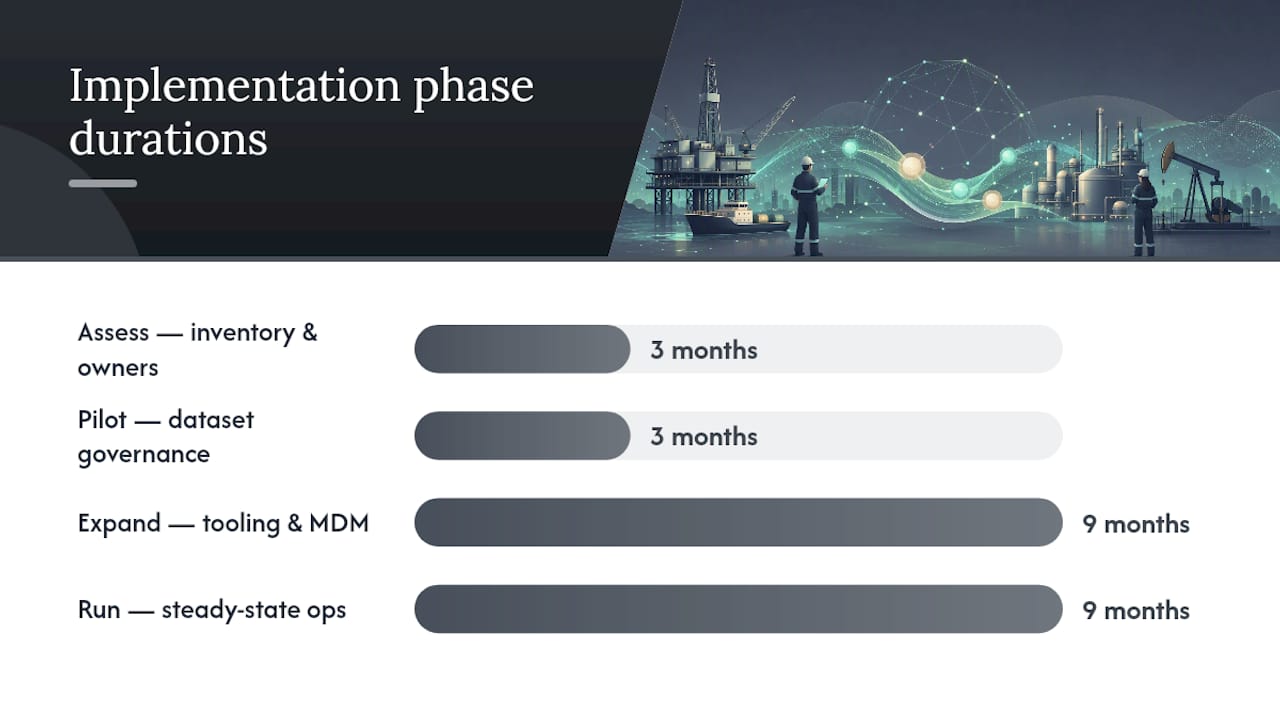
| Phase | Duration | Core Outcomes |
|---|---|---|
| Assess | Months 1 to 3 | Asset inventory complete; data owners assigned; baseline quality scores established; tooling shortlist defined |
| Pilot | Months 4–6 | Governance live on 1–2 high-value datasets; catalog deployed; first quality KPIs tracked; steward cadence running |
| Expand | Months 7–15 | OT/ICS adapters integrated; MDM live for well headers; lineage coverage extended; security controls enforced across IT and OT |
| Run | Months 16–24 | Full program operational; quarterly audits routine; governance automation reducing manual steward effort; KPIs trending toward targets |
Typical cost buckets
Costs vary significantly by operator size and existing infrastructure. Think in three tiers:
- Small pilot (months 1–6): People (part-time sponsor, one data owner, one steward) plus catalog tooling license. No major integration work yet.
- Mid-scale expansion (months 7–15): Add OT adapters, MDM licensing, data quality engine, and integration engineering effort. This is where most of the budget lands.
- Enterprise steady-state (months 16+): Ongoing licensing, automation tooling, training, and quarterly audit support. Governance automation reduces the steward headcount required to maintain quality at scale.
KPIs to track from day one
- Data completeness rate per governed dataset (target: 95%+ for well headers within 90 days of pilot launch).
- Lineage coverage — percentage of datasets with documented lineage from source to report.
- Ownership coverage — percentage of datasets with a named, active data owner.
- Quality incident count — number of data quality issues opened and resolved per month; track trend, not just absolute count.
- Access-rights compliance — percentage of accounts reviewed and confirmed within the quarterly cycle.
What are the most common pitfalls and how do you avoid them?
The failures that kill upstream governance programs are predictable: data silos that no one has authority to break, stewards who have the title but not the time, OT data that sits behind a firewall and never gets governed, and executive sponsors who disappear after the kickoff meeting.
The Frontiers in Earth Science review of oil and gas enterprises documents the data-island problem explicitly: inconsistent standards, slow system construction, and fragmented platforms create governance gaps that compound over time. Here is how each common failure plays out and what to do about it:
- Data silos and legacy systems — mitigation: prioritize OT/ICS integration adapters in the Expand phase; use non-invasive connectors so you can govern historian data without touching control logic. Phase the work to avoid operational disruption.
- Weak or nominal stewardship — mitigation: stewards need protected time (at minimum, four hours per week) and a clear escalation path to their data owner. If stewardship is a side job with no protected hours, quality checks will not happen.
- No executive sponsorship after kickoff — mitigation: tie governance KPIs to an executive dashboard and schedule a monthly 30-minute sponsor review. Sponsors stay engaged when they see their name on a metric.
- Underfunded pilots — mitigation: scope the pilot to one dataset and two systems. A narrow, well-resourced pilot that shows measurable quality improvement in 90 days is worth more than a broad pilot that produces a slide deck.
- Inconsistent standards across vendors and partners — mitigation: adopt PPDM data standards for well identifiers and production units as the contractual baseline for all data deliveries. Put it in vendor contracts, not just internal policy.
- Inaccessible OT data — mitigation: work with operations technology teams early; frame OT governance as a reliability and safety benefit, not an IT compliance exercise. Blockchain-based immutability concepts are emerging for cross-organizational data trust, though most operators start with simpler audit-log approaches.
Pro Tip: Change management in field operations is harder than the technology. Run a half-day workshop with field supervisors before deploying any new data entry workflow. Show them how the change reduces their rework, not how it improves a KPI they will never see. Field buy-in at the source is what keeps governed data clean.
How an operations platform operationalizes governance
An operations platform built for upstream can serve as the practical backbone of your governance program, centralizing master data, enforcing workflows, and delivering the audit trails that regulators and investors expect. The governance outcome is not a side effect — it is the architecture.
Here is how platform features map to governance controls:
- Centralized well and production records → master data single source of truth; eliminates the reconciliation problem between field tablets, accounting, and reporting systems. Wellsmanager’s single-source-of-truth architecture is built around this principle.
- Per-well P&L tracking → financial data lineage from production volume to revenue to investor distribution; every number is traceable to its source record.
- Audit trails on all record changes → satisfies the Audit leg of the 4A framework; supports ONRR and state regulatory reviews without manual log extraction.
- Role-based access controls → enforces Authorization and Access controls across operator, investor, and vendor user types.
- Compliance notifications → automated alerts for lease expirations, regulatory filing deadlines, and production reporting windows; governance-as-workflow rather than governance-as-policy-document.
- AI-generated executive briefs → governance output delivered as a decision-ready summary; only possible when the underlying data is trusted and traceable.
- Invoice approval workflows → financial governance applied to vendor data; every approved invoice creates a governed, auditable record tied to a well and a cost center.
Operators who centralize these functions in a single platform reduce the number of systems that need separate governance controls, which cuts both implementation cost and ongoing steward effort.
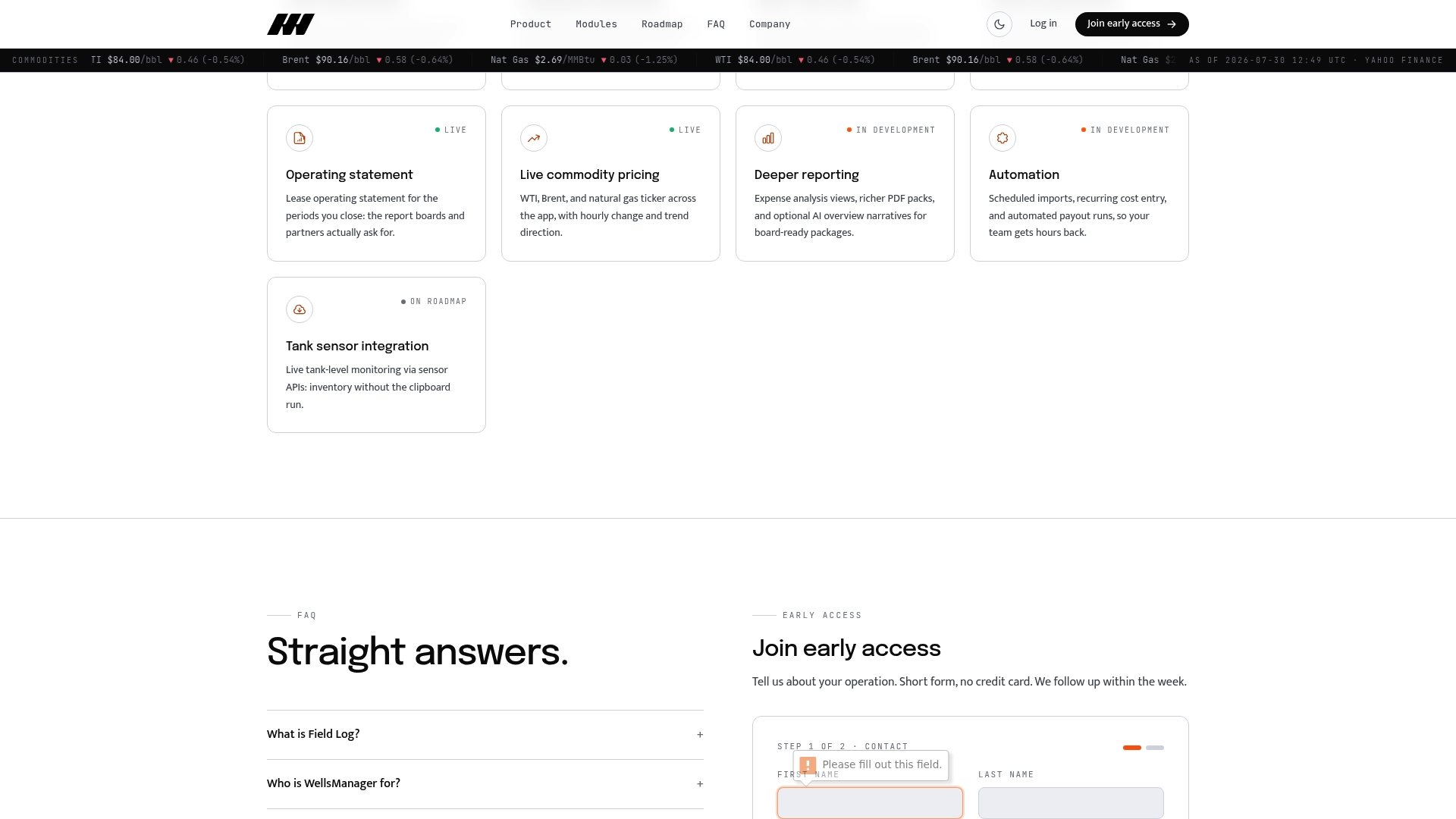
Wellsmanager is built specifically for upstream operators who need governance without a dedicated data engineering team. From per-well P&L to compliance notifications and AI-powered executive reporting, the platform centralizes the records and workflows that make governance real rather than theoretical. See how it works or request access to evaluate it against your current operations.
The governance advice most operators get is backwards
Most governance guidance tells operators to build the framework first: write the policies, stand up the catalog, define the glossary, then worry about adoption. That sequence fails in upstream operations almost every time, and the reason is not technology — it is that field teams and domain engineers were never part of the design.
The PPDM organic governance model gets this right. Governance that is embedded in daily workflows, where a geoscientist’s normal job includes tagging a dataset and a production engineer’s normal job includes validating a daily volume, is governance that actually runs. A separate governance team writing policies in isolation produces documents that nobody reads and audits that nobody passes.
What most articles understate is the OT integration problem. Governing IT data — databases, ERP records, documents — is tractable with standard tools. Governing SCADA historian data, real-time telemetry, and ICS outputs is a different problem entirely. The data volumes are larger, the latency constraints are real, and the operational risk of getting it wrong is measured in production downtime, not report errors.
The other thing worth saying plainly: governance is the prerequisite for credible AI. Every operator is being sold AI-powered analytics and executive reporting. None of it is reliable if the underlying well and production data has no owner, no lineage, and no quality threshold. The AI output is only as trustworthy as the governance program behind it. Build the foundation first, and the analytics investment pays off. Skip it, and you are automating bad data at scale.
Start narrow, show value in 90 days, and use that proof to fund the next phase. That is the sequence that works.
Sources
These references underpin the guidance in this article and are worth reading in full:
- The Rise of Organic Data Governance in Upstream Energy — PPDM Association
- Fortifying Upstream Data Governance - Establishing Centralised Data Governance and Assurance Control Tower
- Data Governance Facilitate Digital Transformation of Oil and Gas Industry — Frontiers in Earth Science
- IBM: Data governance