Compliance Officers: 9 Audit Trail Fields That Prove Tamper Evidence

Audit trail compliance means keeping tamper-evident, time-stamped records that show who did what, when, where, and why, and being able to verify those records the moment an auditor asks. It is not just log storage. It requires proof of integrity: hash-chained or otherwise protected entries, a documented retention schedule, and a way to demonstrate that nothing was altered after the fact. If you can’t verify a record on demand, it doesn’t count as evidence.
TL;DR:
- Audit trails must contain tamper-evident hash chaining or anchoring, with scheduled integrity checks and separate signing keys, to prove records are unaltered.
- Implement centralized, real-time logging with correlation IDs propagated across systems to ensure complete, reconstructible activity chains.
- Retention policies should be explicitly documented, with automated tiered storage for recent, historical, and archived records, aligned with applicable frameworks.
- Regular automated verification, tamper simulation, and separation of duties between data owners and audit system administrators are essential for ongoing compliance.
- Common failures include editable logs, missing key fields like correlation IDs, and admin accounts with write access to audit data, which immediately flag non-compliance.
Table of Contents
- What an Audit Trail Actually Is and What Problem It Solves
- Core Fields Every Compliance-Ready Audit Trail Needs
- How the Major Frameworks Actually Treat Audit Trails
- Making Logs Tamper-Evident: Hash Chains and Anchoring
- Building the Architecture: Ingestion Through Verification
- Setting Retention Rules and Storage Tiers That Actually Hold Up
- Verifying the Trail and Handling It at Scale
- Red Flags Auditors Spot Almost Immediately
- A Practical Checklist for Compliance Officers
- What Field Records Have to Prove in an Audit
- What Compliance Officers Should Prioritize This Year
- How a Field Records Software Can Keep Your Records Audit Ready
- Sources
- FAQ
What an Audit Trail Actually Is and What Problem It Solves
An audit trail is a chronological record of activity built for one purpose: proving what happened after the fact, to someone who wasn’t there. That distinguishes it from a plain application log, which is written for developers to debug something, not for a regulator or forensic investigator to reconstruct events months later.
A real audit trail captures who performed an action, what the action was, when it happened down to the second, where it originated, and why (which business process or request triggered it). Most teams get the “who” and “when” right and skip the “why,” which is exactly the field auditors ask for first when a discrepancy shows up.
The missing piece in most homegrown logging setups is correlation. A single business transaction, say, a payment adjustment, often touches five or six systems. Without a correlation ID or request ID tying those five events together, you can’t reconstruct the full sequence. Auditors notice this immediately, because it means you can show fragments of a story but not the story.
That’s why application logs alone routinely fail audit scrutiny. They’re often mutable (someone with database access can edit a row), inconsistently formatted across services, and missing the context fields an examiner needs.
Audit trails typically serve four overlapping jobs:
- Compliance proof: showing a regulator or auditor that controls were followed, not just claimed
- Incident response: reconstructing exactly what an attacker or a faulty process did, in what order
- Fraud detection: spotting patterns, like the same employee approving and processing the same transaction
- Internal accountability: settling internal disputes about who changed what and when
Core Fields Every Compliance-Ready Audit Trail Needs
Auditors don’t grade audit trails on volume. They grade them on completeness of specific fields, because a missing field is a gap they’ll flag in the finding letter. The NIST glossary definition of audit trail frames it as a record sufficient to reconstruct, review, and examine a sequence of environments and activities, which is a useful test: could a stranger rebuild the event from your record alone?
At minimum, a compliance-ready record needs these fields:
- Actor identifier: the specific user, service account, or system process that performed the action, not a shared or generic login
- Canonical timestamp: recorded in a single, consistent time zone (UTC is standard) with millisecond precision
- Action performed: a specific verb (created, modified, deleted, viewed, approved) rather than a vague status code
- Resource affected: the exact record, file, or account touched by the action
- Result or status: whether the action succeeded, failed, or was rejected
- Source context: IP address, device identifier, or application/user-agent string
- Payload hash: a cryptographic hash of the record’s content at the time of the event, used later to prove nothing changed
- Correlation ID: a shared identifier linking related events across services into one traceable chain
- Sequence number: a strictly increasing counter within a log stream, used to detect missing or deleted entries
Canonical serialization matters more than most teams realize. If you hash a JSON payload before you’ve normalized field order, whitespace, and encoding, the same logical event can produce two different hashes depending on which system wrote it. That breaks your integrity check before you’ve even started verifying anything. Sequence numbers solve a related problem: gap detection. If entry 4,821 is followed by entry 4,823, something is missing, and a verification job should catch that instantly rather than waiting for an auditor to count.
Pro Tip: Store the canonical serialization format alongside the hash algorithm version in your schema documentation. When you eventually rotate hash algorithms (and you will), you need to prove old records were hashed correctly under the rules that existed at the time.
How the Major Frameworks Actually Treat Audit Trails
Different regulations describe audit trail requirements in different language, but they converge on the same core demand: prove activity happened, prove it wasn’t altered, and keep the proof long enough to matter.
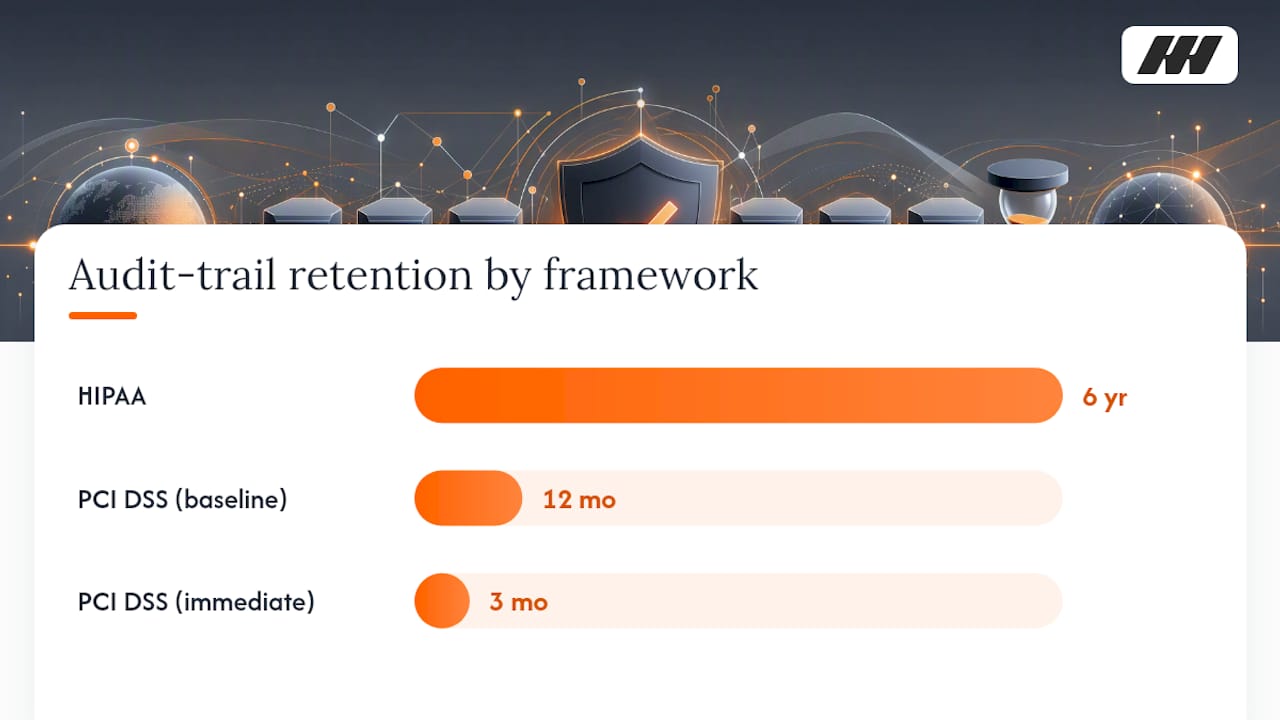
- HIPAA: The Security Rule’s audit controls standard, 45 CFR §164.312(b), requires mechanisms that record and examine activity in any system containing electronic protected health information. Related documentation must be retained for six years.
- PCI DSS: Requirement 10 mandates logging of individual access to cardholder data and administrative actions, with logs protected from modification. Standard guidance calls for at least 12 months of retention, with the most recent 3 months immediately available for analysis.
- SOX: The Sarbanes-Oxley Act doesn’t specify a log format, but Section 404 internal-controls attestations depend heavily on being able to show who approved financial entries and when, which makes an audit trail the practical evidence behind the attestation.
- SEC Rule 17a-4: Broker-dealer recordkeeping rules require preserving records in a non-rewriteable, non-erasable format, though the SEC accepts tamper-evident alternatives to physical WORM storage when the method demonstrably preserves integrity.
- NIST SP 800-92 and SP 800-53: NIST’s log management guidance and its AU control family in SP 800-53 lay out the technical baseline nearly every other framework references indirectly: generate, protect, retain, and periodically review.
- SOC 2: Trust Services Criterion CC7.2 expects organizations to monitor system components for anomalies and evaluate whether those anomalies represent a security event, which in practice requires an audit trail robust enough to support that review.
Retention periods vary sharply by framework, and treating them as interchangeable is a common mistake. HIPAA’s documentation retention runs six years. PCI’s baseline is 12 months of availability with 3 months on hand for immediate review. Federal systems following NIST guidance often set longer windows tied to system categorization under FISMA. There’s no universal number, so document the specific retention period you’re following and the regulation that drives it, rather than picking a round number that sounds safe.
For each framework you’re subject to, keep a short evidence map: the exact citation, the control it maps to internally, and where the proof lives (a policy document, a verification log, a signed checkpoint). That map is usually the first thing an auditor asks for, before they ask to see a single log entry.
Making Logs Tamper-Evident: Hash Chains and Anchoring
A log that can be edited after the fact isn’t an audit trail, no matter how detailed it is. Tamper-evidence is what separates a record an auditor trusts from one they treat as a claim.
The most common mechanism is hash chaining: each new log entry includes a hash of the previous entry, so altering any past record breaks every hash that follows it. Building this correctly requires care at the write path. The system must read the last hash and insert the new record atomically, typically under serializable isolation, or concurrent writes can create a race condition that silently breaks the chain without anyone noticing until a verification job catches it.
At scale, checking every individual hash on every read gets expensive, so most mature systems use Merkle roots: batches of entries get rolled into a tree, and only the root needs to be signed and checked. This lets you verify millions of records by checking one signed value instead of walking the entire chain.
For higher-stakes environments, internal hash chaining alone may not be enough:
- WORM storage: write-once-read-many storage that physically or logically prevents overwrite, often used to satisfy SEC Rule 17a-4
- RFC 3161 timestamping: a trusted third party cryptographically timestamps a checkpoint, proving it existed at a specific moment
- Public notarization: anchoring a checkpoint hash to a public, immutable ledger so its existence at a point in time is independently verifiable
Which level you need depends on your regulatory exposure. A robust internal hash chain with documented, scheduled verification is usually sufficient for SOC 2 or ISO frameworks. Financial and defense environments subject to stricter recordkeeping rules more often need external attestation on top of that.
Pro Tip: Don’t skip key management when you plan your hashing strategy. A perfectly designed hash chain is worthless if the signing key that protects your checkpoints sits in the same database an admin can already edit.
Building the Architecture: Ingestion Through Verification
Audit logging architecture fails most often at the seams between systems, not inside any single system. Getting the ingestion path right matters as much as the cryptography.
Write audit events at the point of action, inside the same transaction as the business operation, rather than reconstructing them later from other data. Post-hoc exports (batch jobs that generate audit records after the fact from application state) are notoriously unreliable, because they miss failed attempts, rejected requests, and anything that didn’t leave a clean trace in the primary data.
- Producer-side writes: emit the audit event synchronously with the action, using guaranteed-delivery patterns (an outbox pattern or durable message queue) so a crash doesn’t silently drop the record
- Centralized ingestion: route every service’s events into one pipeline rather than letting each team keep its own log store with its own format
- Correlation ID propagation: pass the same ID through every service a request touches, from the API gateway to the database write
- Schema enforcement: reject malformed events at ingestion rather than accepting whatever each service happens to send
- Separation of duties: the accounts and roles that write business data should not be the same accounts with write access to the audit store
- Meta-audit logging: log every access to and change made within the audit system itself, so the audit trail has its own audit trail
- Scheduled verification: run automated integrity checks on a fixed cadence, not only when someone remembers to
| Architecture layer | What it prevents | Owner |
|---|---|---|
| Producer-side writes | Silent event loss on crash | Application team |
| Centralized ingestion | Fragmented, inconsistent formats | Platform/security team |
| Correlation ID propagation | Broken chains across services | Application team |
| Separation of duties | Insider tampering | IAM/security team |
| Scheduled verification | Undetected corruption | Compliance/security team |
NIST’s updated log management playbook explicitly ties this kind of layered control to FISMA, HIPAA, SOX, and PCI compliance, and calls out separation of duties and scheduled verification as baseline expectations, not optional hardening.
Setting Retention Rules and Storage Tiers That Actually Hold Up
Retention policy on paper and retention enforcement in practice are two different things, and auditors test the second one, not the first.
A tiered storage approach handles both cost and access speed. Hot storage holds recent records (typically the last 30 to 90 days) for fast query access during active investigations. Warm storage holds records that are older but still occasionally needed, often the remainder of a required retention window. Cold storage, usually immutable object storage or WORM-backed archives, holds records past the active window purely for regulatory retention.
- Set lifecycle rules that automatically move records between tiers rather than relying on someone remembering to archive them
- Document the lawful basis and retention justification wherever personal data appears in the trail, especially under privacy frameworks that require a defined purpose for holding personal data
- Preserve export capability at every tier. An archive you can’t extract and hand to an auditor in a readable format is functionally useless, no matter how well protected it is
- Test your archive restoration process before you need it for real, not during an active audit
Reconciling privacy obligations with retention obligations takes real judgment. A privacy regulation might push you toward minimizing personal data retention, while HIPAA or PCI push toward multi-year retention of activity records. The resolution is usually field-level: keep the audit event, but avoid embedding unnecessary personal data inside the payload itself. Our guide to retention policy design for upstream operators walks through how to structure lifecycle rules in more operational detail.
Verifying the Trail and Handling It at Scale
A hash chain nobody ever checks provides the same protection as no hash chain at all. Verification is the part of audit trail management that most teams build once and then forget to operate.
- Run automated verification jobs on a fixed schedule (daily is common for high-volume systems) that walk the chain or check the latest Merkle root against the last signed checkpoint
- Simulate tamper tests periodically: deliberately alter a test record in a non-production environment and confirm the verification job actually catches it
- Maintain a documented runbook for what happens when verification fails, including who gets alerted and how the incident gets escalated
- Keep a meta-audit trail of the audit system’s own operations, including every verification run, every alert, and every access to the raw log store
Scale introduces its own failure modes. As you add services, formats drift: one team logs timestamps in local time, another in UTC; one uses “user_id,” another uses “actor.” Normalize formats at ingestion, not after the fact, and buffer ingestion so a traffic spike doesn’t cause dropped events under load.
Pro Tip: Schedule your tamper simulation on the same calendar as your disaster recovery tests. If you’re already exercising your incident response muscles once a quarter, verification testing fits naturally into that same rhythm instead of becoming one more thing that quietly never happens.
Red Flags Auditors Spot Almost Immediately
Most audit trail failures aren’t subtle. They’re the same handful of mistakes showing up again and again across organizations that assumed logging was the same thing as compliance.
- Editable database tables marketed as audit logs: if any account with normal database access can update or delete a row in the audit table, it isn’t an audit trail
- Missing required fields: no actor ID, no correlation ID, inconsistent timestamps across services
- No verification records: a hash chain exists, but nobody can produce evidence it’s ever been checked
- Over-privileged admin accounts: the same administrator who manages the application also has write access to the audit store, which defeats separation of duties entirely
- Inconsistent schema across systems: one team’s “created” event looks structurally nothing like another team’s, making correlation across the two nearly impossible
Any one of these findings is usually enough to trigger a broader review of everything else you’ve submitted.
A Practical Checklist for Compliance Officers
Before an audit starts, run through the checkpoints that examiners actually test, not the ones that feel comfortable to check off.
- Confirm tamper-evidence is active: hash chaining or Merkle checkpoints, with signing keys stored separately from the audit data itself
- Confirm a verification schedule exists and produces dated, retrievable proof of each run
- Confirm retention enforcement matches your documented policy, tier by tier, with lifecycle rules actually running
- Confirm separation of duties: no account can both perform an action and edit its own audit trail
- Confirm you can export a readable evidence bundle for any given date range on request
| Priority | Task | Time to fix |
|---|---|---|
| Quick win | Turn on scheduled verification jobs and alerting | Days |
| Quick win | Document the retention policy and citation for each framework | Days |
| Architecture task | Implement hash chaining or Merkle checkpoints | Weeks |
| Architecture task | Centralize ingestion and enforce correlation IDs | Weeks to months |
| Architecture task | Separate audit-store write access from application admin roles | Weeks |
Suggested artifacts to have ready before the auditor asks: verification logs with timestamps, signed checkpoints, the incident runbook for verification failures, and the written retention policy tied to each applicable framework.
What Field Records Have to Prove in an Audit
Compliance officers reviewing operators in the Permian run into the same audit trail principles, just applied to field data instead of IT systems. A field ticket that gets audited needs the same core fields as any other compliance record: who performed the work, the exact timestamp, what work was actually done, the cost incurred, the vendor identifier, and a signature or approval tying the ticket to a specific person, not a shared login.
- Field tickets need the who, when, what-was-done, and cost fields intact, plus a vendor ID that ties back to a specific service company
- Well cost book entries need to trace back to the originating field ticket, not exist as a separate, disconnected total
- Investor payment traces need to show the calculation path from production revenue to expense allocation to the check or distribution amount, so a partner or auditor can follow the money without guessing
- Every one of these records should be exportable on request, not locked inside a format only one person knows how to read
Our guide to electronic field tickets covers which specific fields matter most when a ticket becomes evidence rather than just a work record.
What Compliance Officers Should Prioritize This Year
Most audit trail failures I see aren’t sophisticated. They’re gaps that sat unaddressed because nobody scheduled the fix. If you’re triaging where to spend the next six months, work in three windows.
In the first 30 days, inventory every system that touches regulated data and confirm which ones actually have tamper-evident logging versus editable tables mislabeled as audit logs. In the next 90 days, get scheduled verification running with alerting, even if your hash chaining implementation isn’t perfect yet. Something running beats something planned. By 180 days, separation of duties should be enforced everywhere, not just documented in a policy nobody checks against reality.
The mistake I keep seeing is treating verification as optional because “the chain hasn’t broken yet.” That logic only holds until the day it doesn’t, and that’s the day an auditor is standing in your office asking for proof you don’t have.
— Pedro
How a Field Records Software Can Keep Your Records Audit Ready
Wellsmanager gives Permian operators one place where field work tickets, per-well costs, and investor payments live as connected records instead of scattered notes across a notebook, a group text, and three spreadsheets. That connection is the difference an auditor actually cares about: a cost entry that traces cleanly back to the field ticket that generated it, and a payment that traces back to the well it came from.
Operators using Wellsmanager can pull a well’s full cost history, the field tickets behind each line item, and the investor distribution record tied to that well’s production, all in exportable form. That’s the kind of evidence bundle a partner or an auditor asks for when they want to see the math, not just the total. Get a look at how the WellsManager platform organizes field tickets, per-well cost books, and investor statements, and see whether it fits how your leases actually run.
Sources
Keep these on hand as your primary references rather than relying on secondhand summaries. NIST SP 800-92 and its updated playbook cover technical log management controls in depth. HHS’s HIPAA Security Rule page is the authoritative source for healthcare audit control language. PCI Security Standards Council publishes the current Requirement 10 text for payment environments. The SEC site covers recordkeeping rules for financial firms, and Microsoft’s guidance on 21 CFR Part 11 is a clear technical explainer for electronic records and signatures in regulated life sciences systems.
- Guide to Computer Security Log Management (NIST SP 800-92)
- HHS: HIPAA Security Rule — For Professionals
- PCI Security Standards Council
- Microsoft: Offering — FDA CFR Title 21 Part 11
FAQ
What Should Be Included in an Audit Trail?
A compliant audit trail needs the actor’s identity, a precise timestamp, the specific action taken, the resource affected, the result, source context like IP address, a payload hash, and a correlation ID linking related events across systems.
Is an Audit Trail Mandatory?
Yes, for most regulated organizations. Frameworks including HIPAA’s Security Rule, PCI DSS Requirement 10, SOX financial controls, and SEC Rule 17a-4 all require some form of activity logging with specific integrity and retention expectations.
What Are Common Audit Trail Mistakes?
The most frequent failures are editable database tables mislabeled as audit logs, missing required fields like correlation IDs, no evidence that verification ever ran, and admin accounts with write access to the same audit data they’re supposed to be checked by.
What Are the Requirements for an Audit Trail Under 21 CFR Part 11?
Part 11 requires systems handling electronic records to maintain secure, time-stamped audit trails documenting who created, modified, or deleted a record and when, alongside validated electronic signatures, as detailed in Microsoft’s compliance guidance.
How Long Should Audit Trail Records Be Retained?
Retention periods depend on the framework: HIPAA-related documentation requires six years, while PCI DSS calls for at least 12 months of availability with 3 months immediately accessible. Always document the specific citation driving your retention window rather than applying a generic number.