10, 12, 14 Digit API Number Format for U.S. Wells and Normalize IDs
An API number is a numeric code, generally consisting of 10, 12, or 14 digits, that identifies a single wellbore in the United States. The digits break into five groups: state code, county code, unique well identifier, sidetrack code, and event sequence code. The formal steward of this format is now the PPDM Association, which calls it the US Well Number Standard, though most people in the field still say “API number” out of habit.
TL;DR:
- The 14-digit US Well Number includes separate segments for state, county, well ID, sidetrack, and event sequence, but shorter versions are common in practice.
- State and county codes follow specific numbering schemes that differ from FIPS codes and vary by state, requiring consultation of local reference tables.
- The sidetrack digits indicate wellbore branches, while the event sequence reflects operational changes like recompletions on the same wellbore.
- API numbers are assigned by state regulators and verified through official agency databases, not by PPDM or other organizations.
- Maintaining a consistent, normalized well identifier like the API number prevents data mismatches and reporting errors across various operational systems.
Table of Contents
- API Number Format at a Glance
- Decoding Each Part of the API Number
- Why Everyone Still Calls It an API Number
- Who Assigns API Numbers and How to Verify One
- Common Pitfalls When Working With API Numbers in Data Systems
- Decoded Examples of the API Number Format
- How to Look Up an API Number Yourself
- Why Consistent Well Identifiers Matter More Than They Get Credit For
- Where WellsManager Fits Into Well Identifier Management
- Sources
- FAQ
API Number Format at a Glance
Break the code down visually and it reads like this:
State (2 digits) . County (3 digits) . Unique well ID (5 digits) . Sidetrack (2 digits) . Event sequence (2 digits)
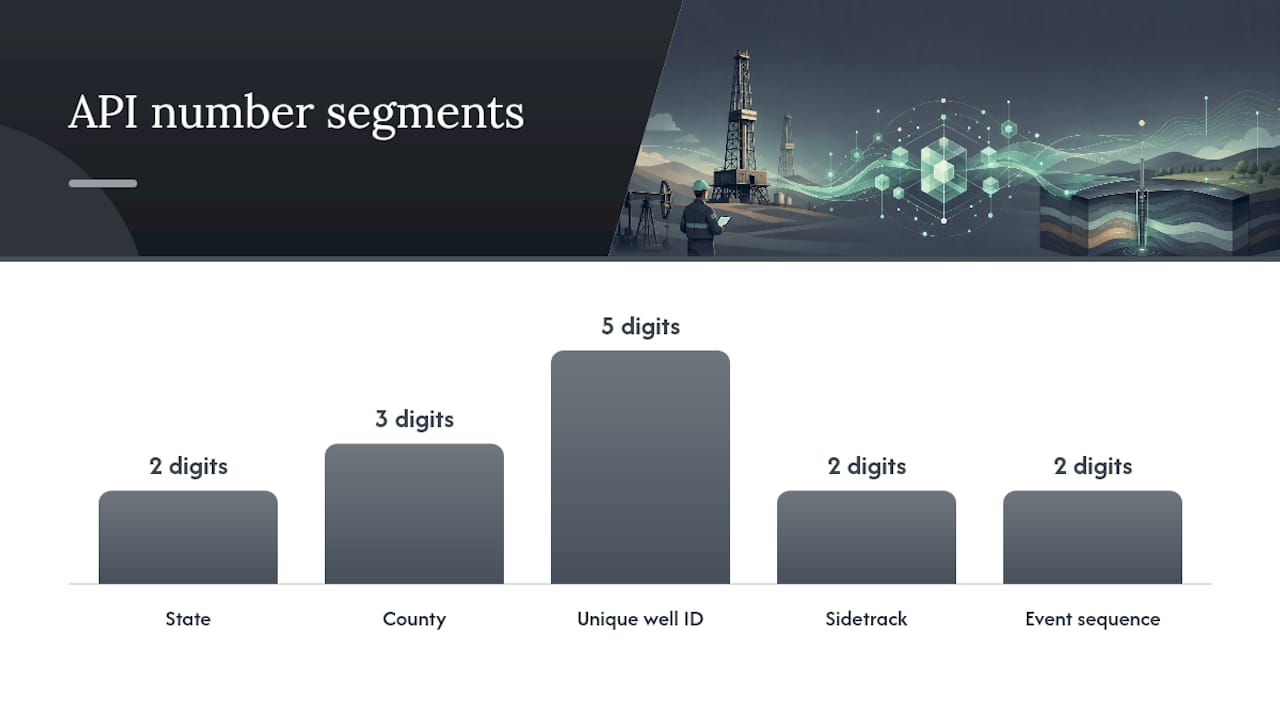
Each segment answers a different question about the well. The state code tells you which jurisdiction issued the number. The county code narrows it to a specific county within that state. The unique well identifier is the actual fingerprint, a number assigned once per wellbore within that county. The last two pairs, sidetrack and event sequence, track what happened to that wellbore over its life.
Shorter versions of the number simply drop the suffixes:
- A 10-digit number covers state, county, and unique well ID only. Practitioners often call this the surface location number because it identifies where the well penetrates the ground, according to Enverus.
- A 12-digit number adds the sidetrack code, useful once a well has more than one wellbore.
- A 14-digit number adds the event sequence, the fullest and most precise version.
Offshore wells and a handful of edge cases use pseudo-state codes rather than a standard two-letter state assignment, since federal waters do not belong to any single state. The number always anchors to the surface hole location, not wherever the wellbore ends up underground.
Decoding Each Part of the API Number
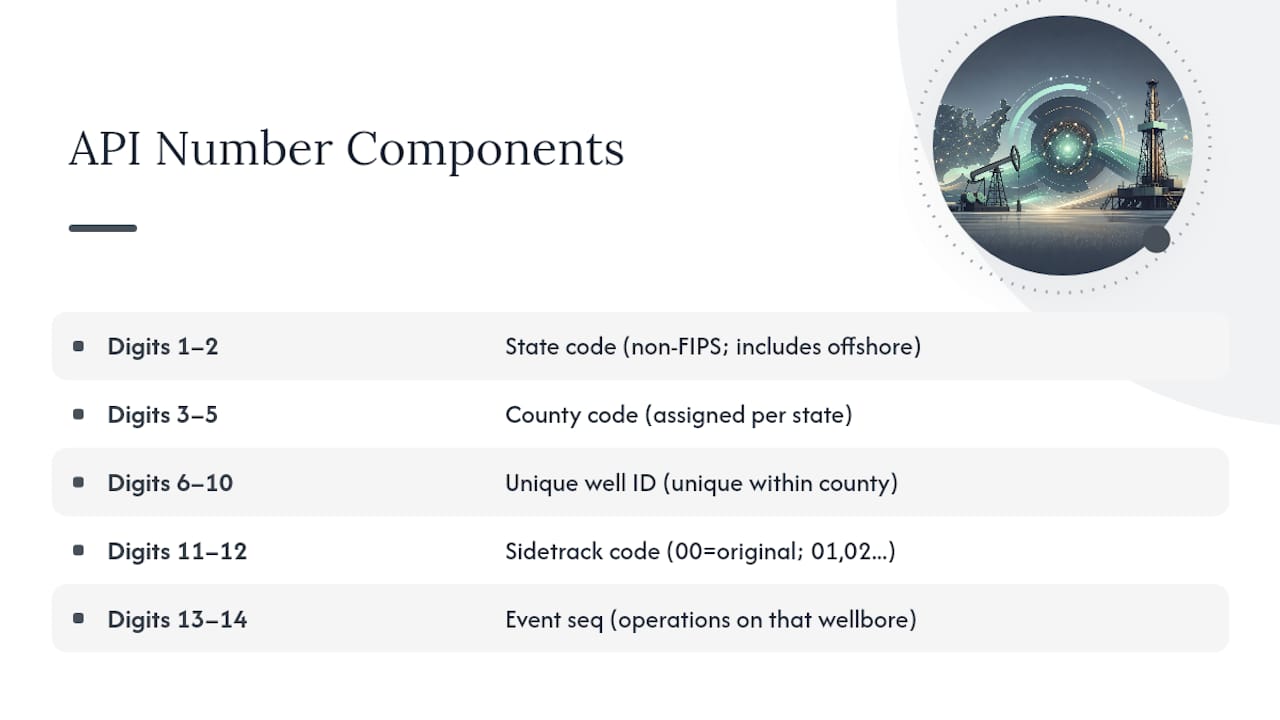
The breakdown documented by the New York State Museum’s ESOGIS resource lays out the five components precisely: digits 1 to 2 are the state code, 3 to 5 are the county code, 6 to 10 are the unique well identifier, 11 to 12 are the sidetrack code, and 13 to 14 are the event sequence code. A 00-00 suffix almost always signals the original wellbore and its original completion.
State code. These two digits do not map to FIPS state codes, a mistake that trips up a lot of people building lookup tables from scratch. They follow a separate numbering scheme with a few pseudo-state codes reserved for offshore federal waters and Gulf Coast areas that do not sit neatly inside one state’s boundary.
County code. Each state assigns its own three-digit county codes, and the logic varies. Some states run them alphabetically; others inherited older numbering conventions from before digital recordkeeping existed. Check the assigning state’s own reference table rather than assuming consistency across state lines.
Unique well identifier. This five-digit block is typically unique within a county, not nationwide. Historical wells sometimes carry a 00000 placeholder or fall into a legacy series issued before modern permitting systems existed.
Sidetrack code (digits 11-12). Increment this when a wellbore branches into a distinct bottom-hole location. The original hole stays 00; the first sidetrack becomes 01, the next 02, and so on.
One detail engineers and analysts miss constantly: the sidetrack digits describe the wellbore, while the event sequence digits describe operations performed on that wellbore. Confusing the two corrupts historical well-event records fast.
Event sequence (digits 13-14). This increments for recompletions, plug-backs, or other major operational events on a specific wellbore. States vary on exactly when they bump this number, per Pennsylvania DEP’s technical guidance, so always check the assigning authority’s own policy before assuming a change means what you think it means.
Why Everyone Still Calls It an API Number
Custody of this standard moved away from the American Petroleum Institute in 2010, when the PPDM Association took over stewardship of what had been API Bulletin D12A. PPDM published an updated standard in 2013 specifically to handle the messier reality of modern wells, multi-lateral designs, and pad drilling that the original bulletin never anticipated.
The name change matters more than it sounds. “US Well Number” is the accurate, current term. “API number” is the shorthand nearly everyone still uses out of momentum, according to Enverus. A few practical points worth remembering:
- PPDM’s revision was built with input from operators and regulators specifically to reduce ambiguity across multi-well pads.
- Datasets labeled “API number” and “US Well Number” refer to the same identifier system; don’t treat them as separate fields.
- Vendors and internal systems built before 2013 may still reference the older bulletin’s terminology in documentation, even though the underlying numbers work the same way.
— Pedro
Who Assigns API Numbers and How to Verify One
The number itself always comes from a state regulator, not from PPDM. PPDM defines the format and the rules; each state oil and gas commission or equivalent agency is the assigning authority that actually issues the number for a specific well.
- Identify the correct state agency. Most operate a public permitting or well database (Texas RRC, North Dakota DMR, and Pennsylvania DEP all run searchable systems).
- Search by operator name, lease name, or a partial well number if you already have one.
- Confirm the assignment matches the surface location and spud date you expect. A mismatch usually means you’re looking at the wrong wellbore, not an error in the number itself.
- If you spot a discrepancy, contact the assigning authority directly. Corrections and legacy 00000 series numbers are handled at the state level, not by PPDM.
Common Pitfalls When Working With API Numbers in Data Systems
The single biggest mistake: the number anchors to the surface location, not the bottom hole. For long laterals crossing county or even state lines underground, this means production sometimes gets attributed to a different jurisdiction than where the oil actually comes from, per ESOGIS.
Pro Tip: Store two versions of every API number: a 14-digit zero-padded numeric string with no dashes as your primary key for machine joins, and a dashed display string for reports and screens humans actually read. Keep the assigning state and spud date attached to that record permanently.
A few more practices worth building into any well data pipeline:
- Normalize digit length before joining datasets. Joining a 10-digit source against a 14-digit source without padding or truncating consistently silently drops matches.
- Treat the unique well identifier as county-scoped, never assume global uniqueness on its own.
- Many operators map API numbers to internal proprietary IDs to represent pads, tank batteries, or shared equipment that doesn’t correspond to a single wellbore at all.
Decoded Examples of the API Number Format
Take 42-201-20245-00-00. That’s state code 42 (Texas), county code 201, unique well identifier 20245, sidetrack 00 (original wellbore), and event sequence 00 (original completion), matching the example format documented by Pennsylvania DEP.
Now compare 23-001-20130-01-01. State 23, county 001, unique well identifier 20130, but sidetrack code 01 tells you this is the well’s first branch off the original bore, and event sequence 01 shows at least one recompletion or major operational event since that sidetrack was drilled.
A few more patterns show up often enough to flag:
- A jump from 00-00 to 00-01 on the same well means a recompletion happened without a new wellbore.
- Historical wells drilled before digital permitting sometimes carry 00000 as the unique well identifier, a legacy placeholder rather than a true sequential ID.
- Offshore wells use pseudo-state codes instead of a conventional two-digit state assignment, since federal waters don’t belong to a single state’s numbering system.
How to Look Up an API Number Yourself
- Find the relevant state’s oil and gas commission or permitting portal (examples include the West Virginia DEP’s explanation page, Texas RRC, and North Dakota DMR).
- Search by operator, lease name, or a partial number if you have one already.
- Confirm surface location, spud date, operator name, and current well status all match what you expect.
- Only after confirming the state’s own record should you cross-check against PPDM or third-party industry datasets, since the state record is the authoritative source.
Why Consistent Well Identifiers Matter More Than They Get Credit For
Most reporting errors I’ve seen trace back to the same root cause: two records for the same well, keyed differently, that nobody caught before an invoice or a distribution went out. Consistent identifiers close that gap. When every field ticket, invoice, and lease operating statement references the same canonical well number, the math reconciles itself instead of requiring someone to chase down which “Smith 3H” record is the real one.
That’s the same logic behind how Wellsmanager structures its field logs and reporting modules around canonical well IDs. If you’re building or cleaning up an internal system, map every well to its API/US Well Number early. It pays for itself the first time an auditor or an investor asks where a number came from.
Where WellsManager Fits Into Well Identifier Management
Normalizing API numbers by hand across spreadsheets, field tickets, and investor reports is exactly the kind of tedious, error-prone work that eats an operations team’s week. WellsManager maps each API/US Well Number directly to your internal assets, so a single canonical identifier ties together mobile field logs, cost tracking, lease operating statements, and investor distributions without anyone re-keying anything twice.
Field staff log maintenance and costs against the well identifier in real time from a mobile device, and that same identifier flows straight into per-well profit and loss reports and automated distribution statements. For readers who want to see how this looks against actual wells, request access to WellsManager and walk through it with your own well list.
Sources
- US Well Number Standard — PPDM Association
- American Petroleum Institute (API) Number — ESOGIS (NYS Museum)
- API number technical explanation and examples — Pennsylvania DEP (technical PDF)
- THE API NUMBER IS DEAD – LONG LIVE THE US WELL NUMBER — Enverus blog
- API Well Number Explanation — West Virginia DEP
FAQ
What does an API number look like?
It typically appears as a string of digits grouped with dashes, such as 42-201-20245-00-00, representing state, county, unique well identifier, sidetrack, and event sequence.
What is an API number?
It’s a unique identifier assigned to a specific oil or gas wellbore in the United States, now formally called the US Well Number under the standard maintained by PPDM.
What is the API number format?
The full format is 14 digits: a 2-digit state code, 3-digit county code, 5-digit unique well identifier, 2-digit sidetrack code, and 2-digit event sequence code, though 10-digit and 12-digit shortened versions are common in everyday use.
What are all the API codes?
The five code groups are state, county, unique well identifier, sidetrack (wellbore), and event sequence (operation); each state also maintains its own internal county code tables, which you can find on that state’s oil and gas commission site, such as West Virginia DEP’s explanation.
Does WellsManager use API numbers to organize well data?
Yes. WellsManager maps each well’s API/US Well Number to internal field logs, cost tracking, and investor reporting so operators keep one canonical identifier across every workflow.