Regulatory Change Monitoring for Upstream Oil & Gas

Regulatory change monitoring must map each incoming rule to the specific well-level control and financial ledger it affects — not just flag that a rule changed. For upstream operators and finance officers, that means tracing every SEC, EPA, or BLM update through to the affected well, the internal control it touches, and the per-well P&L line where remediation costs land. Automated systems can reduce compliance testing time by up to 75% compared to manual processes, but only when traceability is built in from the start. A monitoring program without that chain — regulation → control → evidence → well → cost — is an alert system, not a compliance system.
What success looks like in practice:
- Per-well obligation map: every active regulatory requirement linked to the wells it governs and the controls that satisfy it
- Live alerts: filtered by jurisdiction (federal, state) and change type so teams receive only relevant updates
- Auditable traceability: a timestamped record from the rule text version through to the evidence artifact and the well expense code
- Human-in-the-loop validation: automation handles triage; subject-matter experts review semantic and deontic changes before any control mapping is finalized
Table of Contents
- Does your monitoring program meet the minimum bar?
- How does modern regulatory change monitoring actually work?
- What does a realistic implementation look like?
- Who owns what, and what evidence must they keep?
- What KPIs tell you the program is working?
- What must a monitoring system actually include?
- Wellsmanager as an integrated option for per-well compliance
- Key Takeaways
- What operators actually get wrong
- Wellsmanager gives operators a production-ready compliance and operations platform
- Useful sources and further reading
Does your monitoring program meet the minimum bar?
Before building or buying, confirm your current setup covers each of these capabilities:
| Capability | What “good” looks like |
|---|---|
| Traceability | Each requirement links to a control, evidence artifact, and named well(s) |
| Jurisdiction filtering | Federal and state oil & gas rules separated; irrelevant alerts suppressed |
| Actionability | Auto-suggested control mappings with assigned owners and due dates |
| Audit readiness | Immutable change records, versioned rule text, evidence attachments |
| Per-well P&L tie-in | Remediation costs tagged to the correct well ledger automatically |
Most operators find gaps in the last two rows. Audit readiness tends to be treated as a documentation task rather than a system requirement, and centralizing regulatory obligations alongside operational data is what closes that gap. Per-well P&L linkage is the one capability that separates a compliance program from a compliance filing cabinet.
Pro Tip: Run a spot check: pick any regulation that changed in the last 90 days and trace it to a specific well and a dollar amount. If you can’t complete that trace in under 10 minutes, your program has a traceability gap.
How does modern regulatory change monitoring actually work?
The mechanics matter because most operators underestimate how much work sits between “a rule changed” and “we know what to do about it.”
Ingestion starts with structured feeds from agency sources: SEC filings, EPA rulemakings, BLM notices, and state oil and gas commission updates. The raw output gets normalized into provision-level units. Research from RegTrack calls these Atomic Legal Units (ALUs) — the smallest discrete provision that can change independently. Working at the ALU level is what makes structural alignment possible; character-level text diffs miss the point entirely.
Classification is where most systems fall short. A single word change can shift legal interpretation, so monitoring must classify the type of change: syntactic edit, reference update, semantic shift, addition, or deletion. MURCIA, an automated regulatory change analysis approach, reported textual change detection F1 scores around 90.5% and deontic interpretation F1 scores in the 80–90% range on evaluated datasets — strong performance, but not a replacement for legal review on ambiguous cases.
Impact mapping translates classified changes into operational obligations: which internal controls need updating, which well procedures are affected, and which expense codes need a remediation tag.
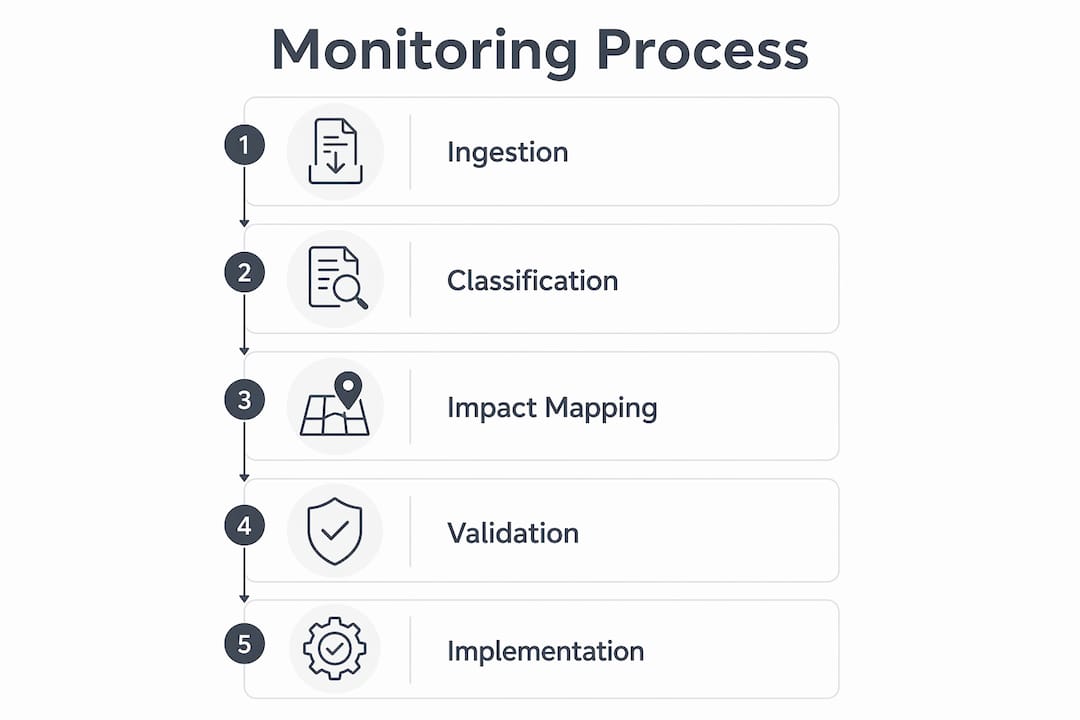
Human-in-the-loop validation is not optional. Automated pipelines perform well on structurally explicit, recurring updates but lose accuracy on narrative or weakly structured documents. Automation handles triage; a compliance analyst or PE reviews every semantic or deontic change before it touches a control mapping.
Pro Tip: Label every change by type in your workflow (syntactic, semantic, deontic, addition, deletion) before routing it. That single classification step cuts expert review time dramatically because reviewers know immediately whether legal sign-off is required.
What does a realistic implementation look like?
A phased rollout keeps risk low and builds internal confidence before you scale.

| Phase | Duration | Key milestone |
|---|---|---|
| — | 2–4 weeks | Regulatory scope defined; wells, controls, and P&L tags inventoried; governance roles assigned |
| Phase 1 — Pilot | 6–10 weeks | 1–2 data sources ingested; 3–5 wells mapped end-to-end; alerting and audit trail validated |
| Phase 2 — Scale | 3–6 months | All wells covered; finance/ERP and field maintenance integration live |
| Phase 3 — Operate | Ongoing | Continuous monitoring; quarterly model tuning; annual regulatory review cadence |
The biggest cost drivers are not licensing fees. Data normalization labor, taxonomy and control-mapping work, and the ongoing cost of expert validation for deontic changes typically exceed software costs in year one. Traceability to per-well procedures and expense codes requires deliberate integration work with your finance and field systems — budget for it explicitly.
Who owns what, and what evidence must they keep?
Governance without named owners collapses under audit pressure. Assign these roles before Phase 1:
- Regulatory owner: monitors feeds, triages incoming changes, and routes by classification type
- Well operations owner: assesses field impact and updates affected procedures
- Compliance analyst: validates control mappings and manages evidence completeness
- Finance owner: tags remediation costs to per-well P&L and tracks financial exposure
- Legal reviewer: required sign-off for every semantic or deontic change
- Audit contact: maintains the immutable change record and evidence export package
The review workflow runs in that order: automated triage → compliance analyst → operations impact → finance tagging → legal sign-off (deontic only). Each step produces a timestamped record. The audit evidence package for any single change must include the rule text version, the control mapping, the well assignment, the owner record, evidence artifact links, and the approval trail.
Pro Tip: For deontic changes — those that create, modify, or remove an obligation — never let the workflow close without a named legal reviewer and a date-stamped sign-off. Regulators ask for exactly that record during field audits.
What KPIs tell you the program is working?
Track these metrics from day one of the pilot:
- Mean time-to-acknowledge an applicable change (target: under 48 hours for high-severity)
- Automated triage rate: percentage of changes classified without manual intervention
- Expert review time per change: hours spent by compliance analysts and legal on each routed item
- Evidence completeness rate: percentage of closed changes with a full audit package attached
- Per-well remediation cost: actual cost tagged to each well’s ledger for regulatory actions
On the ROI side, the math is straightforward. Baseline your current FTE hours spent on manual compliance tracking, apply the up to 75% reduction in compliance testing time that automated systems can deliver on repetitive tasks, and compare that savings against licensing and integration costs to calculate payback months. For most independent operators running 20+ wells, payback falls well inside 18 months.
What must a monitoring system actually include?
Whether you are evaluating a vendor or scoping an internal build, require these capabilities:
- Provision-level change detection using ALU-style structural alignment, not character diffs
- Six-class change taxonomy (no change, syntactic, reference update, semantic, addition, deletion) with routing rules per class
- Traceability chain from rule text version to internal control to specific well asset
- Immutable audit trail with versioned records and evidence attachment support
- Configurable jurisdiction filters for U.S. federal agencies (SEC, EPA, BLM) and state oil and gas commissions
- Per-well P&L and expense code linkage so remediation costs post to the correct ledger automatically
- Field maintenance and vendor invoice integration to capture full remediation cost
- Human review workflow with explicit routing for semantic and deontic changes
- Model explainability — vendors should be able to show why a change was classified as it was
- Evidence export in audit-ready formats (PDF, structured data) for regulator requests
For internal builds, add taxonomy maintenance and ongoing legal validation to your cost model. Benchmarks like RegTrack provide ALU-style test sets you can use to validate vendor accuracy claims before signing a contract.
Wellsmanager as an integrated option for per-well compliance
Wellsmanager implements the full traceability chain as a native feature of its operations platform, not a bolt-on. When a state-level operational condition changes — say, a revised produced water disposal rule from a state oil and gas commission — Wellsmanager routes the notification to the field, tags the affected wells, and attaches any remediation work orders and vendor invoices directly to those wells’ expense ledgers. The compliance record, the cost, and the audit trail live in one place.
Key capabilities relevant to regulatory compliance tracking:
- Per-well P&L tracking with direct linkage to compliance-driven expenses
- Timely compliance notifications filtered to the wells and jurisdictions you operate in
- AI-generated executive briefs that summarize regulatory changes and their operational impact without requiring manual report assembly
- Audit trails with timestamped records from rule change through to evidence and cost posting
For operators who currently manage compliance in spreadsheets, the shift to a per-well obligation map with live alerts and an auditable evidence chain is the single highest-leverage change available.
Key Takeaways
Effective regulatory change monitoring requires per-well traceability from rule text to internal control to financial ledger, with human review preserved for every semantic or deontic change.
| Point | Details |
|---|---|
| Traceability is the core requirement | Map every regulation to a specific well, control, and expense code — not just a corporate obligation register. |
| Automation handles triage, not decisions | Automated systems can reduce compliance testing time by up to 75%, but semantic and deontic changes require expert review. |
| Phase your rollout | Start with a 3–5 well pilot in weeks 6–10 to validate end-to-end alerting and audit trails before scaling. |
| Governance needs named owners | Assign a regulatory owner, operations owner, finance owner, and legal reviewer before Phase 1 begins. |
| Wellsmanager integrates compliance and P&L | Wellsmanager links regulatory notifications to per-well expense tracking and audit trails in a single platform. |
What operators actually get wrong
The operators who struggle with compliance audits almost always have the same problem: they mapped regulations to the company, not to the well. A corporate-level obligation register looks complete on paper. The moment a regulator asks which specific wells were affected by a rule change, when the operator knew, and what it cost to remediate — the spreadsheet falls apart.
The teams that got traction fastest did three things differently. They started with a small, high-risk well cluster rather than trying to cover everything at once. They enforced ownership hard: every change had a named person responsible for closing it, not a team or a department. And they kept legal in the loop for any change that modified an obligation, even when the wording looked minor. A single word shift from “should” to “shall” in a BLM notice is not a syntactic edit — it is a deontic change that can trigger enforcement exposure.
The lesson that keeps coming up: don’t treat the automation layer as a black box. When a system routes a change to a reviewer, the reviewer needs to see the classification rationale, not just the alert. That transparency is what makes the human-in-the-loop model work, and it is what holds up under audit scrutiny.
Wellsmanager gives operators a production-ready compliance and operations platform
Per-well regulatory compliance tracking without a dedicated platform means someone is manually maintaining a spreadsheet that will be wrong by next quarter. Wellsmanager is built for upstream operators who need regulatory obligations, field operations, and per-well financials in one place — not three systems stitched together with exports.
The platform connects compliance notifications directly to well-level P&L, so when a rule changes, the financial exposure is visible immediately. AI-generated executive briefs mean your finance officer gets a clear summary without pulling data from five places. Audit trails are built in, not assembled after the fact.
A focused 30–90 day pilot on a representative well cluster is the fastest way to validate whether your current traceability gaps are as large as you suspect. Request access or schedule a demo to map a sample well set and see the end-to-end chain in your own data.
Useful sources and further reading
- MURCIA — AI-Enabled Regulatory Change Analysis of Legal Requirements (IEEE Xplore): The primary reference for semi-automated regulatory change analysis; covers deontic classification, F1 performance benchmarks, and human-in-the-loop design.
- MURCIA full paper (University of Luxembourg): Detailed methodology for textual and deontic change detection; use to evaluate vendor classification accuracy claims.
- RegTrack — Fine-Grained Benchmark for Multi-Class Legal Change Detection (ACL Anthology): Introduces ALUs and the six-class change taxonomy; the benchmark to use when testing vendor detection accuracy against a structured standard.
- Toward Automated Change Impact Analysis of Financial Regulations (ACM): Covers traceability from regulatory provisions to internal system requirements; directly applicable to per-well procedure and expense code mapping.
- Investigating Automated Change Impact Analysis in FinTech Regulations (fortiss): Sets realistic expectations for automation accuracy on narrative documents; the source for human-in-the-loop design guidance.
- Resolver Compliance Management: Industry reference for the 75% compliance testing time reduction figure and the traceability-to-asset requirement.