Quorum Alternatives for Upstream Operators: 2026 Guide

For U.S. upstream operators evaluating their options, Wellsmanager is the strongest Quorum alternative available today. It covers the full upstream stack — land, production, and accounting — in a single SaaS platform, with per-well P&L, lease operating statements (LOS), vendor expense tracking, and audit trails built in from day one. If your team is running on spreadsheets or hitting the limits of a fragmented toolset, Wellsmanager is where to start the conversation.
One clarification before going further: the name “Quorum” appears in multiple software categories. This guide focuses exclusively on Quorum the oil and gas operations platform — the ERP, land management, and production accounting suite used by upstream operators — not the public affairs or advocacy tools that share the name.
Table of Contents
- What are the best Quorum alternatives for upstream operators?
- What core features must a Quorum alternative deliver?
- How do you choose between Quorum and its alternatives?
- What does a migration from Quorum or spreadsheets actually look like?
- When is Wellsmanager the right pick — and when isn’t it?
- Key Takeaways
- Why Wellsmanager earns the top spot in this comparison
- Wellsmanager is built for operators who need answers at the well level
- Sources and further reading
What are the best Quorum alternatives for upstream operators?
The table below compares Quorum and Wellsmanager across key dimensions that influence purchase decisions for operations managers, production accountants, and CFOs.
| Dimension | Quorum | Wellsmanager |
|---|---|---|
| Overall coverage (land + production + accounting) | Full suite; modular licensing | Integrated suite; all modules included |
| Per-well P&L and LOS | Yes | Yes, with AI-generated executive briefs |
| Compliance and audit trail | Yes | Real-time compliance notifications, full audit trail |
| Integrations (accounting, production, field) | Broad API ecosystem | Accounting, SCADA, field reporting |
| Analytics / AI / digital twin | Limited native AI | AI-powered briefs; digital twin via partners |
| Deployment and security | SaaS and on-premise; SOC2 | SaaS; SOC2-aligned controls |
| Pricing model | Per-module licensing; enterprise contracts | Subscription SaaS; per-operator pricing |
| Implementation and migration | Professional services available | Guided migration with data-mapping support |
| Support and training | Dedicated support; customer community | Onboarding, training, and customer references |
Quorum strengths: Deep market penetration among mid-size to large independents, a broad partner ecosystem, and years of production accounting refinement. Quorum weaknesses: Module-by-module licensing can push total cost of ownership higher than expected, and implementations often run longer than initial estimates.
Wellsmanager strengths: Purpose-built for independent upstream operators, with per-well P&L and LOS available without add-on modules, plus AI-generated executive briefs that save finance teams hours per reporting cycle. Wellsmanager weaknesses: Newer platform, so the partner ecosystem is still growing; very large enterprises with existing ERP commitments may need custom integration work.
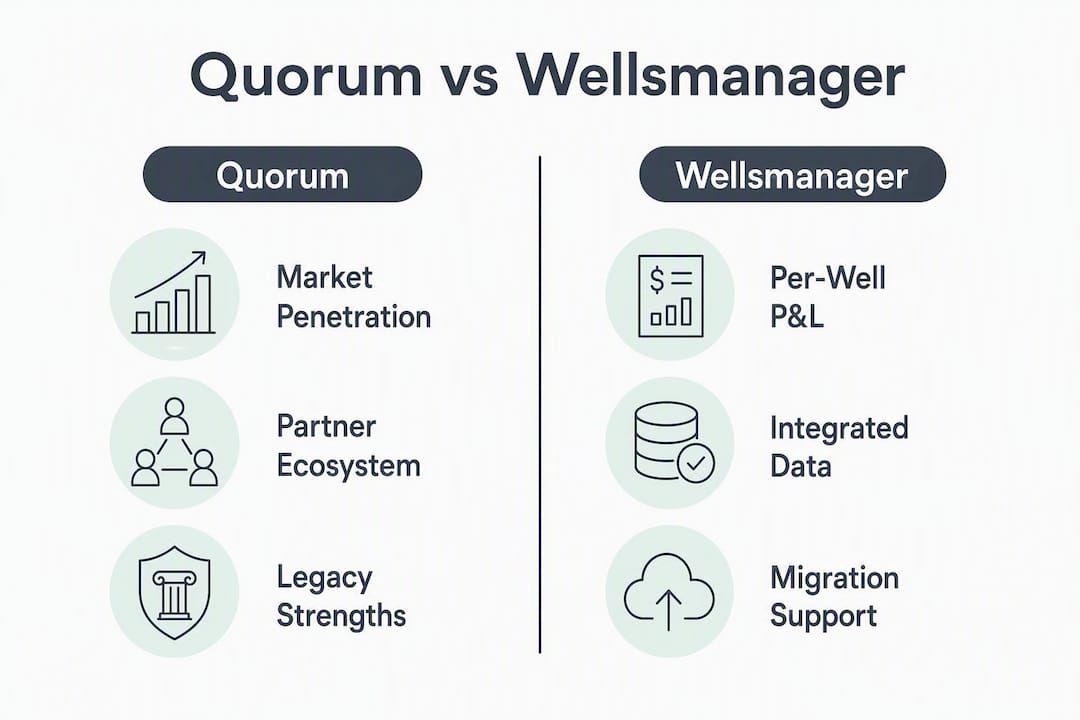
The data-silo risk is the clearest argument for choosing an integrated suite over a patchwork of specialized tools. When land, production, and accounting data live in separate systems, reconciling per-well costs at month-end becomes a manual exercise that introduces errors and delays compliance reporting.
What core features must a Quorum alternative deliver?
Software selection for upstream operators is driven by regulatory compliance and accurate financial reporting — not feature count. Here is what to require from any platform you evaluate:
- Per-well P&L and LOS generation — not just summary financials; you need well-level detail for investor reporting and regulatory filings.
- Expense and vendor ledger tied to individual wells — every invoice, service order, and field cost mapped to a well ID.
- Field work and maintenance logging — pumper reports, workover records, and equipment history in one place.
- Land and lease management basics — lease terms, expiration alerts, and division-of-interest tracking.
- Production accounting — volumes, allocations, and sales tied back to per-well economics.
- Automated distribution and investor calculation support — revenue splits calculated from the same data that drives P&L.
- Audit trails and compliance reporting — every change timestamped and attributable; export-ready for regulatory submissions.
- Integrations with SCADA, production data systems, and accounting software — no re-keying between field and back office.
- Role-based access and SOC2-aligned security controls — field staff, accountants, and investors each see only what they need.
- Analytics, ML, or digital-twin capabilities — some platforms now differentiate on advanced machine learning for production optimization; treat this as a bonus, not a baseline.
- Demo or sandbox access — any vendor that won’t let you run a real LOS in a sandbox before signing is a risk.
Pro Tip: The capability operators most consistently underrate is migration and data-cleaning support. Mapping legacy spreadsheet well IDs to a structured vendor ledger, normalizing expense categories, and validating per-well LOS against historical records takes more time than the software configuration itself. Ask every vendor how many professional services hours they budget for data cleaning specifically.
Skip features that add licensing cost but deliver little in the first 90 days: advanced digital-twin physics models, custom mobile app development, and multi-currency international reporting are worth revisiting at renewal, not at initial selection.
How do you choose between Quorum and its alternatives?
Vendor selection criteria typically span evaluation and contracting, integration and deployment, service and support, and specific product capabilities. For upstream operators, the order of priority looks different than it does for a generic enterprise software buyer.
Must-have criteria, ranked:
- Per-well financial fidelity (LOS and P&L match your existing records)
- Migration support with documented data-mapping methodology
- SOC2 or equivalent security certification with evidence available on request
- Integration APIs for your accounting system and production data source
- Sandbox access before contract signature
Demo questions worth asking every vendor:
- “Show me a sample LOS generated from imported well data — not demo data.”
- “What format do you accept for data import, and what does your mapping validation look like?”
- “How many professional services hours do you estimate for a 50-well migration?”
- “What is the rollback plan if the cutover fails?”
- “Can you provide SOC2 Type II documentation?”
Red flag: A vendor who cannot produce a sample LOS from your data in a sandbox, or who gives vague answers about audit trail granularity, is telling you something important about how the product actually works in production.
Modern SaaS platforms separate themselves from legacy systems through secure, real-time multi-party data sharing — a capability that matters when investors, field contractors, and back-office teams all need live access to the same well data without emailing spreadsheets.
Trust signals that carry weight: documented implementation timelines with phase milestones, customer case studies from operators with similar well counts, SOC2/ISO certificates you can actually read, and a sandbox that runs your data before you sign.
What does a migration from Quorum or spreadsheets actually look like?
| Phase | Key Tasks |
|---|---|
| Discovery and scoping | Inventory data sources, define well IDs, map integrations |
| Data extraction | Export production, leases, vendor invoices from legacy system |
| Data mapping and cleaning | Normalize expense categories, canonicalize well IDs, map chart of accounts |
| Pilot import and validation | Import subset of wells, validate per-well LOS against historical records |
| Full migration | Import all wells, run parallel reports |
| User training and go-live | Train field, accounting, and management users; cut over |
| Post-go-live support | Resolve edge cases, finalize integrations, close parallel reporting |
The practical steps include extracting exports from your current system, canonicalizing well IDs across all data sources to prevent reconciliation failures, cleaning and normalizing expense categories to map to the new platform’s ledger structure, mapping your legacy chart of accounts to the new system’s account codes, validating per-well P&L against historical LOS before pilot completion, running parallel reports for a sufficient period to catch discrepancies, and finalizing cutover only after confirming the numbers match.
Data migration is the most underestimated risk in any upstream software transition. Cleaning and normalizing spreadsheet-based legacy data, mapping well IDs, and validating per-well LOS before cutover require professional services hours that most operators do not budget for upfront.
Pro Tip: Before signing final acceptance, insist on running your own historical data through the sandbox and generating a per-well LOS that matches your records. If the numbers don’t reconcile in the sandbox, they won’t reconcile in production.
When is Wellsmanager the right pick — and when isn’t it?
Wellsmanager is the recommended choice for independent upstream operators who need integrated well lifecycle coverage, per-well finance, and a migration path that doesn’t require a six-month IT project. The platform’s per-well P&L tracking, compliance notifications, AI-generated executive briefs, and audit trails are built for the operator who needs answers at the well level, not just at the company level.
Consider a different direction when: you are a large enterprise with an existing SAP or Oracle ERP that handles multi-entity consolidation, you need specialized physics-based digital-twin models for reservoir simulation, or your operations are primarily outside the U.S. with non-standard regulatory reporting requirements.
For those edge cases, a modular approach — pairing a specialized production accounting tool with your existing ERP — may deliver better data integrity than forcing a single platform to cover every workflow. The market does include niche tools built for specific functions, and there is no penalty for using a specialist where the fit is genuinely better.
Practical next steps: request a sandbox from Wellsmanager, pull three consecutive months of LOS and P&L from your current system for the pilot, and build a migration budget that includes professional services for data cleaning.
Key Takeaways
For U.S. upstream operators, Wellsmanager is the leading Quorum alternative because it delivers integrated per-well P&L, LOS, compliance audit trails, and migration support in a single SaaS platform.
| Point | Details |
|---|---|
| Prioritize per-well financials | Require LOS and per-well P&L generation from any platform before shortlisting it. |
| Insist on sandbox validation | Run your own historical data in a sandbox and confirm LOS numbers reconcile before signing. |
| Budget for data migration | Professional services for data cleaning and well-ID normalization are the most underestimated migration cost. |
| Verify security certifications | Ask for SOC2 Type II documentation and role-based access controls as non-negotiable requirements. |
| Wellsmanager as the recommended pick | Wellsmanager covers land, production, and accounting in one subscription with AI-generated briefs and audit trails built in. |
Why Wellsmanager earns the top spot in this comparison
Most software comparisons in the upstream space treat every platform as roughly equivalent and leave operators to figure out the differences themselves. That approach fails the CFO who needs to know whether the LOS will actually reconcile, and it fails the operations manager who needs to know whether field logs will connect to vendor invoices without a manual export.
The reason Wellsmanager sits at the top of this list isn’t that the alternatives are bad. It’s that the platform was built around the specific workflows that independent operators actually run: per-well cost tracking, investor distributions, compliance notifications, and the kind of audit trail that survives a regulatory review. The AI-generated executive briefs are a genuine time-saver for finance teams closing month-end, not a marketing feature.
Where I’d push back on a pure Wellsmanager recommendation: if you are running 500+ wells with an existing Oracle or SAP environment, the integration work required to replace your ERP’s general ledger may cost more than it saves. In that scenario, a modular approach that adds per-well analytics on top of your existing accounting infrastructure deserves a serious look. But for the independent operator managing 10–200 wells who is still reconciling costs in Excel, the case for a purpose-built platform is clear.
Wellsmanager is built for operators who need answers at the well level
If your current system makes you wait until month-end to know whether a well is profitable, that’s a data problem, not a reporting problem. Wellsmanager gives you per-well P&L and LOS in real time, with compliance notifications that flag issues before they become filing problems and AI-generated briefs that cut reporting prep from hours to minutes.

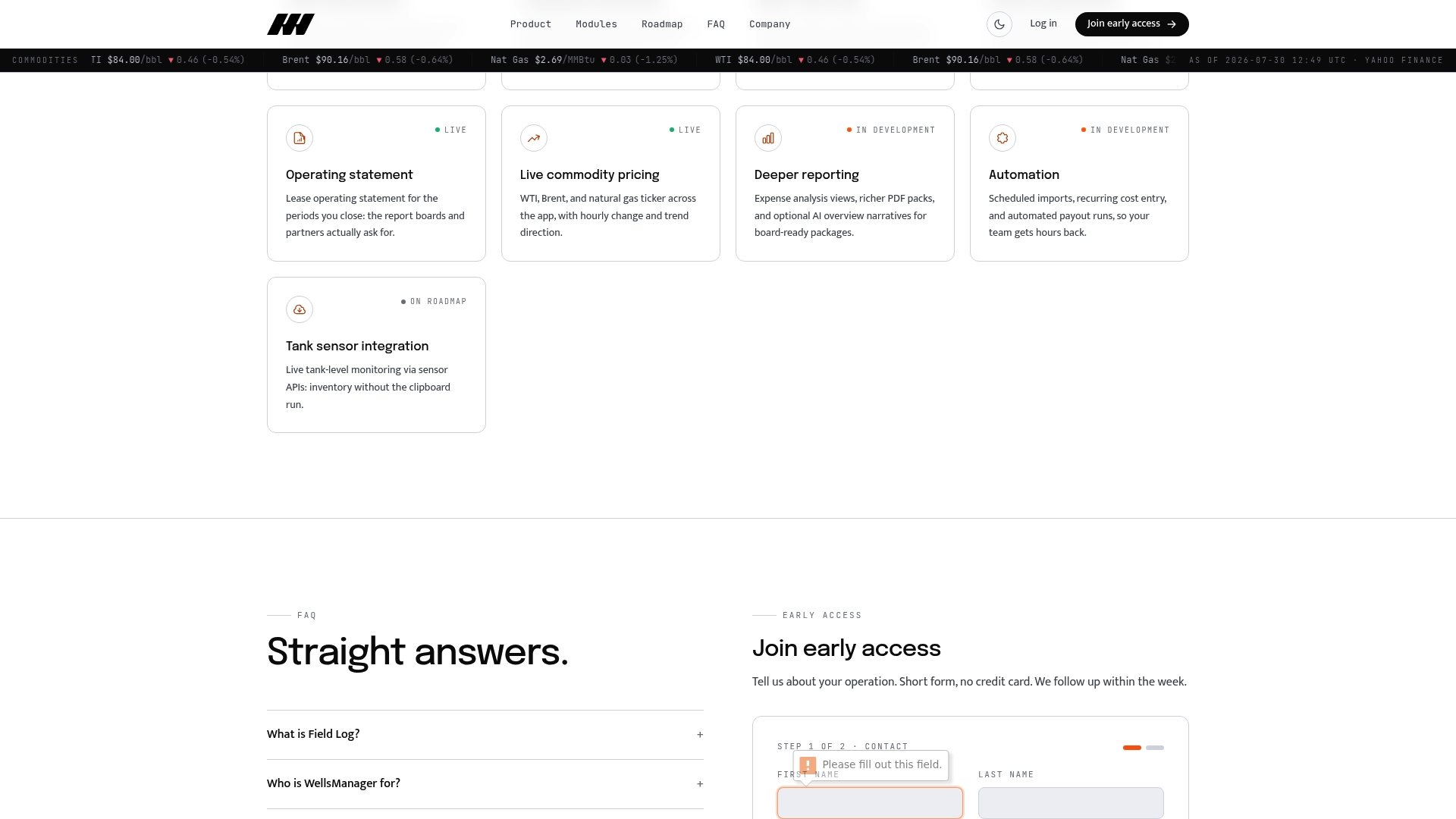
The pre-demo checklist that gets the most out of a Wellsmanager session: pull three months of LOS reports from your current system, export your chart of accounts, list the integrations you need to test (accounting software, SCADA, field reporting), and identify the person on your team who owns data migration. Bring all of that to the demo and ask the team to run your numbers, not theirs.
Request sandbox access to see per-well P&L generated from your own data, or visit the Wellsmanager product overview to review the full module list before booking time with the team.
Sources and further reading
- CB Insights: Quorum Software Alternatives and Competitors — best starting point for market-level competitor mapping and integrated-suite rationale.
- Gartner Peer Insights: Quorum Alternatives — use for vendor evaluation criteria and peer reviews from operators at similar company sizes.
- Oracle Blockchain Platform — reference for multi-party data-sharing architecture and enterprise SaaS security patterns.
- Wellsmanager product overview — per-well P&L, LOS, compliance notifications, and AI brief capabilities in detail.
- Hearing Highlights: Quorum Alternatives — useful for understanding how the Quorum name spans multiple software categories and why upstream-specific searches require careful filtering.